
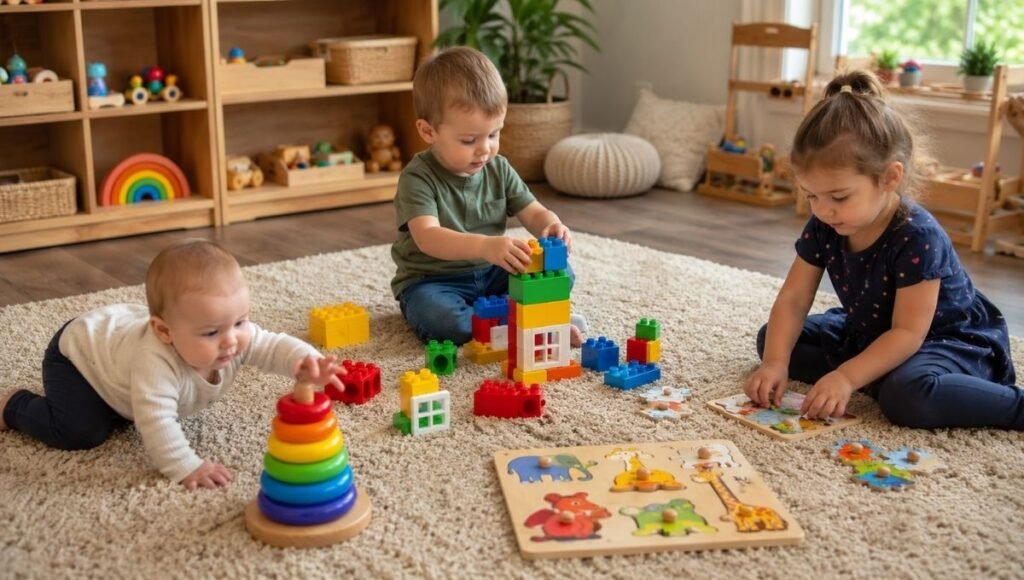
Walk into any toy store — or scroll through any online retailer — and count how many toys claim to be “educational.” Go ahead. I’ll wait.
The answer, if you haven’t already guessed, is almost all of them. Building sets, art kits, musical instruments, sorting games, tablet apps, talking robots — the word “educational” has been applied so broadly and so relentlessly that it has nearly lost all meaning as a shopping signal.
Here’s the honest truth that most toy marketing won’t tell you: there is no legal standard a toy must meet to call itself educational. No certification. No review board. No minimum requirement. Anyone can put it on a box.
So how do parents actually choose? How do you find the educational toys that genuinely support your child’s development — the ones that do what they claim — when every product on the shelf is making the same promise?
That’s exactly what this guide is for. We’ll cover what educational toys actually do, how to evaluate them by developmental stage from babies through school age, which specific categories deliver real value, and — just as importantly — which “educational” toys are mostly marketing. No recycled bestseller lists. No sponsored recommendations. Just the developmental-first guidance parents actually need.
Key Takeaways
- “Educational” is an unregulated label. There is no legal minimum a toy must meet to use this term in the United States. Always evaluate the actual toy, not the box claim.
- The best educational toys don’t feel like school. Research from Temple University’s Infant and Child Lab confirms that children learn most effectively through play that feels intrinsically motivating — not through toys that feel like lessons.
- Age-matching is the most important factor. An educational toy pitched at the wrong developmental stage is either boring (too easy) or frustrating (too hard). Both outcomes mean no learning happens.
- Open-ended beats single-answer. Toys with one correct solution teach one thing once. Toys with multiple possible outcomes teach problem-solving, creativity, and persistence — skills that transfer across every academic domain.
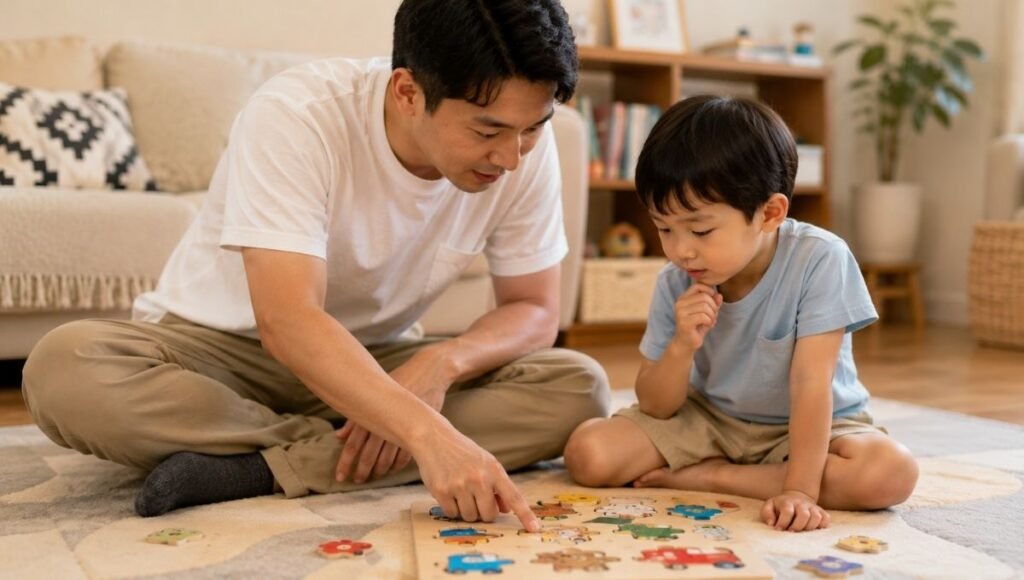
- You are still the most powerful educational tool. The American Academy of Pediatrics confirms that caregiver interaction during play — narrating, questioning, responding — amplifies the learning benefit of any toy significantly. The best educational toy in the world is less effective without engaged adult participation.
What Makes a Toy Genuinely Educational?
Before we get to specific recommendations, let’s establish a real standard — because the box won’t give you one.
Researchers at Temple University, Eastern Connecticut University, and the LEGO Foundation have all studied this question. The consistent findings across multiple studies identify five characteristics that genuinely educational toys share:
1. Active engagement — the child does something; the toy responds. A toy that performs for your child without requiring their input is entertainment. It may be valuable entertainment, but it’s not education.
2. Meaningful challenge — the activity sits at the right difficulty level. Too easy and there’s no learning. Too hard and there’s only frustration. The productive zone is just beyond current mastery.
3. Social opportunity — the toy invites interaction with a caregiver, sibling, or peer. Learning in conversation produces measurably better outcomes than learning in isolation.
4. Iterative play — the child can try, fail, adjust, and try again. This trial-and-error cycle is the scientific method in its most basic form, and it’s how children build both specific skills and general problem-solving confidence.
5. Open-ended potential — there’s more than one way to use the toy and more than one possible outcome. This is what separates a toy that teaches one thing once from a toy that keeps developing as your child does.
Keep these five criteria in mind as you read the rest of this guide — and as you evaluate any “educational” toy you encounter.
Educational Toys for Babies (0–12 Months): Learning Before Words
Parents often underestimate how much learning happens in the first year. By the time a baby reaches their first birthday, they’ve already learned more — about physics, faces, language patterns, cause and effect, and social interaction — than they will learn in any comparable period for the rest of their lives.
The best educational toys for babies in this period aren’t teaching babies academic content. They’re providing the sensory inputs, social opportunities, and physical experiences that build the neural architecture everything else will depend on.
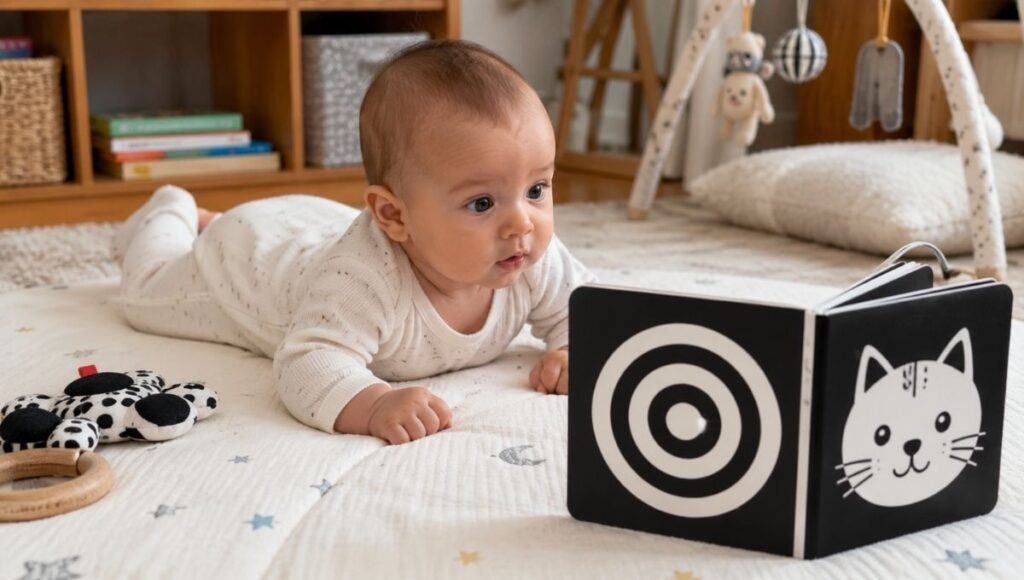
High-Contrast Visual Toys (0–3 Months)
A newborn’s visual system can focus clearly at roughly 8–12 inches — exactly the distance to a caregiver’s face. Colors appear muted. What babies can perceive clearly is contrast: the boundary between dark and light.
High-contrast books, cards, and mobiles work because they match this visual capacity. They’re not stimulating babies arbitrarily — they’re providing the specific visual input that develops the optic nerve and visual processing pathways during a critical window. This is one of the clearest examples of a toy that’s genuinely educational because it meets the brain where it is.
Cause-and-Effect Toys (3–9 Months)
Around 3 months, something remarkable happens: babies begin reaching intentionally. They’re discovering that they can make things happen. A rattle shaken produces a sound. A hanging toy batted swings and makes a noise. A button pressed produces a light.
These “simple” interactions are foundational cognitive experiences. Understanding that actions produce predictable results — cause and effect — is the conceptual basis of science, mathematics, engineering, and logical thinking. Every time your 5-month-old bats a hanging toy and watches it swing, they’re running a physics experiment.
The best educational toys for this stage give babies clear, immediate, one-action responses: press this, hear that. Complexity comes later; clarity of cause and effect comes first.
Sensory Exploration Toys (6–12 Months)
From about 6 months, babies are active multi-sensory explorers. They touch, mouth, shake, bang, and examine everything they can reach. This isn’t random — it’s systematic exploration of physical properties. Heavy vs. light. Soft vs. hard. Smooth vs. textured. Loud vs. quiet.
The educational toys that serve this stage best are ones that offer varied sensory input safely: textured balls, soft fabric books with crinkle pages and lift-the-flap elements, stacking cups in different sizes, simple shape sorters with 2–3 shapes.
Safety is non-negotiable at this stage. Every toy that goes near a baby under 12 months must be free of small parts (toilet paper roll test: if it fits through, it’s a choking hazard), button batteries, strings over 12 inches, and any liquid-filled components. BPA-free and phthalate-free materials are the baseline for anything that will be mouthed — which is everything.
→ For complete baby toy recommendations: Best Sensory Toys for Babies | Best Toys for 6-Month-Olds
Educational Toys for Toddlers (12–36 Months): The Hands-On Learning Years
Toddlerhood is when “educational toy” starts meaning something more recognizable to most parents. The developmental priorities of this period — language explosion, fine motor development, early problem-solving, beginning pretend play — are ones that thoughtfully chosen toys can directly support.
Language Development Toys
Between 12 and 36 months, most children’s vocabulary grows from 1–5 words to 200–1,000 words or more. This growth is primarily driven by one thing: the amount of back-and-forth conversation and language exposure a child receives.
The educational toys that support language development most effectively aren’t the ones that talk at your child. They’re the ones that give you and your child something to talk about — board books, pretend play props, stacking toys, puzzles. The toy is the prop; the conversation is the actual language tool.
Research note: A landmark study from Stanford University found that the quality and quantity of parent-child conversation during play — not the toys themselves — was the strongest predictor of vocabulary development at age 3. The best language toy you can give your toddler is your own engaged presence.
Building and Construction Toys
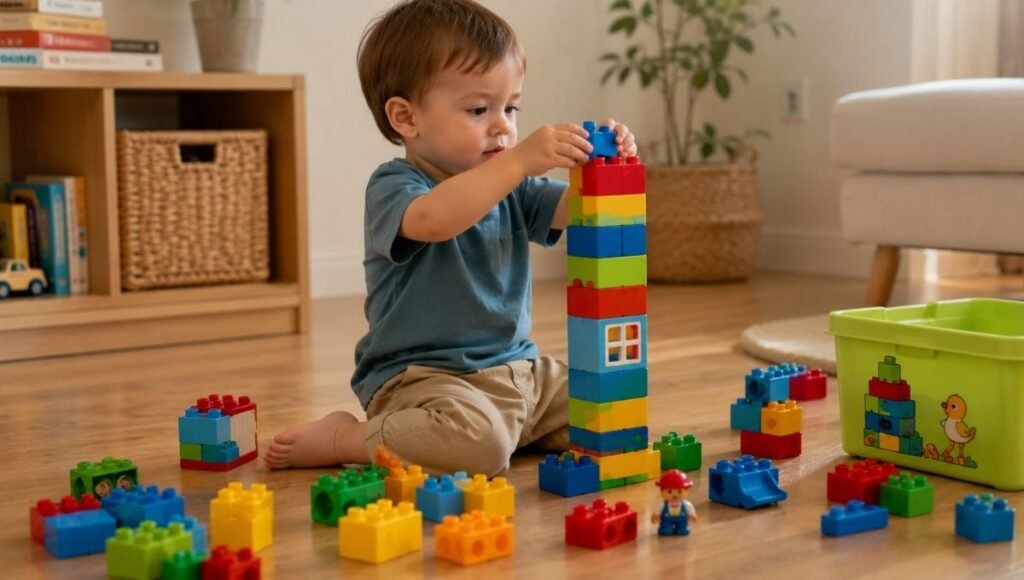
Building toys — stacking cups, LEGO DUPLO, wooden unit blocks, magnetic tiles — are among the most thoroughly researched toy categories in child development. The evidence for their educational value is unusually strong.
A 2017 study published in the Journal of Early Childhood Research found that complex block play in preschool directly improves math learning. A 2014 review in Trends in Neuroscience and Education confirmed that spatial play in early childhood — building, stacking, arranging shapes — develops the spatial reasoning that underlies later mathematical and scientific thinking.
This isn’t correlation. Block play builds specific cognitive skills that transfer to academic achievement. A set of wooden unit blocks or a DUPLO brick box is one of the highest-evidence educational toy investments available at this age.
Shape Sorters and Early Math Toys
A shape sorter with 3–5 basic shapes is a toddler’s first experience with classification, spatial reasoning, and trial-and-error problem-solving. The persistent attempt to get the square through the square hole — turning it, adjusting, trying the other orientation — is genuine mathematical thinking in its earliest form.
Stacking rings introduce the concept of size ordering (seriation) — a foundational pre-math skill. Nesting cups introduce the same concept with different physical properties. Simple color-matching and sorting activities introduce the classification skills that underpin data literacy.
None of this requires flashcards or drilling. It requires the right toys and a caregiver who narrates: “You found the circle — it’s round. Where does the round one go?”
Educational Toys for 1 Year Old Children: The Transition Moment

Twelve months is a pivotal moment. Your baby is becoming a toddler, and the educational toys that serve them best reflect this transition: still sensory-safe for mouthing, but increasingly requiring intentional action and offering more complex responses.
Best educational choices at 12 months:
- Shape sorters (2–3 large shapes to start)
- Stacking rings and cups
- Simple cause-and-effect toys (press button → one clear response)
- Push walkers (gross motor + walking confidence)
- Board books read together daily
→ Full guide: Best Toys for 1-Year-Olds | Best Gifts for 1-Year-Olds
Educational Toys for 2 Year Old Children: The “Me Do It” Learning Stage
At two, the defining developmental drive is independence — and the educational toys that work best at this age channel that drive rather than fight it. Toys your child can operate entirely themselves, succeed at with effort, and return to repeatedly.
Best educational choices at 2 years:
- LEGO DUPLO (building, fine motor, creative problem-solving)
- Simple 6–12 piece puzzles with knob handles
- Play kitchen (pretend play, language, social development)
- Play-Doh (fine motor strength, creativity)
- Shape sorters with 4–6 shapes
- Simple matching and sorting games
→ Full guide: Best Toys for 2-Year-Olds | Best Gifts for 2-Year-Olds
Educational Toys for Preschoolers (3–5 Years): The Imagination and Pre-Academic Years
Three to five is when educational play becomes more obviously connected to school readiness — and when parents often start feeling pressure to make sure their child is “on track.” Let’s address that pressure directly: the research is very clear that the most effective preparation for kindergarten at this age is rich play, not early academics.
Children who spend preschool years in play-based environments consistently outperform those in academic-drill environments on school readiness measures by age 7 — not immediately, but over time. The skills built through play (executive function, emotional regulation, curiosity, persistence) are exactly the skills that determine school success.
This doesn’t mean unstructured chaos. It means choosing toys that build real cognitive skills through engagement your child finds intrinsically motivating.
Pretend Play Toys
The educational value of pretend play is one of the best-documented findings in all of developmental psychology. Three to five-year-olds who engage in rich pretend play show stronger executive function, better emotional regulation, more sophisticated language, and greater empathy than peers with less pretend play experience.
What makes pretend play educational isn’t the content — it’s the cognitive demands. When your child decides that a block is a phone, assigns roles to family members in a dollhouse, and maintains a consistent narrative across multiple play sessions, they’re doing something cognitively demanding: holding an imaginary world in mind while interacting with the real one. This is a genuine precursor to abstract thinking.
Best pretend play toys:
- Play kitchens and food sets
- Doctor and veterinarian kits
- Dollhouses with family figures
- Dress-up clothes (open-ended pieces, not specific costumes)
- Simple puppet theaters with hand puppets
STEM Toys for Preschoolers
“STEM” has become as meaningless a label as “educational” in the toy industry. But genuinely STEM-aligned toys do exist, and at the preschool stage they have real value.
A genuinely educational STEM toy for this age shares the five criteria established at the top of this guide — particularly active engagement, meaningful challenge, and iterative play. At 3–5, this looks like:
- Simple gear sets — introducing mechanism thinking (turn one, another turns)
- Basic marble runs — building, predicting, troubleshooting
- Magnetic tiles — geometry, symmetry, structural engineering
- Simple science experiments — baking soda and vinegar, color mixing, magnet exploration
→ Full guide: Best STEM Toys for Kids
Fine Motor Development Toys
The years between 3 and 5 are critical for fine motor development — the small, precise hand movements that underpin writing, self-care, and academic task completion. The skills developed (or not developed) during this window create the foundation that kindergarten will build on.
Best fine motor educational toys for preschoolers:
- Lacing cards and bead threading
- Child-safe scissors with cutting activities
- Pegboards
- Simple puzzles (24–48 pieces at 4+)
- Play-Doh with increasingly detailed tools
- Tweezers and tong transfer activities
→ Full guide: Best Fine Motor Skills Toys
Educational Toys for 3 Year Old and 4-Year-Old Children
At 3–4, educational toys can begin to introduce pre-literacy and pre-math concepts through play — not through drilling, but through games and activities that make letters, numbers, and patterns feel playful.
Best educational choices at 3–4:
- Magnetic alphabet letters (on the fridge, in the bath)
- Simple cooperative board games (turn-taking, rule-following)
- 24–48 piece puzzles
- Magnetic tiles (60-piece)
- Art supplies that support controlled mark-making
- Simple science kits (2–3 experiments)
→ Full guides: Best Toys for 3-Year-Olds | Best Toys for 4-Year-Olds
Educational Toys for Kids Ages 5–8: Real Learning Through Play
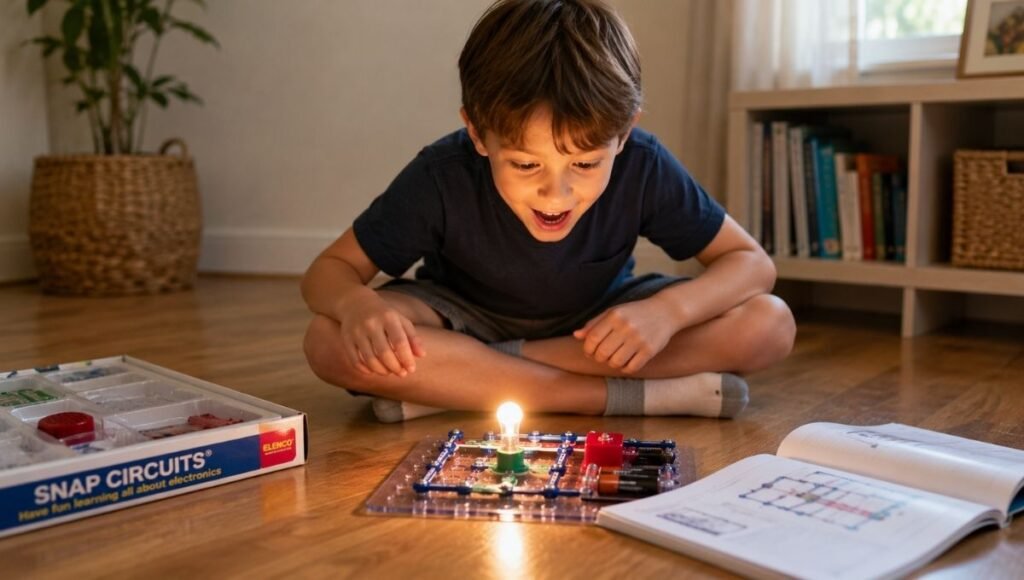
By age 5, educational toys can take on more academic-adjacent content — letters, numbers, basic coding concepts, science experiment kits — while still being genuine play rather than instruction. The line between “educational toy” and “school at home” should remain clear: if your child is doing it because they want to, it’s play. If they’re doing it because you’re making them, it’s work.
Reading Readiness and Literacy Toys
Five is the year most children begin decoding — the process of connecting sounds to letters to words. Toys that make this process feel like a game rather than a lesson have real impact.
Best literacy educational toys:
- Zingo Sight Words — bingo-format sight word recognition, fast and competitive
- Leapfrog Letter Factory — magnetic letters with letter sounds
- BOB Books — simple decodable books that create early reading wins
- Word-building magnetic sets — physical manipulation of letters supports decoding
Math Thinking Toys
At 5–8, mathematical thinking expands rapidly from counting to basic operations, pattern recognition, and early spatial reasoning. Toys that develop these skills through play are extraordinarily valuable.
Best math educational toys:
- Pattern blocks and tangrams (spatial reasoning, geometry)
- Abacus (counting, place value in physical form)
- Simple strategy games (Blokus, Connect 4, Sequence for Kids)
- Snap Circuits Junior (logical sequencing, cause and effect)
- Money sets for pretend play (number recognition, basic addition)
Science Kits
At 6+, children are ready for science kits that go beyond “look at this cool thing happen” to “why did that happen and what would change if we adjusted the variable?” The educational value is in the investigation process, not the result.
Best science educational toys:
- National Geographic science kits (multiple experiments, age-appropriate)
- Crystal growing kits
- Snap Circuits (electricity, circuits)
- Simple microscope with prepared slides
→ Full guides: Best Toys for 5-Year-Olds | Best Toys for 6-Year-Olds
The Educational Toy Avoid List: What Doesn’t Actually Work
Electronic toys that do the learning for the child A toy that talks, sings, and provides answers without requiring the child’s active engagement is passive entertainment. It may be pleasant. It may even expose the child to content. But it doesn’t produce the active cognitive engagement that drives learning. The child watching a toy “teach” is not in the same cognitive state as the child figuring something out.
Tablets and learning apps marketed as educational toys The AAP recommends no more than one hour of screen time per day for children ages 2–5, for good reason. Screen-based “educational” experiences consistently underperform hands-on physical play on developmental measures. A dedicated “learning tablet” is still a screen — and at this age, hands-on learning wins every comparison.
Single-answer, single-solution toys A toy that can only be used one way, solved once, and then is “done” teaches one thing once. The educational toys with the greatest developmental impact are ones with multiple possible outcomes and approaches — the definition of open-ended play.
Toys pitched significantly above developmental stage A toy designed for a 5-year-old given to a 3-year-old produces frustration, not learning. Age labels on educational toys reflect real developmental appropriateness, not just safety concerns. Always match the toy to where your child actually is, not where you hope they’ll be.
Quick Reference: Best Educational Toys by Age
| Age | Top Picks | What They Build |
|---|---|---|
| 0–6 months | High-contrast books, soft rattles, sensory toys | Visual development, cause-and-effect |
| 6–12 months | Shape sorters, stacking cups, fabric books | Pincer grasp, object permanence |
| 1 year | DUPLO, simple puzzles, push walker | Fine motor, language, walking |
| 2 years | Play kitchen, DUPLO, play-doh, matching games | Pretend play, fine motor, vocabulary |
| 3 years | Magnetic tiles, doctor kit, lacing cards, puzzles | Imagination, fine motor, spatial reasoning |
| 4 years | LEGO 4+, cooperative board games, science kits | Building, rule-following, early STEM |
| 5–6 years | Snap Circuits, sight word games, strategy games | Literacy, math thinking, executive function |
Frequently Asked Questions
What are the best educational toys overall? The toys with the strongest evidence base for educational value are: wooden unit blocks or magnetic tiles (spatial reasoning and math), pretend play props (language and executive function), simple puzzles (problem-solving), fine motor toys like play-doh and lacing cards (school readiness), and books read together daily. None of these are expensive, and all are consistently recommended by child development researchers and occupational therapists alike.
Are educational toys worth the money? Yes — when the toy is genuinely educational and appropriately chosen. The “educational” label alone is meaningless. But toys that meet the five criteria in this guide (active engagement, meaningful challenge, social opportunity, iterative play, open-ended potential) deliver real developmental value. The good news: most of the highest-value educational toys are relatively affordable.
What’s the difference between educational toys and regular toys? In practice, the distinction is mostly about intentional design. Educational toys are specifically designed to develop one or more cognitive, physical, or social skills. But many “regular” toys are equally educational — a set of stacking cups, a box of crayons, a ball. The key question is always: does this toy require the child to actively engage, think, and do? If yes, it’s educational regardless of the label.
Do educational toys for toddlers really work? The research is clear that hands-on, age-appropriate play with open-ended toys produces measurable developmental benefits in toddlers — in language, spatial reasoning, fine motor skills, and executive function. The toys work. The caveats: they work best with caregiver engagement, they need to match the child’s developmental stage, and they need to be genuinely open-ended rather than passive entertainment.
How many educational toys does my child need? Far fewer than you might think. Research consistently shows that children engage more deeply and creatively with a smaller selection of well-chosen toys than with an overwhelming collection. 6–10 accessible toys at a time is sufficient for most children. Rotating toys from storage keeps engagement high without requiring constant purchases.
When should I be concerned that my child isn’t developing normally? Talk to your pediatrician if your child isn’t meeting developmental milestones for their age, has lost skills they previously had, or shows consistent disinterest in interactive play. Many developmental differences respond extremely well to early intervention — and early support always produces better outcomes than waiting.
The Bottom Line
The best educational toys share one essential quality: they require your child to be an active participant rather than a passive observer. They invite thinking, doing, building, experimenting, and imagining — in ways that feel like play, not like school.
You don’t need to spend a fortune. You don’t need to fill a playroom. You need a handful of well-chosen, appropriately matched, open-ended toys — and your own engaged presence alongside your child while they play.
The toy is the invitation. The learning happens in everything that follows.
Explore our complete age-by-age and topic-specific guides:
- Best Sensory Toys for Babies
- Best Toys for 1-Year-Olds
- Best Toys for 2-Year-Olds
- Best Toys for 3-Year-Olds
- Best STEM Toys for Kids
- Best Fine Motor Skills Toys
- Best Toddler Toys: The Complete Guide
References
- American Academy of Pediatrics (AAP). (2024). The Power of Play: A Pediatric Role in Enhancing Development in Young Children. https://www.healthychildren.org
- Hirsh-Pasek, K., et al. (Temple University). (2015). Putting Education in “Educational” Apps: Lessons From the Science of Learning. Psychological Science in the Public Interest.
- Bower, C., et al. (2017). The effect of block play on mathematics achievement. Journal of Early Childhood Research.
- Uttal, D.H., et al. (2014). The malleability of spatial skills: A meta-analysis of training studies. Trends in Neuroscience and Education.
- Centers for Disease Control and Prevention (CDC). (2023). Developmental Milestones. https://www.cdc.gov/ncbddd/actearly/milestones/
- National Association for the Education of Young Children (NAEYC). (2024). Good Toys for Young Children by Age and Stage. https://www.naeyc.org
- Zero to Three. (2025). Learning Through Play. https://www.zerotothree.org
- U.S. Consumer Product Safety Commission (CPSC). Toy Safety. https://www.cpsc.gov