
Five feels like a turning point. Not just because of kindergarten — though that milestone alone is enough to send most parents into a quiet spiral of “are they ready?” and “am I doing enough?” — but because your child has genuinely changed. The tantrums have mostly given way to negotiations. The babbling has become full conversations. And the toys that worked six months ago? Suddenly boring.
If you’re shopping for the best toys for 5 year olds and feeling overwhelmed, you’re not alone. This is the age where the toy aisle splits in two directions: still-too-babyish on one side, way-too-complex on the other, with a bewildering middle ground of “educational” claims that may or may not mean anything at all.
Here’s what I’ve learned: five-year-olds are at a genuinely fascinating developmental crossroads. They’re building real friendships, developing a sense of fairness, starting to read, and — for the first time — genuinely interested in how things work. The toys that serve them best aren’t the flashiest or the most expensive. They’re the ones that respect this new level of sophistication while still being, above all, fun.
This guide covers what’s actually worth buying, what to skip, and how to make sure whatever you choose actually gets played with past the first afternoon.
Key Takeaways
- Kindergarten changes everything. According to the CDC, most 5-year-olds can count to 10, write some letters, follow multi-step directions, and want to play by the rules — which makes structured games newly meaningful.
- Competitive play emerges now. Five-year-olds genuinely want to win — which means board games with clear rules and fair outcomes are suddenly both appropriate and valuable for learning emotional regulation.
- Attention spans have grown significantly. A focused 5-year-old can sustain independent play for 20–30 minutes with the right toy — making longer, more complex building projects and games newly accessible.
- Block play predicts math ability. A study published in the Journal of Research in Early Childhood Education found that children who regularly play with blocks at ages 3–5 perform better in math — especially algebra — in middle school.
- Reading readiness is happening right now. The best learning toys for 5 year olds are ones that make letter sounds, phonics, and early words feel like a game rather than a lesson.
What’s Actually Happening in Your 5-Year-Old’s Brain
Five is the year everything accelerates. Your child is developing what child psychologists call “theory of mind” — the ability to understand that other people have different thoughts, feelings, and perspectives than their own. This is a profound cognitive leap, and it changes how they play, what stories they create, and how they navigate friendships.
According to CDC developmental milestones, most 5-year-olds can now tell a simple story using full sentences, count to 10, draw a person with at least six body parts, and use a fork and spoon independently. They’re beginning to understand the difference between real and make-believe. They care deeply about fairness. And they genuinely want to do things correctly — which is both endearing and occasionally exhausting.
The best toys for 5 year olds honor all of this. They offer enough complexity to feel like a real challenge, enough open-endedness to spark creativity, and enough social opportunity to build the friendships and emotional skills your child is working on right now.
The Builders: Construction Toys That Grow With a 5-Year-Old
Five is when building becomes genuinely architectural. Your child isn’t just making towers — they’re planning cities, designing vehicles, and problem-solving when their structures collapse. This is engineering thinking in its most joyful form, and the right toys can nurture it for years.
LEGO Sets for 5-Year-Olds
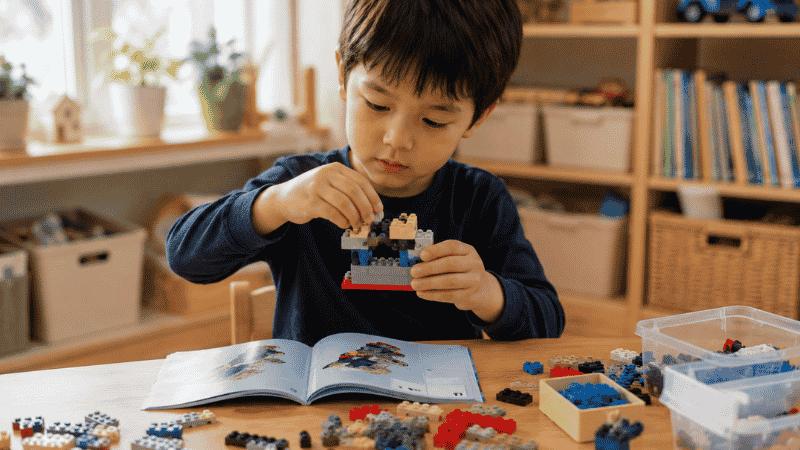
Five is a strong LEGO year for most children. Standard LEGO bricks (not DUPLO) are appropriate for the majority of 5-year-olds, and the “5+” labeled sets are specifically designed for this developmental stage.
The key to a successful first experience is choosing a set that matches your child’s current patience and focus level — not where you hope they’ll be. A 100–150 piece set with a clear subject they love (vehicles, animals, space, their favorite characters) will create a positive first experience. A 400-piece set with complex techniques will create frustration.
What makes a good LEGO set for a 5-year-old:
- 100–200 pieces maximum for first independent builds
- Clear, image-based instructions with simple steps
- A subject that genuinely interests your child specifically
- Pieces that can be rebuilt into something new after the first build
Parent tip: Sit with them for the first build — not doing it for them, but narrating alongside. “What shape is that piece? Where do you think it goes?” The shared experience makes the toy mean more, and they’re more likely to return to it independently afterward.
Building Toys for 5-Year-Olds: Magnetic Tiles Level Up
If your family already has Magna-Tiles or similar magnetic tiles, five is the year to expand. At this age, children are ready for specialty expansion pieces — ramps, doors, panels with windows, and car bases — that open up new building challenges and keep the toy feeling fresh.
If you’re buying magnetic tiles for the first time, a 60–100 piece set is ideal. The play value at this age is extraordinary: a recent study from Michigan State University Extension confirmed that block and construction play directly supports mathematical thinking, spatial reasoning, and problem-solving skills that transfer directly to academic performance.
Marble Runs and Mechanism Toys
Five is a great age for marble runs with moderate complexity. Your child can now follow multi-step instructions, understand cause and effect sequences, and troubleshoot when things don’t work the first time — which is exactly what a marble run requires.
Look for sets with pieces that connect clearly and hold firmly. The most frustrating marble runs are the ones where pieces pop apart mid-run. Ravensburger and Gravitrax both make consistently reliable options.
The Thinkers: Games and Puzzles That Build Real Academic Skills
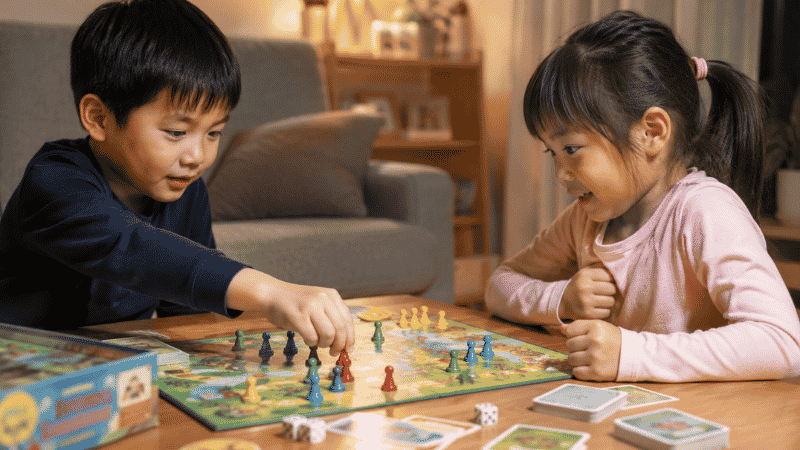
Five-year-olds are genuinely ready for structured games with rules — and not just the cooperative “everyone wins” variety. They can now handle losing, processing the disappointment in the moment and moving on. This is a skill worth practicing through play, because it’s one of the most important emotional regulation capabilities they’ll need in kindergarten and beyond.
Board Games for 5-Year-Olds: Competitive and Cooperative
Best competitive games for 5-year-olds:
- Zingo Sight Words — bingo-style, builds reading readiness, fast rounds
- Sequence for Kids — strategy, pattern recognition, winning and losing gracefully
- Sleeping Queens — memory, basic addition, story elements
- Outfoxed! — deductive reasoning, cooperative, slightly complex
Best cooperative games for 5-year-olds:
- Hoot Owl Hoot — still great for younger 5s or mixed-age sibling play
- Forbidden Island — slightly more complex, excellent for 5.5+ with adult guidance
- Magic Maze — wordless cooperative play, builds communication skills
The key at this age is post-game conversation. When they win: “What did you do that worked well?” When they lose: “What would you try differently next time?” These questions build the reflective thinking that makes games genuinely educational rather than just fun.
Puzzles (100–200 Pieces)
Most 5-year-olds are ready for puzzles in the 100–200 piece range, particularly if they’ve been doing puzzles regularly. The satisfaction of completing a larger puzzle — spread out across an afternoon, returned to and finished — builds persistence and delayed gratification in a way that few other toys can.
Choose puzzles with bold, clear imagery and well-cut pieces that fit together firmly. Ravensburger remains the gold standard for piece quality. A puzzle with a subject your child genuinely loves will get significantly more engagement than a “educational” one they find boring.
Early Literacy Toys and Reading Games
Five is a pivotal reading readiness year — and play-based literacy tools are genuinely valuable here, precisely because they make letters and sounds feel like games rather than homework.
Best literacy tools for 5-year-olds:
- Leapfrog Fridge Phonics — magnetic letters with letter sounds
- BOB Books Set 1 — simple decodable books that create reading wins
- Zingo Sight Words — high-frequency word recognition through play
- Osmo Little Genius Starter Kit — tangible letter manipulation with digital feedback
None of these are flashcards. All of them work because they make the child feel successful — and a child who feels successful at reading will want to keep reading.
The Imaginators: Pretend Play for Kindergarteners
Five-year-olds are at peak storytelling. Their pretend play scenarios have plots, characters, conflicts, and resolutions. They assign roles, negotiate rules, and get genuinely upset when someone breaks the story. This elaborate pretend play isn’t just fun — according to the American Academy of Pediatrics, it’s building executive function, empathy, language skills, and social cognition simultaneously.
Small World and Miniature Play
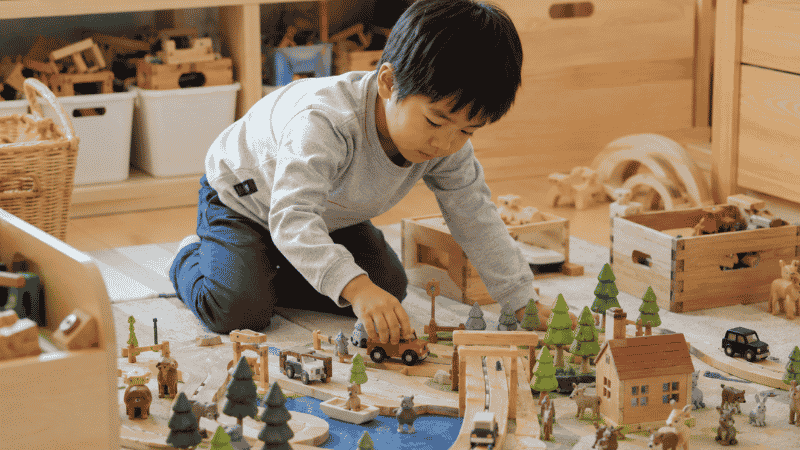
At five, small-scale play becomes newly engaging. Miniature figures, small vehicles, train sets, and dollhouse-scale accessories allow for the elaborate narrative play that five-year-olds love without requiring a lot of physical space.
A wooden train set — the kind with a flexible track that can be arranged differently every time — is one of the best investments at this age precisely because of its open-endedness. The track becomes a city, a countryside, a story, or an engineering challenge depending on the day.
Best LEGO Sets for 5-Year-Olds That Double as Pretend Play
Certain LEGO themes serve double duty at this age: they’re satisfying to build and they become pretend play props afterward. LEGO City sets (fire stations, police stations, farms) and LEGO Animal sets work particularly well because the characters and vehicles naturally invite storytelling after the build is complete.
Creative Arts and Open-Ended Making
Five-year-olds are moving from process-focused art (just enjoying the painting) toward product-focused art (trying to make something specific look a particular way). Both are valid — and both deserve good materials.
What works well at this age:
- Watercolor sets with real pigment (not watered-down craft store sets)
- Air-dry clay for three-dimensional making
- Beeswax crayons for rich color with a satisfying texture
- Simple sewing or weaving kits designed for this age group
- Craft kits with clear projects but enough flexibility to personalize
Michigan State University Extension research confirms that art activities at this age support fine motor development, cognitive pattern-making, mathematical thinking, and language skills — all through what feels like pure creative play.
The Movers: Active Toys for 5-Year-Olds With Endless Energy
Five-year-olds are significantly more physically capable than they were even six months ago. Their balance is better, their coordination is improving, and they’re genuinely interested in mastering physical challenges — riding a bike, learning to pump a swing, catching a ball thrown with some speed.

Pedal Bikes and Two-Wheel Riding
If your child hasn’t moved to a two-wheel pedal bike yet, five is an excellent time. Children who come from balance bikes often make this transition surprisingly quickly — sometimes within a single afternoon — because the balance skill transfers directly.
Choose a bike that’s appropriately sized: when sitting on the seat, your child’s feet should reach the ground with a slight bend in the knee. A bike that’s too large is significantly harder to learn on than one that fits correctly.
Helmet, every single time, before they ever sit on the bike. This is the one non-negotiable.
Outdoor Toys for 5-Year-Olds That Actually Get Used
- Jump rope — they’re developmentally ready for this now, and it builds rhythm and coordination
- Hula hoop — core strength, coordination, and genuinely endlessly entertaining
- Kick scooter (two-wheel) — most 5-year-olds have the balance for this
- Frisbee — hand-eye coordination, social play, works with any number of people
- Sidewalk chalk — still one of the highest-value outdoor toys at any age
Skip elaborate outdoor play structures unless you have significant outdoor space and a strong budget. Most of the above costs under $30 total and will get more daily use than a plastic playhouse at ten times the price.
Indoor Active Play for Rainy Days
A balance board is one of the most underrated toys for this age — it builds the vestibular (balance) development that supports focus and learning, and it’s genuinely entertaining. Many 5-year-olds can spend 20 minutes just exploring what they can do on a balance board.
A simple indoor obstacle course using couch cushions, painter’s tape “balance beams” on the floor, and a small trampoline with handlebar costs almost nothing and channels that after-school energy productively.
Safety at 5: What Parents Still Need to Watch
Five-year-olds are significantly more capable and safety-aware than younger children — but “more capable” isn’t the same as “doesn’t need supervision.”
What’s generally safe at 5:
- Standard small toy pieces (standard LEGO bricks, puzzle pieces, art materials)
- Child-safe scissors with blunt tips
- Most board game components
- Basic craft materials clearly labeled non-toxic
What still requires adult attention:
- Powerful rare-earth magnets: Any toy with small, strong magnets (not the sealed edges of Magna-Tiles, but separate magnetic pieces) remains a serious hazard if swallowed. Keep these away from children under 6, and supervise carefully even after that.
- Bikes, scooters, and active equipment: Helmet every time, knee pads strongly recommended. Establish the rules before the first ride.
- Science and chemistry kits: Some kits marketed to this age group include materials that require adult supervision. Read the safety instructions fully before giving these as gifts.
- Art supplies: Look for ACMI (Art and Creative Materials Institute) non-toxic certification on all paints, glues, and modeling materials.
Safety certifications to look for:
- ASTM F963 (U.S. toy safety standard)
- CPSC compliance
- ACMI AP (non-toxic) seal for art supplies
- CE mark for European-manufactured toys
What NOT to Buy: The 5-Year-Old Honest Skip List
Toys your child will outgrow in three months At five, children’s skills and interests are advancing fast. A toy that’s perfect in September may feel babyish by December. Prioritize open-ended toys that grow with your child over single-function toys with a narrow developmental window.
Learning tablets and electronic “educational” devices The American Academy of Pediatrics recommends a maximum of one hour of screen time per day from high-quality sources for children ages 2–5, and thoughtful management of screen time beyond that. A dedicated learning tablet competes with — rather than supplementing — the hands-on play that builds the deepest skills at this age.
Anything with more than 100 pieces that requires adult assembly If the parent has to spend 45 minutes setting it up, something has already gone wrong. At five, the child should be part of the setup process — and a toy that requires expert adult assembly before it can even be played with starts the experience on the wrong foot.
Character-licensed toys with poor underlying design The character will generate excitement. The flimsy construction will disappoint both of you within a week. Always evaluate the actual toy — its durability, play value, and safety — rather than the branding on the outside.
If You Only Have 10 Minutes: The Quick-Pick Summary
Gift due tomorrow? Here’s the shortlist:
- Best overall: LEGO Classic 5+ Set (your child’s favorite subject)
- Best board game: Zingo Sight Words or Sleeping Queens
- Best building toy: Magna-Tiles expansion set (or 60-piece starter)
- Best outdoor toy: Two-wheel scooter + helmet OR balance board
- Best creative toy: Quality watercolor set + large paper pad
- Best puzzle: 100-piece Ravensburger (their favorite theme)
- Best gifts for 5 year old girl: Art kit + marble run OR LEGO Friends set
- Best gifts for 5 year old boy: LEGO City set + outdoor active toy
- Best toys for kindergarteners: BOB Books Set 1 + Leapfrog Fridge Phonics

Frequently Asked Questions
What are the best gifts for a 5-year-old girl? The most genuinely useful gifts for 5-year-old girls match her current interests and developmental stage — not what’s traditionally pink or princess-themed. Art supplies, LEGO sets, marble runs, board games, and active outdoor toys are all excellent choices. At five, what matters most is whether the toy respects her growing intelligence and invites her to create, build, or solve something.
What are the best gifts for a 5-year-old boy? Same principle: match his genuine interests, not generic “boy” categories. Building sets, LEGO, outdoor active toys, science kits, board games with strategy, and art supplies are all strong options. The best gift for any 5-year-old boy is one that challenges him just enough to feel proud when he succeeds.
What are the best toys for kindergarteners? The toys that serve kindergarteners best are ones that support what they’re building in school: early literacy (letter sounds, sight words), early numeracy (counting, patterns, simple addition), cooperative social skills, and physical confidence. None of this has to feel academic — the best kindergarten toys are ones that make all of the above feel like pure play.
Is my 5-year-old ready for regular LEGO? Most 5-year-olds are, yes — but start with a simpler set labeled “5+” and sit with them for the first build. Signs of readiness: can focus on one task for 15+ minutes, handles small objects with good control, and doesn’t get frustrated and give up easily. If they struggle with the first set, that’s okay — try again in a few months.
What learning toys actually work for 5-year-olds? The ones that don’t feel like learning. Phonics games, magnetic letters, sight word bingo, counting games, and pattern puzzles all build real school-readiness skills — but through play rather than instruction. Your child doesn’t need to know they’re “learning.” They just need to be genuinely engaged.
My 5-year-old prefers screens to all toys. What should I do? This is very common and very normal — screens are designed by adults to be maximally engaging, and they’re competing against toys that require effort. The most effective approach is to reduce available screen time, introduce a new toy by playing with it yourself in your child’s presence (the “I want what you have” instinct is strong), and be patient. Re-engagement with physical play usually takes a week or two once screens are less available.
When should I be concerned about my 5-year-old’s development? Talk to your pediatrician if your 5-year-old has significant difficulty with any of these: following two-step instructions, being understood by people outside the family, showing interest in other children, or managing basic self-care tasks. Early support for developmental differences makes a genuine difference — bring up any concerns at your next well visit without waiting.
The Bottom Line
Shopping for the best toys for 5 year olds is ultimately about understanding this specific, remarkable moment in your child’s life. They’re curious, they’re capable, they’re social in ways they’ve never been before, and they’re hungry for challenges that feel real.
The toys that serve them best aren’t the most expensive or the most “educational”-looking. They’re the ones that invite your child to build something, figure something out, tell a story, or master a physical challenge — and that make them feel genuinely competent when they succeed.
That competence is what you’re really buying. Everything else is packaging.
Explore more in our age-by-age series: Best Toys for 4-Year-Olds for the year before kindergarten, or our Gift Guides for birthday and holiday picks by age and budget.
References
- Centers for Disease Control and Prevention (CDC). (2023). Developmental Milestones: 5 Years. https://www.cdc.gov/ncbddd/actearly/milestones/milestones-5yr.html
- American Academy of Pediatrics (AAP). (2024). The Power of Play: A Pediatric Role in Enhancing Development in Young Children. https://www.healthychildren.org
- National Association for the Education of Young Children (NAEYC). (2024). Good Toys for Young Children by Age and Stage. https://www.naeyc.org/resources/topics/play/toys
- Michigan State University Extension. (2023). What Are the Best Toys for Children? https://www.canr.msu.edu/news/what-are-the-best-toys-for-children
- Journal of Research in Early Childhood Education. (2021). Block Play and Mathematics Achievement: A Longitudinal Study. Referenced in MSU Extension research summary.
- U.S. Consumer Product Safety Commission (CPSC). Toy Safety. https://www.cpsc.gov/Safety-Education/Safety-Guides/Toys
- Art and Creative Materials Institute (ACMI). Safety in the Arts. https://acmiart.org