
There’s a moment that every new parent knows. You’re standing in the baby aisle, completely overwhelmed, holding two nearly identical rattles and wondering if you’re about to make a $20 mistake. Meanwhile, your baby is at home happily staring at the ceiling fan — which, as far as you can tell, is the most fascinating thing they have ever encountered.
Here’s the truth: in those first months, babies don’t need much. But what they do need matters more than most people realize. The right sensory toys for babies aren’t about entertainment — they’re about giving a rapidly developing brain the specific inputs it’s hungry for at each stage of growth.
The problem is that most guides either give you a generic product list with no developmental context, or they go so deep into child psychology that you need a degree to follow along. Neither of those helps you standing in the aisle on a Thursday afternoon.
This guide is different. We’ll walk through exactly what your baby’s senses need at each stage from newborn to 12 months, which toy types actually deliver those inputs, and — just as importantly — what to skip entirely. Safe, simple, and genuinely useful. That’s the standard we hold everything to here at Toizora.
Key Takeaways
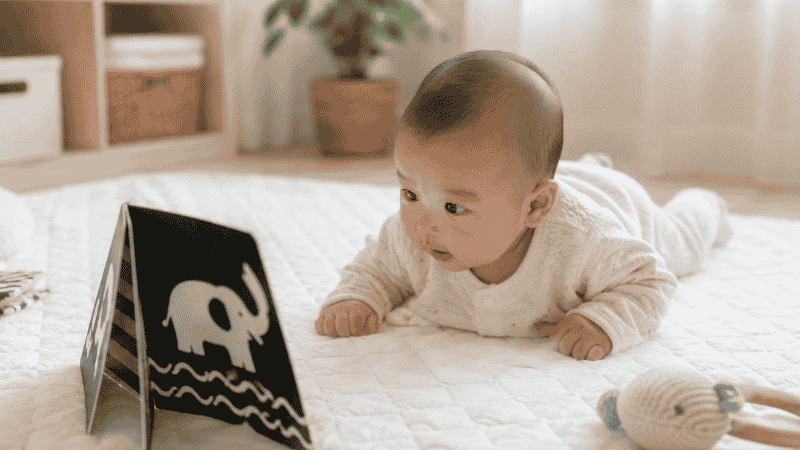
- Newborns see best in black and white. A baby’s vision at birth can only focus clearly at 8–12 inches — exactly the distance to a caregiver’s face. High-contrast toys work because they match this visual capacity, not because they’re trendy.
- Sensory play builds neural connections. According to the Harvard Center on the Developing Child, the brain forms over one million new neural connections per second in early infancy — and sensory experiences are the primary driver of this growth.
- Less is genuinely more. Research consistently shows that babies engage more deeply with one or two simple toys than with an overwhelming array. Rotate toys frequently rather than presenting everything at once.
- Safety first, always. The American Academy of Pediatrics recommends that all toys for babies under 12 months be free of small parts, button batteries, loose strings over 12 inches, and liquid-filled components.
- You are the best sensory toy. No product replaces the developmental power of face-to-face interaction, talking, singing, and responsive play with a caregiver.
What Are Sensory Toys for Babies — and Why Do They Matter?
“Sensory toy” is a term that gets thrown around a lot, but it’s worth understanding what it actually means before you spend any money.
A sensory toy is simply a toy designed to engage one or more of your baby’s senses in a way that supports development. That includes the five senses most of us know — sight, sound, touch, taste, and smell — plus two often-overlooked systems: proprioception (body awareness) and the vestibular system (balance and movement).
What makes a sensory toy genuinely useful isn’t that it’s expensive or complex. It’s that it delivers the right kind of input for where your baby is developmentally right now. A newborn and a 9-month-old have completely different sensory needs — and a toy that’s perfect for one can be inappropriate or simply uninteresting for the other.
The good news: once you understand the developmental stage, choosing the right toys becomes much simpler.
Sensory Toys for Newborns (0–3 Months): Start Simple, Start High-Contrast
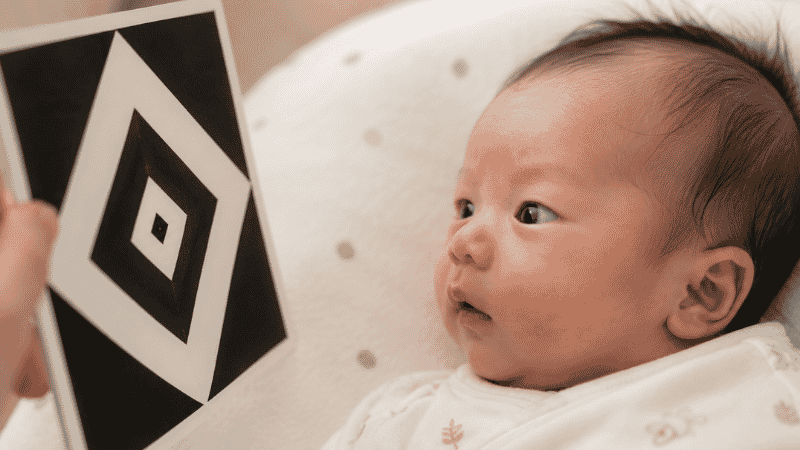
At birth, your baby’s visual system is one of the least developed of all their senses. They can see clearly at roughly 8–12 inches — the distance to your face when you’re holding them. Colors appear muted and blurry. What they can perceive clearly is contrast: the sharp boundary between dark and light.
This is why every pediatric vision expert recommends high-contrast toys for newborns. Black-and-white patterns don’t just look engaging — they actively stimulate the optic nerve and help build the visual processing pathways your baby will rely on for the rest of their life.
High-Contrast Books and Cards
A soft, high-contrast book — bold black and white patterns, simple geometric shapes, bold outlines — is genuinely one of the best newborn investments you can make. Prop it against a pillow during tummy time, hold it 8–12 inches from their face during alert windows, or use it as a focal point during diaper changes.
Look for books with:
- Bold black and white patterns with occasional high-contrast color (red reads particularly well to newborns)
- Soft, crinkle-free pages that lie flat easily
- Washable covers — these get handled a lot
Soft Rattles and Gentle Sound Toys
A newborn’s hearing is fully functional at birth — in fact, they’ve been hearing sounds in the womb for months. But their auditory processing is still developing, and loud or sudden sounds are genuinely startling and stressful for young babies.
Choose rattles with:
- Soft, muted sounds (not loud plastic clickers)
- Lightweight construction — tiny hands can’t grip well yet, but they’ll bat at objects
- Easy-to-grasp shapes (rings, soft plush rattles) for when grasping develops around 3 months
Tummy Time Mirrors
A soft, shatter-resistant mirror placed in front of your baby during tummy time does several things simultaneously: it provides a visually engaging focal point (babies are fascinated by faces, including their own), it encourages them to lift their head, and it supports the neck strength development that leads to rolling and, eventually, sitting.
Keep tummy time sessions short initially — 2–3 minutes several times a day — and always supervised. The mirror makes those minutes significantly more engaging for your baby.
Sensory Toys for Babies 3–6 Months: Reaching, Grasping, and Discovering Cause and Effect
Around 3 months, something exciting happens: your baby starts reaching intentionally. Those random arm flails become deliberate attempts to touch, grab, and bring things to their mouth. This is a huge developmental shift — and it changes what toys are useful.
Play Gyms and Activity Mats
A good play gym is the workhorse of the 3–6 month stage. When your baby bats a hanging toy and it moves or makes a sound, they’re learning one of the most foundational concepts of early childhood: cause and effect. I did something, and something happened. This is the beginning of agency — and it’s deeply important.
Look for a play gym with:
- Hanging toys at varying heights (to encourage reaching in different directions)
- A mix of textures and sounds among the dangling elements
- A comfortable, easy-to-clean mat base
- Toys that can be removed and used independently as your baby grows
Safety note: Remove any hanging elements that could pose a strangulation hazard as your baby becomes more mobile. Most play gyms recommend removing the arch once your baby can push up on hands and knees.
Sensory Toys for 3 Month Old Babies: Teethers Begin
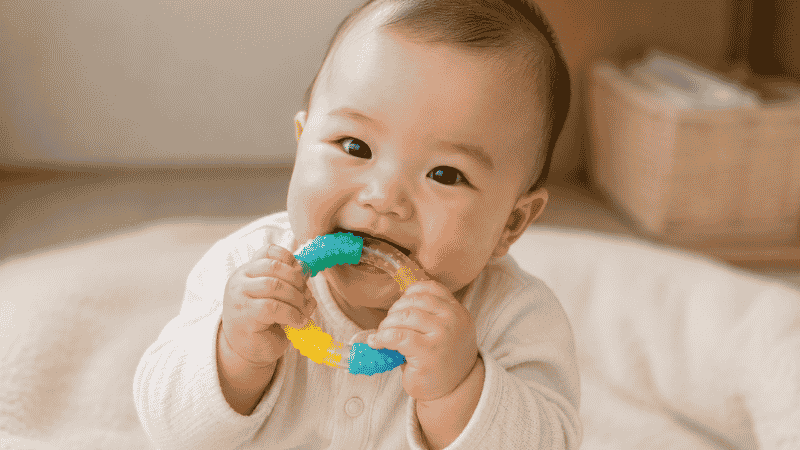
Around 3–4 months, the drool fest begins. Your baby’s gums are preparing for teeth, and everything — toys, fingers, your shoulder — becomes a candidate for mouthing. This is completely normal and developmentally appropriate: babies learn through oral exploration at this stage.
Choose teethers made from:
- Food-grade silicone: The gold standard. Soft, safe, easy to sterilize, available in a huge variety of textures.
- Natural rubber (like Sophie la Giraffe): A classic choice. Natural rubber is flexible, has a satisfying texture for gums, and is free from PVC and BPA.
- Avoid: Liquid-filled teethers (they can leak or be punctured), painted wood without confirmed non-toxic certification, and teethers with small detachable parts.
Temperature tip: Chill silicone teethers in the refrigerator (not the freezer) for 15 minutes before offering. Cold soothes inflamed gums without the hardness of a frozen teether, which can damage delicate oral tissue.
Crinkle Toys and Textured Fabrics
Soft toys with crinkle material inside, varied textures on different surfaces, and easy-to-grab shapes are perfect for this stage. They engage touch, hearing, and early grasping simultaneously — and they’re safe for mouthing.
The Oball is a perennial recommendation for 3–6 months: its open lattice design is easy for small hands to grasp from any angle, it’s lightweight, and the gentle rattle inside provides satisfying cause-and-effect feedback.
Sensory Toys for Babies 6–9 Months: The World Becomes a Laboratory
At 6 months, your baby is a different creature than they were at 3. Many are sitting with support, some are beginning to roll in both directions, and nearly all are in full sensory exploration mode — touching, mouthing, banging, and dropping everything they can get their hands on.
The dropping, by the way, is not random. It’s intentional. When your baby drops their spoon and watches you pick it up, they’re running a science experiment about object permanence and your predictable behavior. It’s exhausting for you and genuinely important for them.
Sensory Toys for 6 Month Old Babies: Stacking Cups
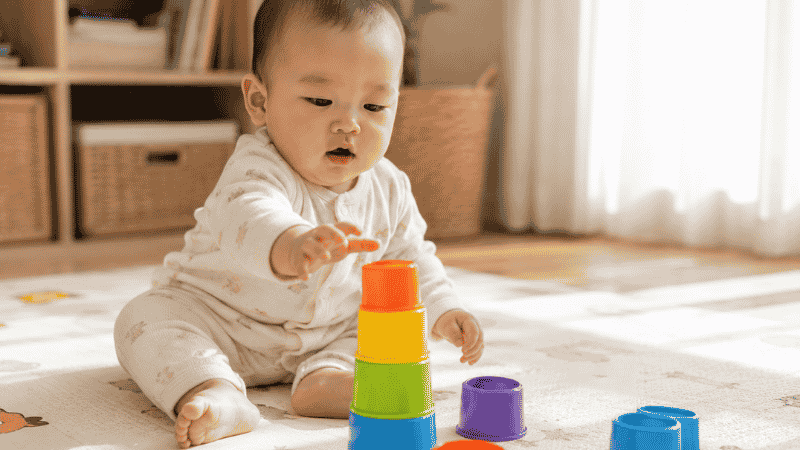
Simple stacking cups are one of the best-value toys you can buy at this stage. At 6 months, your baby will mostly bang them, nest them, and drop them. By 9 months, they’ll start attempting to stack. By 12 months, they’ll be doing it with some success. One toy, months of play, multiple developmental skills.
Look for:
- BPA-free plastic or soft silicone cups
- Graduated sizes that nest clearly inside each other
- Smooth, rounded edges — no sharp lips
Fabric Books with Textures and Crinkle
At 6 months, board books are still too rigid for comfortable exploration — but soft fabric books with varied textures, crinkle pages, and simple bright images are perfect. They’re safe to mouth, satisfying to touch, and the simple images (faces, animals, everyday objects) support early language development when you read and narrate alongside your baby.
Musical Cause-and-Effect Toys
A simple toy that plays a sound or light when your baby presses, shakes, or hits it is perfect for this stage. The key word is simple. Avoid toys with too many modes, too many sounds simultaneously, or flashing lights that activate on their own. The toy should respond to your baby’s action — not provide passive entertainment without any input from them.
Sensory Toys for Babies 9–12 Months: Problem-Solving, Pulling Up, and First Words
The final quarter of the first year is astonishing. Your baby is likely crawling, possibly pulling to stand, may be cruising along furniture, and is beginning to understand that words refer to actual things. Their attention span has grown noticeably. They’re beginning simple problem-solving — putting objects in containers, pulling a cloth off a hidden toy to find it.
Shape Sorters (Simple, 3–4 Shapes)
At 9–12 months, most babies are ready to begin understanding that different shapes fit in different places — even if they can’t yet succeed independently. A simple shape sorter with 3–4 large, basic shapes introduces this concept without overwhelming small hands.
Success at 9–10 months usually means: getting the shape near the hole and wanting to push it in, even if it doesn’t quite work. That effort is the point. By 12 months, many babies can successfully sort simple shapes with some trial and error.
Sensory Toys for 9 Month Old Babies: Pull-to-Stand Toys
As your baby begins pulling up on furniture, a sturdy pull-to-stand toy gives them something safe to use as a support while also providing sensory and cognitive engagement. Look for a weighted base that won’t tip easily, activities at different heights, and elements that reward interaction with sounds or movement.
Avoid toys on wheels for this purpose — they move too easily when a baby pulls on them, which can lead to falls.
Push Walkers
As walking approaches, a push walker — the kind your baby pushes in front of them — provides support and confidence. Look for adjustable resistance on the wheels: too little and it slides away too fast; too much and it’s hard to move. The best push walkers have a wide, stable base and a handle at the right height for your baby’s current standing position.
What Makes a Sensory Toy Safe for Babies: The Non-Negotiables
Before we get to the avoid list, let’s name the safety standards that should be your baseline for every single toy you consider.
Material safety:
- BPA-free and phthalate-free for all plastics
- Food-grade silicone for teethers and mouthing toys
- Non-toxic, water-based paint for any painted wooden toys
- ASTM F963 compliance — the U.S. toy safety standard
- CPSC certification — required for all toys sold in the United States
Size and construction:
- No parts that fit through a toilet paper tube (choking hazard)
- No button batteries, or battery compartments secured with screws
- No strings or cords longer than 12 inches
- No liquid-filled chambers that can leak or be punctured
- Firm stitching on all fabric toys with no loose buttons or eyes
Cleaning:
- Sensory toys get mouthed constantly. Choose toys that can be wiped clean with a damp cloth or — even better — washed in warm soapy water. Fabric toys should be machine washable.
What NOT to Buy: The Sensory Toy Honest Avoid List
Loud, flashing electronic toys for babies under 6 months Young babies are easily overstimulated. Toys with sudden loud sounds, fast-flashing lights, or multiple simultaneous inputs can actually cause distress rather than engagement. Start quiet and simple; add complexity as your baby shows readiness.
Toys with small detachable parts This seems obvious, but many toys marketed for babies have small decorative elements — button eyes, small plastic pieces, decorative stitching — that can come loose. Inspect any new toy thoroughly before giving it to your baby.
Liquid-filled teethers The liquid can harbor bacteria if the teether is punctured, and punctures happen more easily than you’d expect. Stick with solid silicone or natural rubber.
“Educational” toys with complex programs or apps At this age, your baby doesn’t need curriculum. They need sensory input, cause-and-effect experiences, and interaction with you. A toy that requires an app, has multiple learning “modes,” or is designed to teach your baby things they’re not developmentally ready for is just noise.
Oversized toy collections More toys does not mean more development. Research consistently shows that presenting babies with too many options reduces the depth of engagement with any single toy. A small, curated selection rotated regularly is far more valuable than a room full of everything.
DIY Sensory Toys for Babies: Simple and Safe
Some of the best sensory experiences for babies cost almost nothing:
- A crinkled piece of tissue paper (supervised) — fascinating texture and sound
- A clean, smooth wooden spoon — perfect for mouthing, holding, and banging
- A small sealed plastic bottle with rice or beans inside — a DIY rattle (ensure it’s completely sealed with no way to open)
- A soft scarf in a bright color — wave it, drape it, play peek-a-boo
- A piece of foil (supervised) — the texture, sound, and reflective quality are endlessly interesting to babies 4+ months
Always supervise closely with household items and inspect for any potential hazards before offering.
When to Talk to Your Pediatrician About Sensory Development
Sensory development varies enormously between babies, and most differences are completely normal. But there are some signs worth bringing up at your next well-baby visit:
- Your baby consistently seems distressed or distressed by normal sensory experiences (sounds, textures, light) rather than just occasionally fussy
- By 3 months, your baby isn’t tracking moving objects with their eyes
- By 6 months, your baby isn’t reaching for objects or responding to sounds
- By 9 months, your baby shows no interest in exploring objects with their hands or mouth
- You notice your baby seems to “check out” or become very still when stimulated, rather than engaging
These observations don’t necessarily indicate a problem — but they’re worth discussing. Early identification of sensory processing differences allows for early support, which makes a significant difference.
Frequently Asked Questions
What are the best sensory toys for newborns? Newborns do best with high-contrast black-and-white books and cards, soft low-sound rattles, and tummy time mirrors. Keep it simple — a newborn’s sensory system is easily overwhelmed, and short, calm interactions are more valuable than busy, stimulating ones.
Are sensory toys good for babies? Yes, when chosen appropriately for the baby’s developmental stage. Sensory play supports neural development, motor skill growth, early cognitive development, and caregiver bonding. The key is matching the toy to where your baby actually is — not where you hope they’ll be in a few months.
What sensory toys are safe for babies to mouth? Food-grade silicone and natural rubber teethers are the safest options. Any toy your baby will mouth should be BPA-free, phthalate-free, free of small detachable parts, and easy to clean. Inspect mouthing toys regularly for wear and replace any that are cracked, torn, or deteriorating.
How often should I rotate sensory toys? Every 1–2 weeks is a good rhythm. Putting some toys “away” for a few weeks and then reintroducing them makes them feel new again — and babies engage more deeply with a toy they haven’t seen recently than one that’s always available.
Can I make DIY sensory toys for my baby? Yes, with some caution. Household items can provide excellent sensory experiences under close supervision. The key rules: no small parts, no strings, no sharp edges, and always supervise closely. Sealed sensory bottles, soft fabrics, and safe mouthing objects are all good DIY options.
What’s the difference between sensory toys and regular toys? The distinction is mostly about intentionality. Sensory toys are specifically designed to engage one or more of the senses in a way that supports development. In practice, many good baby toys are inherently sensory — rattles, textured balls, crinkle books — whether they’re labeled that way or not. Focus less on the label and more on whether the toy matches your baby’s developmental stage.
When should my baby start playing with sensory toys? From birth. Even in the first days of life, your baby is taking in sensory information and building neural connections. High-contrast visual input, your voice, gentle touch, and the smell of you are all sensory experiences your newborn is actively processing.
The Bottom Line
Choosing the right sensory toys for babies doesn’t require a child development degree or an unlimited budget. It requires knowing roughly where your baby is right now — what they can see, what they can hold, what they can do — and then choosing toys that meet them there.
Start simple. Prioritize safety above everything else. Rotate toys so they stay interesting. And remember that the most powerful sensory experience your baby can have is time with you — talking, singing, making faces, and responding to their cues.
Everything else is just a prop.
Wondering what comes next? Read our guide to the Best Toys for 1-Year-Olds when your baby is ready to level up, or explore our Baby Development Toys Guide for a broader look at the first year of play.
References
- Harvard Center on the Developing Child. (2023). Brain Architecture. https://developingchild.harvard.edu/science/key-concepts/brain-architecture/
- American Academy of Pediatrics (AAP). (2024). Choosing Safe Toys. https://www.healthychildren.org
- Centers for Disease Control and Prevention (CDC). (2023). Developmental Milestones. https://www.cdc.gov/ncbddd/actearly/milestones/
- Zero to Three. (2025). Best Toys for Babies and Toddlers. https://www.zerotothree.org/resource/best-toys-for-babies-toddlers/
- National Association for the Education of Young Children (NAEYC). (2024). Good Toys for Young Children by Age and Stage. https://www.naeyc.org/resources/topics/play/toys
- U.S. Consumer Product Safety Commission (CPSC). Toy Safety. https://www.cpsc.gov/Safety-Education/Safety-Guides/Toys