
Walk down any toy aisle these days and count how many boxes say “STEM.” Go ahead — I’ll wait.
The answer is: almost all of them. Building sets, art kits, musical instruments, even some stuffed animals have quietly acquired the label. Which means the word “STEM toy” has become almost entirely meaningless as a shopping signal — and parents are left trying to figure out which ones actually deliver on the promise and which ones are just well-marketed plastic.
Here’s the honest truth: there’s no legal minimum standard a toy must meet to call itself a STEM toy. Anyone can put it on a box. As Kathy Hirsh-Pasek, a childhood learning researcher at Temple University, has pointed out, the best learning toys aren’t the ones with the cleverest marketing — they’re the ones that require a child to actively engage, problem-solve, and experiment.
That distinction matters, because the best STEM toys for kids genuinely do something remarkable: they build the curiosity, spatial reasoning, persistence, and creative problem-solving that serve children for life. The bad ones just blink at your child while they sit there passively.
This guide will show you the difference — and give you clear, age-matched recommendations you can actually trust.
Key Takeaways
- “STEM toy” is an unregulated label. There are no legal requirements for a toy to call itself educational or STEM. Always look at what the toy actually does, not what the box claims.
- Open-ended beats single-solution. Research published in the Journal of Early Childhood Research found that complex block play in preschool directly improves math learning. The key: toys that can be used in multiple ways outperform single-function toys every time.
- Spatial skills predict math ability. A landmark 2014 review in Trends in Neuroscience and Education confirmed that early spatial play — blocks, puzzles, shape toys — builds the spatial reasoning that underlies later mathematical thinking.
- Child-led is better than adult-directed. The most effective STEM toys are ones where the child drives the activity, not the toy or the parent. Your job is to ask questions and follow their lead.
- STEM starts at 2, not 8. Age-appropriate STEM for toddlers looks like stacking cups and shape sorters. You don’t need a robot kit to start building a scientific mind.
What Actually Makes a Toy a Real STEM Toy?
Before we get to the recommendations, let’s establish a real standard — because the box won’t give you one.
According to researchers at Temple University and Eastern Connecticut University’s Center for Early Childhood Play, genuinely effective educational toys share five characteristics:
1. Active, not passive. The child does something; the toy responds. A toy that just performs for your child — blinking, singing, reciting facts — is entertainment, not education.
2. Engaging and meaningful. The child is genuinely interested in figuring something out, not just following instructions to a predetermined answer.
3. Social when possible. STEM play with a parent, sibling, or friend multiplies the developmental benefit because it adds language, negotiation, and shared problem-solving.
4. Open-ended. There are multiple ways to use the toy, multiple possible outcomes, and no single “correct” solution. A marble run with a hundred configurations teaches more than a kit that produces one fixed result.
5. Iterative. The child can try something, see what happens, adjust, and try again. This is the scientific method in its simplest form — and it’s exactly what great STEM toys enable.
Keep these five criteria in mind as you read the recommendations below, and you’ll have a better filter than any “STEM certified” label.
Best STEM Toys for Toddlers (Ages 2–3): Where STEM Actually Begins
Most parents don’t think of toddler toys as STEM toys. They should. The spatial reasoning, cause-and-effect understanding, and pattern recognition that young children develop through play are the exact cognitive foundations that later support mathematical and scientific thinking.
Shape Sorters and Stacking Toys
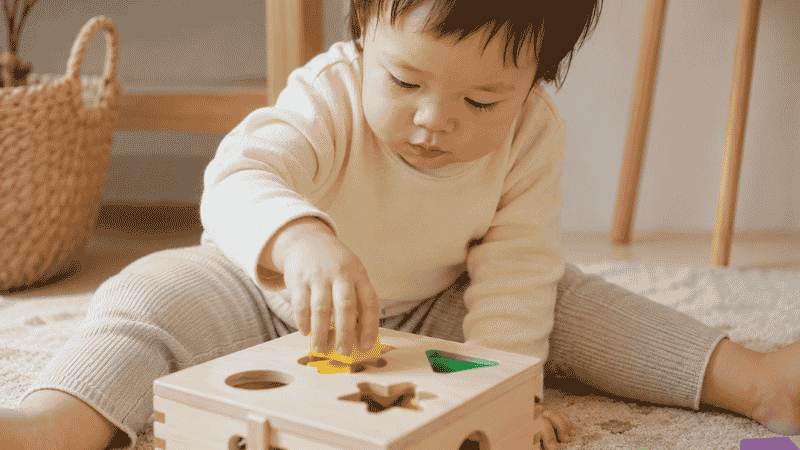
A shape sorter is a 2-year-old’s first engineering challenge. Which shape fits in which hole? What happens when I turn it? Why won’t this one go in? The trial-and-error process — trying, failing, adjusting, succeeding — mirrors the scientific method precisely.
Research from the University of Chicago confirmed that spatial play in toddlerhood directly predicts later STEM achievement. A $15 shape sorter is doing more cognitive work than most people give it credit for.
What to look for: 3–5 basic shapes (not 12), large pieces safe for mouthing, satisfying “thunk” when shapes drop through, BPA-free materials.
Magnetic Tiles (Magna-Tiles and Similar)
Magnetic building tiles are arguably the single best STEM investment across the preschool years. They introduce geometry (shapes, angles, symmetry), physics (balance, gravity, structural integrity), and engineering (planning, testing, problem-solving when things collapse) — all without any instructions.
At two, children mostly click tiles together and make flat shapes. By three, they’re building enclosures and simple structures. By five, they’re making multi-story buildings with ramps and roofs. The developmental arc of this one toy is remarkable.
Safety note: Only buy from reputable brands with fully enclosed magnets. Cheap imitations sometimes have poorly sealed magnets that can come loose — a serious swallowing hazard.
Best STEM Toys for Toddlers: Simple Cause-and-Effect Toys
Pound-a-peg sets, ball drop towers, and simple gear sets all deliver cause-and-effect learning — the foundational concept that actions have predictable consequences. This sounds basic, but it’s a genuinely important cognitive milestone that underpins scientific thinking.
Choose toys where the child’s action directly and immediately produces a result. Complexity comes later; clarity of cause and effect comes first.
Best STEM Toys for Preschoolers (Ages 3–5): Building the Foundation
Three to five is a golden window for STEM play. Children at this age are naturally scientists — they ask “why” constantly, they experiment without fear of failure, and they have just enough fine motor control to manage more complex building activities.
Unit Blocks (Wooden)
This is the toy that every child development researcher, preschool teacher, and pediatric occupational therapist recommends — and yet somehow it’s always underestimated by parents because it doesn’t have a screen or a catchy name.
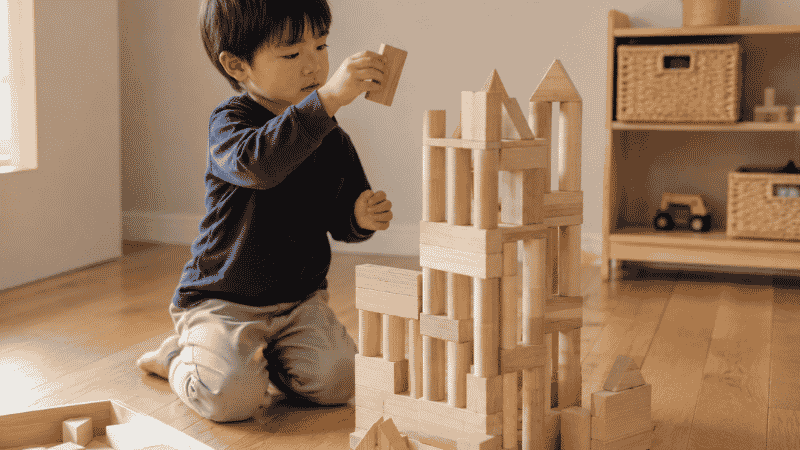
A 2017 study in the Journal of Early Childhood Research found directly that the construction of complex block buildings in preschool is associated with improved math learning. Not correlated. Associated. Children who play with blocks regularly do measurably better in math.
Unit blocks teach proportion (these two short blocks equal one long one), symmetry, balance, gravity, spatial reasoning, and planning. They also invite language — “I’m making a bridge,” “This keeps falling because…” — which doubles the developmental payoff.
What to look for: Solid hardwood (not MDF or particle board), smooth finish with non-toxic stain or paint, a set large enough to build actual structures (at least 60–80 pieces).
Best STEM Toys for 3 Year Olds: Marble Runs
At 3.5 and up, many children are ready for a basic marble run. The process of connecting pieces, predicting where the marble will go, watching it fail to reach the end, and troubleshooting why — that is the scientific method in miniature.
Choose marble runs with large, clearly connecting pieces and marbles no smaller than 1.75 inches for children under 5. Start simple; add complexity as they master each configuration.
Best STEM Toys for 4 Year Olds: Simple Gear Sets and Mechanism Toys
Gear sets introduce a concept that fascinates 4-year-olds: interlocking systems. Turn one gear and another turns too — but in the opposite direction. Add a third gear and the direction reverses again. This is physics, and most 4-year-olds find it genuinely magical.
Fat Brain Toys Crankity and Gears! Gears! Gears! are both widely recommended by occupational therapists and preschool educators for exactly this age range.
Simple Science Kits for Preschoolers
Baking soda and vinegar volcano kits, color-mixing experiments, and simple magnet exploration sets are all appropriate for the preschool years. The key at this age isn’t the complexity of the experiment — it’s the experience of doing an experiment: making a prediction, trying it, seeing what happens, talking about it.
Keep science activities to 10–15 minutes. Preschoolers’ attention spans don’t require elaborate setups — a bowl, some baking soda, and your enthusiastic narration is enough to build scientific curiosity.
Best STEM Toys for Kids Ages 5–7: First Experiments and Early Coding
Five to seven is when children begin to genuinely understand sequences, simple rules, and the concept of a system — which opens the door to early coding, more complex building challenges, and beginner science experiments.

Best STEM Toys for 5 Year Olds: LEGO Classic and Technic Junior
Standard LEGO bricks are genuinely STEM toys when used for open-ended building rather than just following instructions to one predetermined result. Encourage your child to use their LEGO to solve a challenge: “Can you build something that can hold this book?” “Can you make a vehicle with moving wheels?” That constraint-based building is engineering thinking in action.
LEGO Technic Junior sets (designed for ages 7+) introduce simple mechanisms — axles, gears, levers — that make STEM concepts tangible in a way that fascinates children at this age.
Best STEM Toys for 6 Year Olds: Snap Circuits Junior
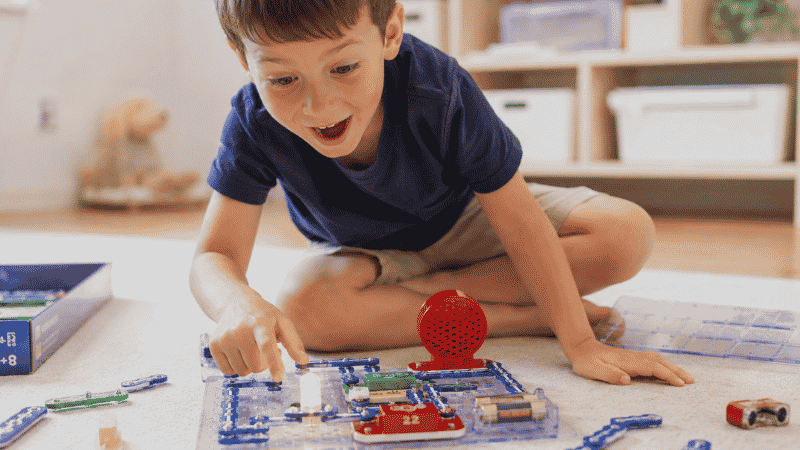
Snap Circuits Junior is one of the most consistently recommended STEM toys for early elementary children, and for good reason. The snap-together components allow children to build real working circuits — lights that turn on, fans that spin, sounds that play — without any soldering or adult assembly.
The “success moment” when a circuit is complete and a light comes on is genuinely powerful for a 6 or 7-year-old. They built something that works. That feeling of competence is exactly what builds STEM confidence.
Beginner Coding Toys (Screen-Free)
Screen-free coding toys are an excellent introduction to programming logic for ages 5+. Toys like Cubetto (a wooden robot that follows a sequence of physical command blocks), Code-a-Pillar (a caterpillar robot whose segments determine its path), and Botley the Coding Robot all teach sequencing, logical thinking, and debugging — the core skills of programming — without any screen time.
Important distinction: these toys teach coding concepts — sequencing, conditionals, loops — not actual programming languages. That’s appropriate and valuable at this age. Actual language-based coding comes later.
Best STEM Toys for Kids Ages 8–12: Real Challenges, Real Science
By age eight, children are ready for genuine complexity. Their attention spans have grown, their fine motor skills are well-developed, and they can follow multi-step instructions, work toward long-term goals, and handle the frustration of things not working immediately.
Science Kits and Chemistry Sets
Age-appropriate chemistry sets (clearly labeled for 8+) introduce real scientific concepts through hands-on experiments — pH testing, polymer chemistry, crystal growing, and more. The National Geographic science kits are consistently well-reviewed for safety, quality of materials, and genuine educational content.
What to look for in a science kit:
- Clear age labeling and safety guidelines
- Materials that are genuinely safe (not just “non-toxic” on the label — read the ingredient list)
- Adult supervision recommended for any kit involving heat, sharp tools, or reactive materials
- Enough experiments to sustain interest beyond one afternoon
Robotics Kits
At 8+, robotics kits that involve actual building and basic programming open up a world of engineering thinking. LEGO SPIKE Prime (for ages 9+) and Snap Circuits Pro are both widely used in school STEM programs and translate well to home use.
The most important feature of any robotics kit: the child should be doing the programming, not just running a pre-written program. If the robot comes with everything pre-coded and the child just presses “go,” it’s a toy, not a learning experience.
Science Toys for Kids: Microscopes and Observation Kits
A quality beginner microscope (not a toy microscope — there’s a meaningful difference in optical quality) opens up a world of discovery for curious 8–12-year-olds. Start with prepared slides, then move to making their own — pond water, onion cells, fabric fibers, insect parts.
National Geographic and AmScope both make reliably good entry-level microscopes that deliver real clarity without requiring a professional budget.
STEM Toys for Boys and Girls: Let’s Talk About This
You’ll notice that when you search for stem toys for boys or stem toys for girls, the results are often very different — and this matters.
The research is clear: there are no meaningful cognitive differences between boys and girls in spatial reasoning, mathematical ability, or scientific aptitude in early childhood. The differences in STEM career paths that emerge later are significantly influenced by what we tell children they’re good at — and which toys we hand them.
Magnetic tiles, marble runs, coding toys, science kits, and building sets are for all children. The child who isn’t drawn to any of them needs a different toy — not one filtered by gender.
When shopping for STEM gifts, skip the “for boys” and “for girls” filter entirely. Ask instead: what is this specific child interested in? Dinosaurs? There’s a fossil excavation kit for that. Animals? There are nature and biology kits. Space? Astronomy sets and planetarium projectors. Follow the interest, and the STEM follows naturally.
The STEM Toy Avoid List: What Doesn’t Actually Work
Anything that does the thinking for your child If the toy provides all the answers — tells them what to do, shows them the solution, corrects every error immediately — your child isn’t learning. They’re watching. The productive struggle is where the learning happens.
Apps marketed as STEM learning for young children The American Academy of Pediatrics recommends thoughtful management of screen time for children, particularly under age 5. A coding app is still a screen. At this age, hands-on physical manipulation of objects produces significantly better spatial and cognitive development than screen-based equivalents.
Single-experiment science kits A kit that produces one cool result — a volcano that erupts once — has limited educational value. The first eruption is exciting. But if there’s nothing to vary, test, or repeat, it’s spectacle rather than science.
“STEM” toys with no failure path The best STEM toys allow children to fail and then figure out why. If a toy is designed so that it always works correctly regardless of what the child does, it’s removing the most important part of the learning experience.
If You Only Have 10 Minutes: The Quick-Pick Summary by Age
- Ages 2–3: Shape sorter + magnetic tiles (32-piece starter)
- Ages 3–5: Unit blocks + marble run (simple, large pieces)
- Ages 4–5: Gear set + simple magnet exploration kit
- Ages 5–7: Snap Circuits Junior OR screen-free coding robot (Botley, Cubetto)
- Ages 6–8: LEGO Classic open-ended set + beginner science kit
- Ages 8–12: Snap Circuits Pro OR robotics kit + quality microscope
- Best stem gifts for kids overall: Magnetic tiles (grows from age 2 to 10+)

Frequently Asked Questions
What are the best STEM toys for toddlers? For toddlers, STEM looks like shape sorters, stacking cups, magnetic tiles, and simple cause-and-effect toys. These build the spatial reasoning, pattern recognition, and problem-solving foundations that support later STEM learning. Skip anything too complex — the best STEM toy for a 2-year-old is one they can successfully interact with on their own.
Are STEM toys worth it? Yes — when chosen correctly. The research is consistent: open-ended building toys, spatial play, and hands-on experimentation genuinely build the cognitive skills associated with mathematical and scientific achievement. But “STEM” on the label means nothing. The toy’s actual design is what matters.
What makes a STEM toy actually educational? Five things: it requires active engagement from the child, it has multiple possible outcomes, it allows for trial and error, it produces a visible result connected to the child’s action, and it’s appropriately challenging for the child’s developmental stage. If a toy checks these boxes, it’s genuinely educational regardless of what the label says.
Are coding toys good for kids? Yes, particularly screen-free coding toys for younger children (ages 5–8) and language-based coding for older children (ages 8+). Coding toys develop sequencing, logical thinking, and debugging skills. The key is choosing toys where the child is actually programming — not just operating a pre-programmed device.
What STEM toys are good for girls? All of them. The research consistently shows no meaningful difference in early STEM aptitude between boys and girls. The differences that emerge later are driven by messaging and cultural expectations, not ability. Give girls the same magnetic tiles, marble runs, coding robots, and science kits you’d give anyone — and skip the pink-packaging versions that are often functionally inferior.
How do I know if a STEM toy is safe? Look for ASTM F963 compliance (required for U.S. toys), CPSC certification, and BPA-free labeling for any plastic components. For science kits, read the materials list carefully and follow age recommendations. Any kit involving chemicals, heat, or sharp tools should be used with adult supervision regardless of age labeling.
My child isn’t interested in STEM toys. Should I be worried? No. Children develop interests at their own pace, and forcing engagement with any toy category is counterproductive. Instead, follow what genuinely interests your child and look for the STEM element within that interest. A child who loves cooking is doing chemistry. A child who loves drawing is exploring geometry. A child who loves animals can explore biology through nature kits. STEM is everywhere — it doesn’t have to come in a branded box.
The Bottom Line
The best STEM toys for kids aren’t the ones with the most impressive packaging or the longest list of “educational benefits” on the side of the box. They’re the ones that get your child genuinely curious about how something works — and then let them figure it out themselves.
Start simple. Choose open-ended over single-solution. Match the toy to your child’s current abilities, not where you hope they’ll be. And then get on the floor with them, ask questions, and follow their lead.
That’s the whole formula. The toy is just the starting point.
Explore more: our age-specific guides cover Best Toys for 3-Year-Olds, Best Toys for 4-Year-Olds, and Best Toys for 5-Year-Olds with developmental context for every stage.
References
- Hirsh-Pasek, K., et al. (Temple University). Research on characteristics of effective educational toys. Cited in Live Science, 2020. https://www.livescience.com/how-stem-toys-teach-math-science.html
- Verdine, B.N., et al. (2014). Deconstructing Building Blocks: Preschoolers’ Spatial Assembly Performance Relates to Early Mathematical Skills. Child Development.
- Borriello, G.A., & Liben, L.S. (2018). Encouraging Maternal Guidance of Preschoolers’ Spatial Thinking. Journal of Applied Developmental Psychology.
- Bower, C., et al. (2017). The effect of block play on mathematics achievement. Journal of Early Childhood Research.
- Uttal, D.H., et al. (2014). The malleability of spatial skills: A meta-analysis of training studies. Trends in Neuroscience and Education.
- American Academy of Pediatrics (AAP). (2024). Media and Young Minds. https://www.healthychildren.org
- U.S. Consumer Product Safety Commission (CPSC). Toy Safety. https://www.cpsc.gov/Safety-Education/Safety-Guides/Toys