
You know that feeling when you spend $60 on a toy, wrap it beautifully, watch your toddler tear it open with delighted screaming — and then see them spend the next 45 minutes playing with the empty box?
Yeah. We’ve all been there.
Two is a genuinely bewildering age to shop for. Your child is no longer a baby, but they’re not quite a preschooler either. They have opinions — loud, passionate, unpredictable opinions — about everything, including which toys deserve their attention. And spoiler: it’s rarely the one you spent the most money on.
The best toys for 2 year olds aren’t the ones with the most features or the biggest box. They’re the ones that match where your child actually is right now — developmentally, emotionally, and physically. Get that match right, and a toy becomes something they return to again and again. Get it wrong, and you’ve just donated $40 to the toy graveyard under the couch.
This guide cuts through the noise. We’ll cover what’s actually happening in your 2-year-old’s brain, which toy categories deliver real play value, what to skip, and how to make any toy work harder for your child’s development. No recycled Amazon lists. Just honest, development-first guidance from a parent who’s made all the expensive mistakes already.
Key Takeaways
- Two is the “parallel play” age. According to the CDC, most 2-year-olds play alongside other children, not with them — which means solo-play toys matter more than group games right now.
- Language is exploding. Between ages 2 and 3, most children’s vocabulary grows from 50–100 words to over 1,000. Toys that invite conversation and narration actively support this leap.
- Attention spans are short but growing. A focused 2-year-old can sustain independent play for about 5–8 minutes with the right toy. Plan for rotation, not marathon sessions.
- “Me do it” is their entire personality. Independence is the defining drive at this age — the best educational toys for 2 year olds are ones they can operate and succeed at themselves, without constant adult help.
- Open-ended beats single-use. Research from NAEYC consistently shows that simple, open-ended toys (blocks, play dough, stacking cups) produce more complex play and language development than single-function electronic toys.
What’s Actually Happening in Your 2-Year-Old’s Brain
Before we get to the recommendations, it helps to understand why certain toys work so well at this age — because that knowledge will serve you well long after this article.
At two, your child’s brain is forming over one million new neural connections every second, according to the Harvard Center on the Developing Child. This is one of the most explosive periods of development in human life. What that means practically is that your toddler is simultaneously:
- Learning to run, jump, and climb (often without the coordination to do it safely yet)
- Developing the ability to sort, match, and categorize objects
- Entering the beginning stages of pretend play — “cooking” with toys, putting dolls to bed, imitating everything you do
- Experiencing emotions they don’t yet have words for — hence the legendary “terrible twos” meltdowns
- Building language at a rate that will astonish you if you’re paying attention
The CDC’s developmental milestones for 2-year-olds include: using two- to four-word phrases, following two-step instructions, beginning to sort shapes and colors, and engaging in simple make-believe play.
The best toys for 2 year olds work with these developments — not ahead of them, and not behind them.
The Builders: Toys That Develop Hands, Minds, and Patience
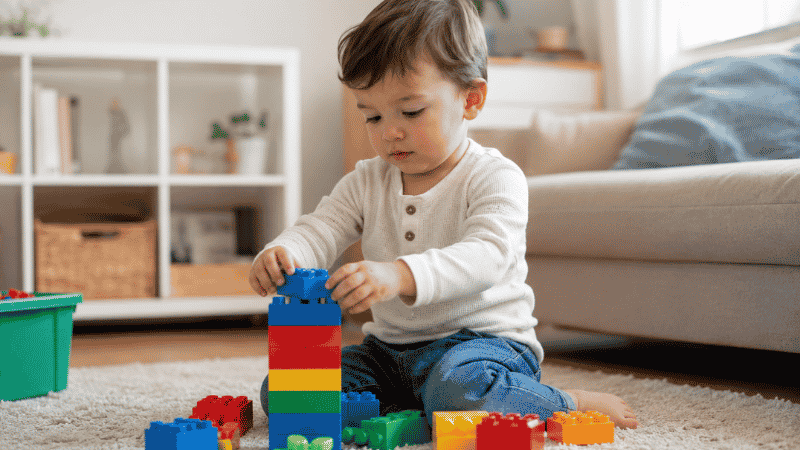
Building toys are the foundation of any good 2-year-old toy collection, and for good reason. When your toddler stacks a block, knocks it down, and stacks it again, they’re running a series of physics experiments: testing gravity, balance, spatial relationships, and cause and effect. That’s not just play. That’s science.
Stacking Cups and Mega Blocks
At two, your child has moved past the basic dump-and-fill stage. Now they want to build something — and the satisfaction of a successful stack is enormous for them. Start with large, smooth pieces they can manage independently.
LEGO DUPLO is the gold standard here. The bricks are large enough to be completely safe, connect satisfyingly, and build enough complexity to stay interesting well into the preschool years. A basic DUPLO brick box is one of the best investments you can make at this age — and one of the few toys that will still be in heavy rotation at age 4.
Safety note: Standard LEGO bricks (the small kind) are not appropriate for 2-year-olds. DUPLO bricks are exactly 8 times larger and specifically designed for this age group.
Shape Sorters and Simple Puzzles
Shape sorting is the 2-year-old’s first real “problem-solving” experience, and the developmental payoff is significant. Research from the University of Chicago found that spatial play in toddlerhood directly predicts later achievement in math and science. A simple shape sorter isn’t just a toy — it’s building the cognitive architecture for logical thinking.
Choose a shape sorter with 4–6 basic shapes (not 12 — that’s too frustrating for this age) and large, easy-to-grip pieces. By the time your child can do it easily, they’ll be ready to level up to a simple wooden puzzle with large knob pieces.
One coaching tip worth sharing: Resist the urge to point to the correct hole when they’re struggling. The struggle itself is where the learning happens. Instead, narrate what you see: “You’re trying the square hole… turning it… does that side work?” That narration also doubles as language development.
Magnetic Drawing Boards
Underrated, mess-free, and genuinely engaging. A magnetic drawing board lets your 2-year-old draw, erase, and draw again — building hand control and creativity without the chaos of paint or crayons on your walls. The erase function also teaches a subtle but important concept: that you can try something, change it, and try again.
The Imaginators: Pretend Play Toys That Build Language and Empathy
Around 24 months, something shifts in how toddlers play. It becomes intentional. They’re not just exploring objects anymore — they’re assigning meaning to them. A banana becomes a phone. A blanket becomes a cape. Their stuffed rabbit gets tucked in and sung to sleep.
This is the beginning of pretend play, and it’s one of the most developmentally significant things happening right now. According to Zero to Three, pretend play at this age directly supports language development, emotional regulation, and early social skills.
Play Kitchens and Food Sets
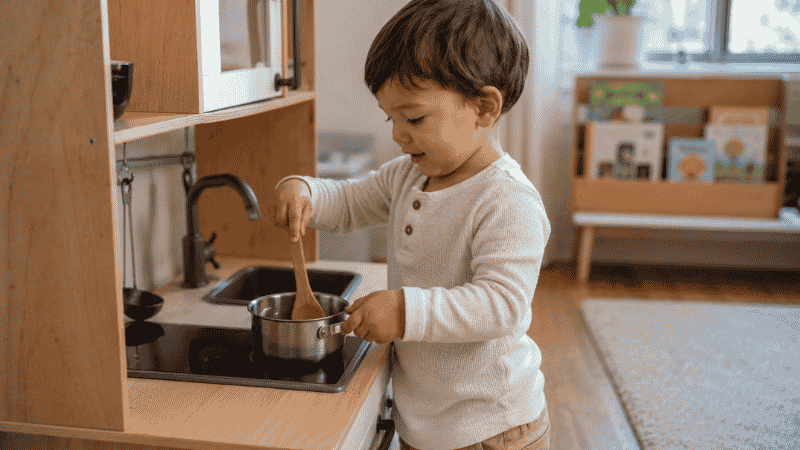
A play kitchen placed near your real kitchen is one of the smartest toy investments for this age. When you cook, they cook. When you stir, they stir. The parallel play that defines 2-year-old social behavior suddenly becomes a shared activity — and the language that naturally flows (“What are you making? Is your soup hot? Can I have some?”) is pure developmental gold.
Look for a play kitchen with:
- A simple design without too many confusing features
- Durable construction — it will get used hard every single day
- Some realistic elements (a knob that clicks, a door that opens) to satisfy their drive to imitate exactly
Best picks: Melissa & Doug Wooden Kitchen, KidKraft Uptown Kitchen, or any solid wooden option that fits your space and budget.
Baby Dolls
Whether you have a boy or a girl, a simple baby doll is one of the best gifts for 2 year olds you can give. At two, children are processing enormous emotions — separation anxiety, frustration, jealousy, excitement — and they often work through those feelings by acting them out with a doll.
Feeding the baby. Putting her to sleep. Telling her not to cry. This is your child practicing empathy and emotional regulation in the safest possible context. It’s not just sweet. It’s developmental work.
Choose a doll with a soft, huggable body, simple features, and no small accessories that can be lost or swallowed.
Play Food and Simple Roleplay Sets
A small set of play food — fruits, vegetables, a few “dishes” — extends the play kitchen experience and adds sorting, categorizing, and early math concepts (more vs. fewer, big vs. small). Cut-and-velcro food sets are particularly popular because the cutting action satisfies that “I can do it myself” drive perfectly.
The Movers: Active Toys for the 2-Year-Old Who Never Stops
Two-year-olds have energy levels that seem medically impossible. If that energy doesn’t get channeled into physical play, it tends to get channeled into chaos. The right active toys aren’t just fun — they’re necessary for sleep, mood regulation, and gross motor development.
Balance Bikes
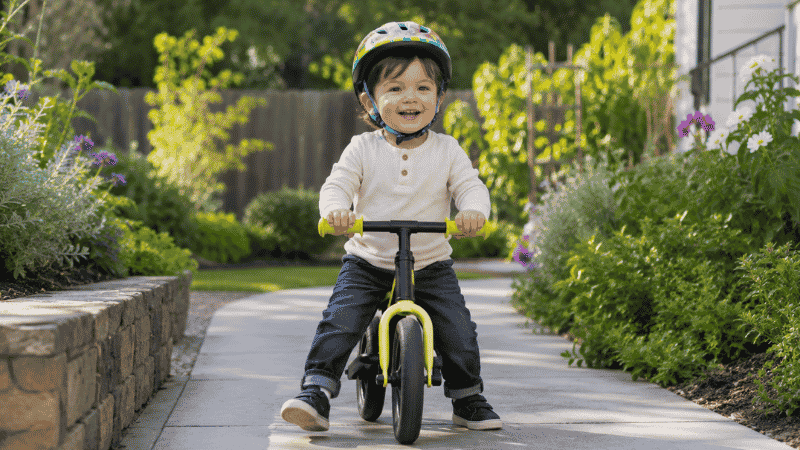
If your 2-year-old isn’t on a balance bike yet, start now. The earlier they begin, the more natural it feels — and children who learn on balance bikes typically skip training wheels entirely, moving directly to a pedal bike around age 3.5–4.
Look for a balance bike where your child’s feet rest flat on the ground with a slight bend at the knee. The seat height is everything — too high and they can’t steer confidently, too low and they can’t develop the gliding motion that makes balance bikes so effective.
Always pair with a properly fitted helmet from day one. Make it a non-negotiable habit before they ever sit on the bike.
Ride-On Toys and Push Cars
For the toddler who isn’t quite ready for a balance bike, a simple ride-on toy (the kind they propel with their feet) builds the same leg strength and coordination without the balance challenge. Look for a wide, stable base with rubber wheels that grip without scratching your floors.
Outdoor Toys for 2-Year-Olds: Balls, Shovels, and Water
The simplest outdoor toys for 2 year olds are often the best ones. A few soft balls of different sizes, a set of sandbox tools, and a simple water table will occupy a 2-year-old outside for longer than almost anything else. Water play in particular is deeply satisfying for this age — it’s sensory, it’s cause-and-effect, and it requires zero instruction.
For sandbox or outdoor digging play, choose oversized tools designed for small hands. Standard garden tools are too large and heavy; look for toddler-specific sets with chunky handles and soft edges.
The Sensory Explorers: Toys That Calm, Engage, and Develop
Two-year-olds are still very much sensory learners — and the right sensory toys for 2 year olds do double duty, both engaging their developing senses and helping regulate their emotional state when things get overwhelming.
Play-Doh and Modeling Clay
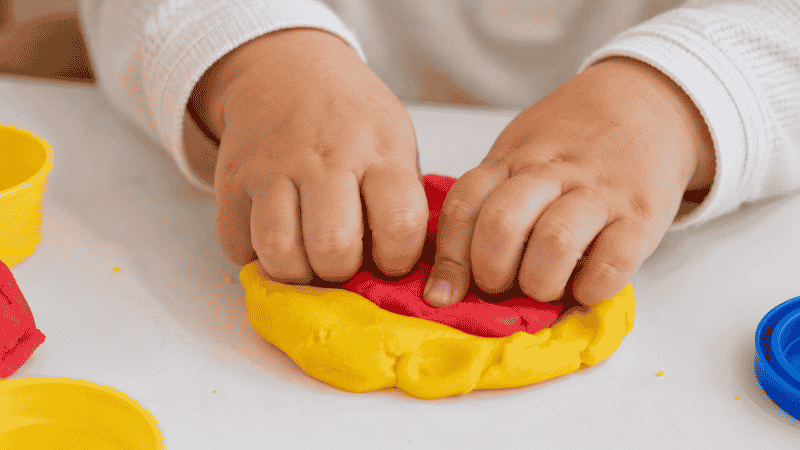
Squeezing, rolling, pinching, and pressing play dough builds the exact hand strength that prepares children for holding a pencil. It also has a genuinely calming effect on most toddlers — the rhythmic, repetitive motion of kneading clay activates the same self-regulation pathways that sensory activities are known to support.
Keep it simple: a few colors, a rolling pin, and some basic shape cutters. Resist the urge to buy elaborate sets with 40 accessories that will scatter within 24 hours.
Important: All play dough used with children who still put things in their mouths should be clearly labeled non-toxic. Homemade play dough with food-safe coloring is an excellent alternative.
Simple Musical Instruments
At two, “music” means banging things together and making noise — and that’s exactly right developmentally. Rhythm, pattern recognition, and cause-and-effect are all firing at once. A small set of toddler-appropriate instruments (a simple xylophone, a shaker, a small drum) encourages exploration without requiring any skill.
Avoid cheap instruments with loud, piercing tones. Look for wooden instruments with a genuine, resonant sound — they’re more pleasant for everyone in the house and tend to hold interest longer.
Books as Sensory Toys
Board books with lift-the-flap elements, textured pages, or mirror inserts are perfect learning toys for 2 year olds because they engage multiple senses simultaneously. At this age, “reading” is less about the words and more about shared attention, language exposure, and the physical experience of turning pages, lifting flaps, and pointing at pictures.
Read together daily, even if it’s just 10 minutes before bed. The vocabulary exposure alone has measurable effects on language development that last well into the school years.
Montessori Toys for 2-Year-Olds: What’s Worth It and What’s Marketing
“Montessori” has become one of the most overused labels in the toy industry — slapped on everything from wooden puzzles to expensive play sets with dubious educational value. Here’s how to think about it clearly.
Genuinely Montessori-aligned toys for 2-year-olds share these qualities:
- Child-led — the child can operate and succeed independently
- Open-ended — no single “right” way to play
- Natural materials where possible (wood, cotton, silicone)
- Match the child’s current developmental stage, not where you hope they’ll be
What that looks like in practice: wooden stacking toys, shape sorters, simple puzzles with knob handles, play food, building blocks, art supplies, and water play. None of these are expensive or hard to find.
What it doesn’t have to mean: buying a specific brand, spending a lot of money, or filling your home with only wooden toys. A well-chosen plastic toy can be more genuinely Montessori than an overpriced wooden toy that only does one thing.
Safety at 2: What Every Parent Needs to Know
Two-year-olds are more physically capable than they were at one — but more capable doesn’t mean more safe. In fact, their new mobility and curiosity often puts them in more danger, not less.
What Changes at 2 (and What Doesn’t)
Getting safer:
- Most 2-year-olds have largely stopped mouthing objects, though some still do when tired or bored
- They can follow simple safety instructions (“don’t put that in your mouth”)
- Small puzzle pieces, chunky crayons, and play food with pieces larger than 1.75 inches are generally appropriate
Still dangerous regardless of age:
- Small, powerful magnets: If two are swallowed separately, they can attract through intestinal walls and cause life-threatening injuries requiring emergency surgery. Never use toys with small neodymium magnets with children under 6.
- Button batteries: Require screwed-shut battery compartments. A 2-year-old is more than capable of prying open an unsecured battery cover.
- Latex balloons: A leading cause of choking death in children under 8. Always supervise balloon play.
- Ropes, strings, or cords longer than 12 inches: Strangulation hazard, especially during unsupervised play.
Safety Certifications to Look For
- ASTM F963: The U.S. toy safety standard — required for all toys sold in America
- CPSC compliance: Enforced by the Consumer Product Safety Commission
- BPA-free and phthalate-free labeling: Important for any plastic toy that may be mouthed
What NOT to Buy: The 2-Year-Old Avoid List
Electronic “learning” toys that do the talking A toy that sings the alphabet, recites numbers, and plays melodies on its own is providing entertainment — not education. When a toy does the thinking for your child, your child’s brain isn’t doing the work. At two, interaction and open-ended play consistently outperform passive electronic stimulation for language and cognitive development.
Sets with tiny pieces At two, any toy with pieces smaller than 1.75 inches is still a choking risk for some children. More importantly, sets with 30+ tiny components become cleanup disasters that make playtime feel like punishment. Simpler is better.
Screen-based “educational” devices The American Academy of Pediatrics recommends limiting screen time to 1 hour per day of high-quality content for children ages 2–5. A dedicated learning tablet is still a screen. At this age, hands-on play consistently outperforms screen-based learning for developmental outcomes.
Anything rated 3+ Those age labels exist for safety reasons. A toy rated for 3-year-olds may have small parts, require fine motor skills that haven’t developed yet, or involve concepts your 2-year-old’s brain isn’t ready for. Buying ahead of the age range usually just creates frustration — for both of you.
If You Only Have 10 Minutes: The Quick-Pick Summary
Running low on time before a birthday? Here’s the shortlist:
- Best overall: LEGO DUPLO Classic Brick Box
- Best for imaginative play: Melissa & Doug Wooden Play Kitchen
- Best active toy: Balance bike (Strider or similar) + helmet
- Best sensory toy: Play-Doh 10-color pack with basic tools
- Best budget pick: Melissa & Doug Stacking Rings or Shape Sorter
- Best gifts for 2 year old girl: Soft baby doll + small play food set
- Best gifts for 2 year old boy: DUPLO set + a soft ball assortment
- Best quiet time toy: Magnetic drawing board
Frequently Asked Questions
What are the best gifts for a 2-year-old girl? The most genuinely useful gifts for 2-year-old girls are ones that support her current developmental stage — not ones that lean on gender stereotypes. A play kitchen, a baby doll, a DUPLO set, art supplies, or a balance bike are all excellent choices. At two, what matters is developmental match, not pink packaging.
What are the best gifts for a 2-year-old boy? Same answer as above, honestly. Two-year-old boys benefit enormously from pretend play props (kitchen sets, dolls, tool sets), building toys, active outdoor toys, and sensory play. The best gift is one that matches his current interests and developmental stage — whether that’s trucks, animals, music, or cooking.
What toys help 2-year-olds with language development? Any toy that gives you and your child something to talk about together. Play kitchens invite narration and conversation. Board books build vocabulary and language rhythm. Pretend play sets prompt back-and-forth dialogue. The toy is the prop — your conversation is the actual language tool.
Are Montessori toys worth it for 2-year-olds? The concept is worth it; the brand names are optional. The Montessori principles that genuinely work at this age — open-ended, child-led, developmentally matched — apply to many affordable, widely available toys. You don’t need to spend a fortune on specialty Montessori products to give your child a rich play environment.
My 2-year-old destroys every toy. What’s actually durable? Welcome to the club. Two-year-olds are thorough testers of structural integrity. Best bets for durability: wooden toys with non-toxic paint (Melissa & Doug, Hape), LEGO DUPLO (essentially indestructible), silicone bath toys, and fabric dolls. Avoid thin plastic, toys with stickers instead of printed details, and anything with delicate moving parts.
How many toys does a 2-year-old need? Fewer than you think. Research consistently shows that toddlers play more creatively and for longer when they have a smaller, curated selection of toys rather than an overwhelming abundance. Aim for 6–8 accessible toys at a time, rotate others in storage, and donate anything that hasn’t been touched in three months.
When should I be concerned about my 2-year-old’s play development? Speak with your pediatrician if your 2-year-old doesn’t engage in any pretend play, shows no interest in other children, isn’t using at least 50 words, or has lost skills they previously had. These can be early signs of developmental differences that benefit significantly from early intervention — and early support makes a real difference.
The Bottom Line
Finding the best toys for 2 year olds isn’t about finding the most impressive thing on the shelf. It’s about finding the thing that meets your specific, unique, magnificently chaotic toddler exactly where they are right now.
Simple beats complicated. Open-ended beats single-use. Your presence beside them beats any toy ever made.
Start with a few well-chosen basics — some building toys, a pretend play set, something for active outdoor time, and some art supplies — and rotate them regularly to keep things feeling fresh. You don’t need to fill a playroom. You just need to choose thoughtfully.
And when they spend 45 minutes playing with the box? That’s fine too. Curiosity is the whole point.
Ready for what comes next? Read our guide to the Best Toys for 1-Year-Olds if you’re shopping for a younger sibling, or jump ahead to Best Toys for 3-Year-Olds when your toddler is ready to level up. Our Gift Guides also have age-specific birthday and holiday recommendations.
References
- Centers for Disease Control and Prevention (CDC). (2023). Developmental Milestones: 2 Years. https://www.cdc.gov/ncbddd/actearly/milestones/milestones-2yr.html
- American Academy of Pediatrics (AAP). (2024). Media and Young Minds. https://www.healthychildren.org
- National Association for the Education of Young Children (NAEYC). (2024). Good Toys for Young Children by Age and Stage. https://www.naeyc.org/resources/topics/play/toys
- Zero to Three. (2025). Best Toys for Babies and Toddlers. https://www.zerotothree.org/resource/best-toys-for-babies-toddlers/
- Harvard Center on the Developing Child. (2023). Brain Architecture. https://developingchild.harvard.edu/science/key-concepts/brain-architecture/
- University of Chicago Department of Psychology. (2022). Spatial Play and STEM Achievement in Early Childhood. Referenced in child development literature.
- U.S. Consumer Product Safety Commission (CPSC). Toy Safety. https://www.cpsc.gov/Safety-Education/Safety-Guides/Toys