
Toy bins fill up faster than most parents expect. Birthdays, holidays, and well-meaning relatives have a way of adding “just one more toy” until every shelf seems full. Then another special occasion comes around, and the same question pops up again: What should I buy that they’ll actually use?
That’s what makes shopping for gifts for toddlers so challenging. It isn’t a lack of choices—it’s having far too many. Some toys are exciting for a day and quickly forgotten. Others become favorites that get played with for years. The hard part is knowing which is which before you spend your money.
This guide makes that decision easier. Whether you’re shopping for your own child, a grandchild, a niece or nephew, or a friend’s toddler, you’ll learn how to choose gifts that are safe, age-appropriate, fun to play with, and genuinely worth bringing home—even when it feels like they already have everything.
Quick Answer: What Makes a Great Toddler Gift
A great toddler gift does more than keep a child busy for a few days. It should be safe, match where they’re at developmentally, and still be something they reach for weeks or even months later. The toys that get the most use are usually the ones that grow with a child instead of being exciting for only one afternoon.
Before you buy anything, keep these in mind:
- ✔ Prioritize safety before popularity. A trending toy is worthless if it isn’t safe for your child’s age.
- ✔ Choose open-ended toys over noisy electronic toys. Simpler toys tend to hold attention longer.
- ✔ Match gifts to developmental milestones, not just the age printed on the box.
- ✔ Pick gifts that grow with your toddler instead of ones they’ll outgrow in weeks.
- ✔ Consider non-toy and experience gifts if the family already has plenty of toys.
How to Choose the Best Gift for a Toddler
Before looking at specific products, it helps to have a simple framework in mind. This is the same standard we’ll use throughout the rest of the guide.
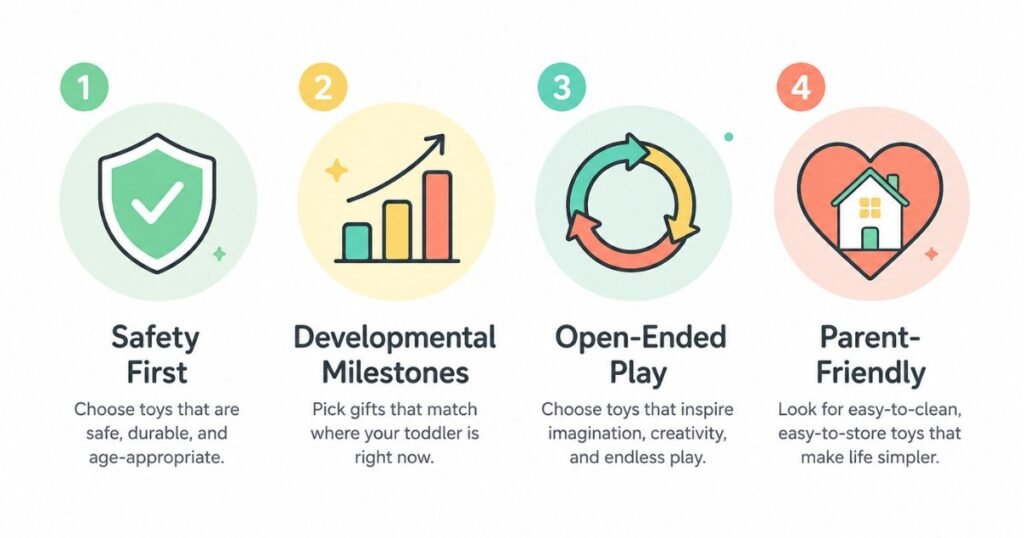
Safety first. No toy is a good toy if it isn’t appropriate and safe for your child’s age — this always comes before anything else, no matter how educational or impressive a toy looks on the box.
Developmental milestones matter more than the age label. A toy built for “18 months and up” can still be too advanced or too simple depending on where your specific child is right now.
Open-ended play beats a single function. Toys that can be used in more than one way — stacked, sorted, built, pretended with — tend to stay interesting far longer than toys that do just one thing.
Long-term play value is worth paying attention to. The real test isn’t how excited a toddler is in the first five minutes. It’s whether the toy is still getting used a few months later.
Parent-friendly features count too. Storage needs, ease of cleaning, and noise level all affect whether a toy actually gets used day-to-day — or quietly gets pushed to the back of a closet.
What makes a toy educational?
Don’t let flashy packaging fool you. Some of the best learning toys are also the simplest. Blocks, shape sorters, and pretend play toys encourage toddlers to build, explore, and use their imagination instead of just pressing buttons and watching lights flash. That’s the kind of play that keeps them interested—and helps them learn naturally along the way. problem-solve, and use their imagination rather than just react to lights and sounds. For a deeper look at this category, our educational toys guide breaks down what to look for by age.
Why simple toys usually last longer
Ask almost any parent which toys get the most use, and you’ll probably hear the same answer: not the loud, flashy ones, but the simple toys that leave room for imagination. Blocks and puzzles often stay in the playroom long after the novelty of electronic toys has worn off. Battery-powered toys that do all the “work” themselves tend to lose their appeal quickly, since there’s nothing left for the child to create. If you’re building a toy collection from infancy, our complete baby toy guide is a good place to see how this pattern starts even before toddlerhood.
Toddler Gift Buying Checklist
- [ ] Is it safe and age-appropriate, with no small or detachable parts?
- [ ] Does it support open-ended, imaginative play?
- [ ] Will it likely still be interesting in three to six months?
- [ ] Is it easy to clean and store?
- [ ] Does it avoid duplicating toys the family already owns?
Key takeaway: A great toddler gift should benefit both the child and the parents.
Gifts by Developmental Stage: What Toddlers Actually Need at Each Age
Buying by developmental stage — rather than the age printed on the packaging — is the single most reliable way to choose a gift a toddler will actually engage with.
12–18 Months
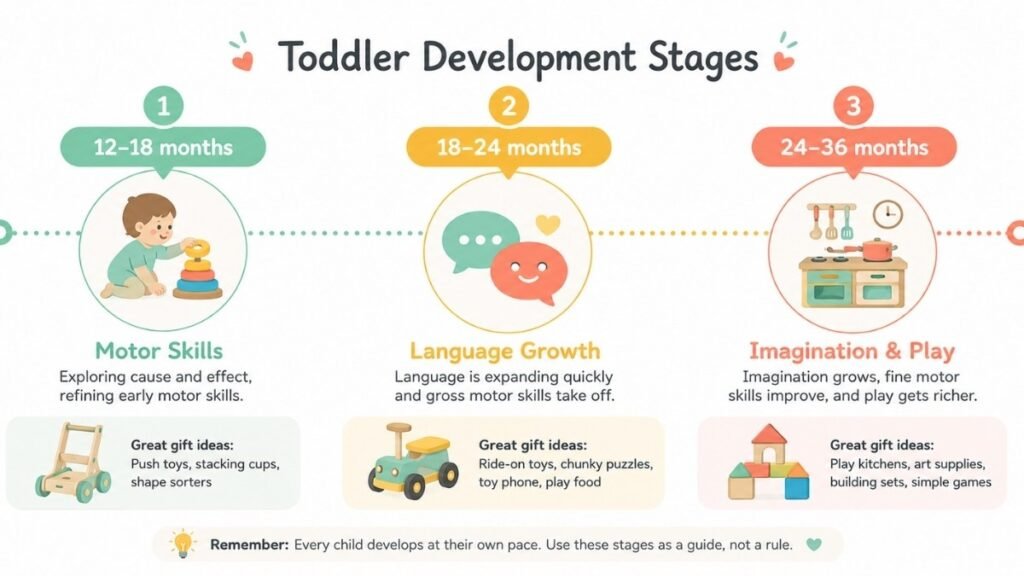
At this stage, toddlers are exploring cause and effect, refining early motor skills, and starting to understand simple words and instructions. Push toys, stacking cups, and simple shape sorters tend to be the biggest hits. For more specific picks, developmental toy guide for 1-year-olds and our complete guide to gifts for 1-year-olds go into more detail.
18–24 Months
Language is expanding quickly and gross motor skills — climbing, running, kicking — are taking off. Ride-on toys, chunky puzzles, and early pretend play props like a toy phone or play food tend to fit well here. Gifts for 2-year-olds covers this window more fully.
24–36 Months
Imagination really takes off during this stage. Pretend play becomes more elaborate, fine motor control improves enough for early art projects, and toddlers start to enjoy simple turn-taking games. It’s worth reading what 2-year-olds actually need from their toys as well as gifts for 3-year-old boys and girls, since needs shift quickly through this range.
Age vs Development vs Recommended Gift Types
| Age Range | Key Development | Recommended Gift Types |
|---|---|---|
| 12–18 months | Cause and effect, early motor skills | Push toys, stacking cups, shape sorters |
| 18–24 months | Language growth, gross motor skills | Ride-on toys, chunky puzzles, early pretend play props |
| 24–36 months | Imagination, fine motor control | Play kitchens, art supplies, building sets, simple games |
Many parents find that a gift which felt too advanced at first is exactly right just a couple of months later. It’s rarely worth returning something right away — sometimes a toy just needs to sit on the shelf a little longer before it clicks.
Key takeaway: Developmental readiness matters more than the age printed on the box.
What Are the Best Gifts for Toddlers Who Already Have Too Many Toys?
Short answer: when a toddler already has plenty of toys, consumable gifts, books, memberships, and personalized keepsakes are usually more appreciated than another toy — and they’re far less likely to add to the clutter.
Why adding more toys isn’t always better
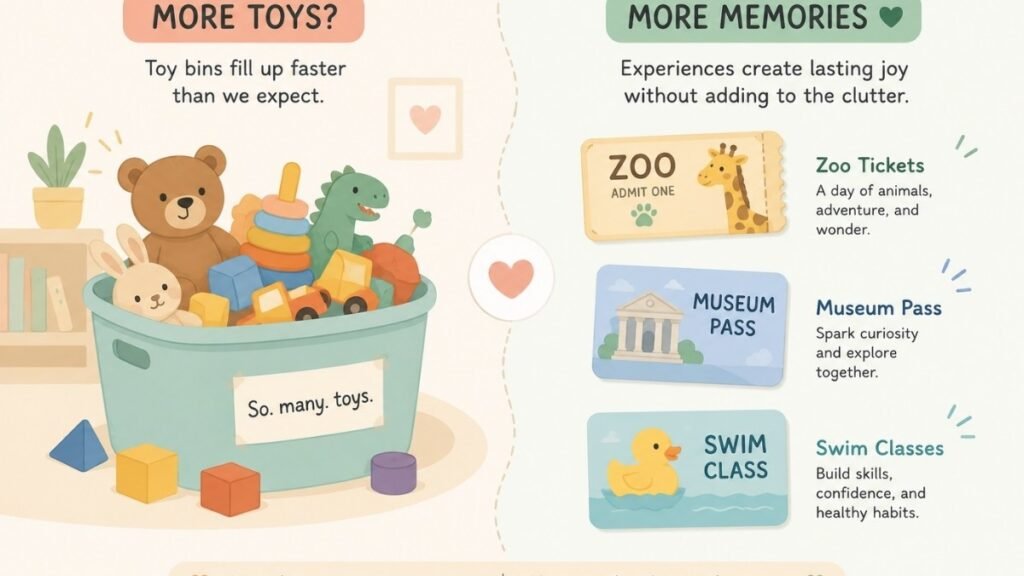
Toy clutter is one of the most common frustrations parents run into, especially after a birthday or holiday season where several gifts arrive at once. Beyond the mess, too many toys at once can actually make it harder for a toddler to focus and engage deeply with any single one — a phenomenon that’s led many families toward a smaller, higher-quality rotation instead of a constantly growing pile.
Experience Gifts
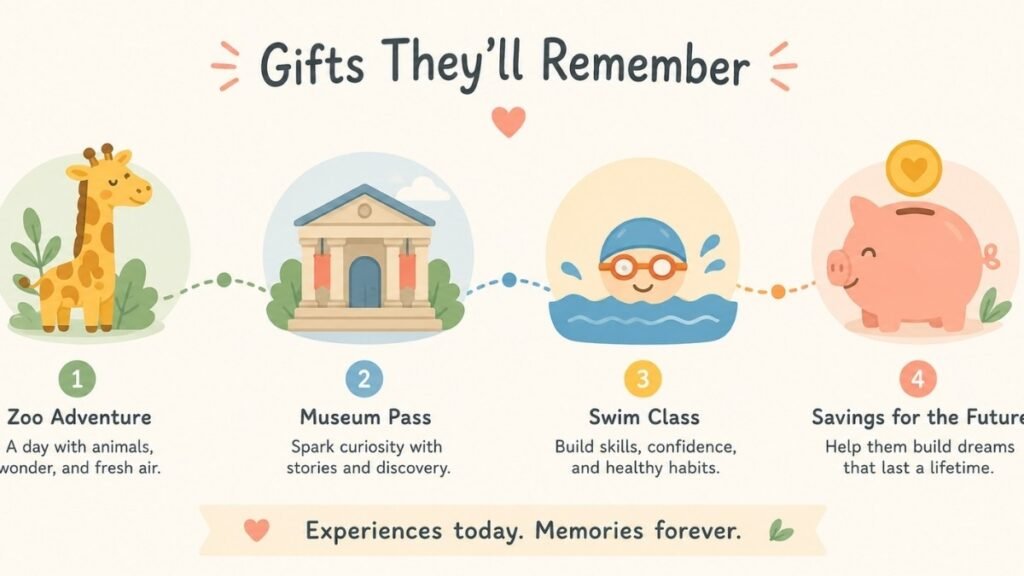
Zoo passes, museum memberships, or a class package (swim, music, movement) give a family something to look forward to without taking up shelf space. These tend to be some of the most memorable gifts a toddler receives, even if they don’t remember it years later — the parents usually do.
Consumable Gifts
Art supplies, bath toys that eventually wear out, and dress-up costumes are “used up” rather than accumulated, which makes them a popular choice for families actively trying to reduce toy volume.
Meaningful Keepsakes
Personalized books, growth charts, or a keepsake box are gifts that add sentimental value without contributing to the toy pile — and they tend to be treasured well beyond the toddler years.
A practical tip for grandparents and relatives: if you’re not sure whether a family wants more toys, it’s completely reasonable to ask directly, or to suggest a class, membership, or experience instead. Most parents welcome the question rather than finding it awkward — it usually solves a problem they’ve been quietly trying to figure out how to raise themselves.
For families managing an already-full toy shelf, setting up a simple toy rotation can also help existing toys feel new again — our guide on how to start a toy rotation system covers this in detail.
Key takeaway: Sometimes the best toddler gift isn’t another toy.
What Non-Toy Gifts Do Parents Actually Appreciate?
Short answer: learning towers, books, subscription boxes, and practical everyday items like personalized towels or backpacks are consistently among the most appreciated non-toy gifts for toddlers.
Practical, everyday gifts
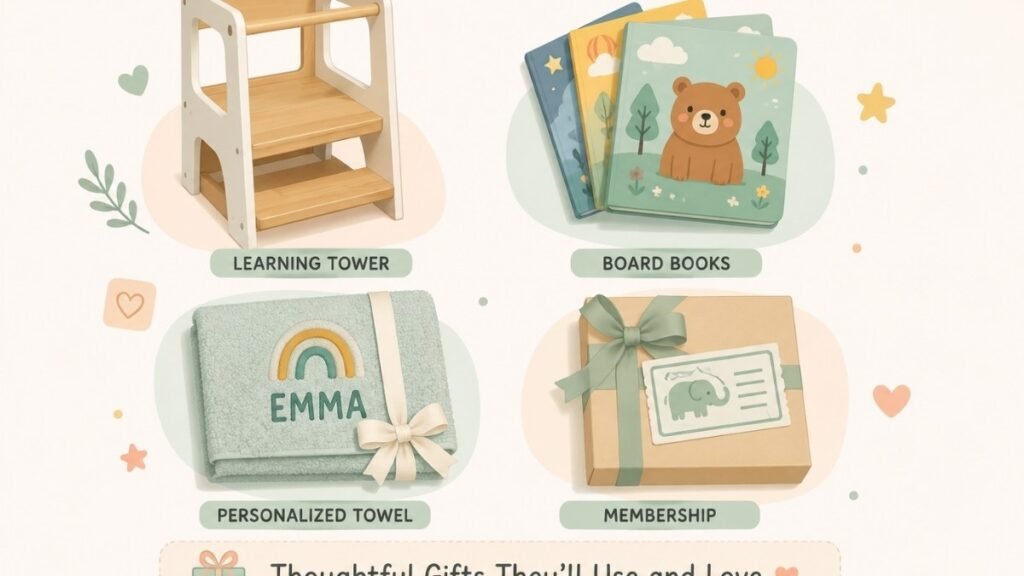
A learning tower is a standout in this category — it supports independence in the kitchen and tends to get used daily, not just occasionally. Personalized towels, water bottles, and backpacks fall into the same category: useful, low-clutter, and genuinely helpful for daily routines.
Books and subscription boxes
Board books rarely get “outgrown” the way toys do, and a well-loved one often stays in rotation from age one through preschool. Subscription boxes geared toward toddlers can also be a good middle ground for families who want ongoing novelty without a single big toy purchase.
Bigger, longer-term gifts
Zoo and museum memberships, swim or music lesson packages, and even contributions to a 529 education savings plan are gifts that keep giving well beyond the day they’re given.
Best Non-Toy Gifts Comparison
| Gift Type | Best For | Why It Works |
|---|---|---|
| Learning tower | Everyday use | Builds independence, gets used daily |
| Board books | Any age, any occasion | Long-lasting, low cost, no clutter |
| Subscription box | Ongoing novelty | Regular new activities without overbuying |
| Zoo/museum membership | Repeated experiences | Shared family time, no physical clutter |
| 529 savings gift | Long-term value | Grows over time, no storage needed |
It’s surprisingly common for parents to say, after the fact, that a practical gift like a learning tower ended up being used more than any toy from that same birthday. These gifts don’t always feel as exciting to give, but they tend to earn their place in daily life quickly.
Key takeaway: Practical gifts often become family favorites.
What Toys Keep Toddlers Busy Without Screens or Noise?
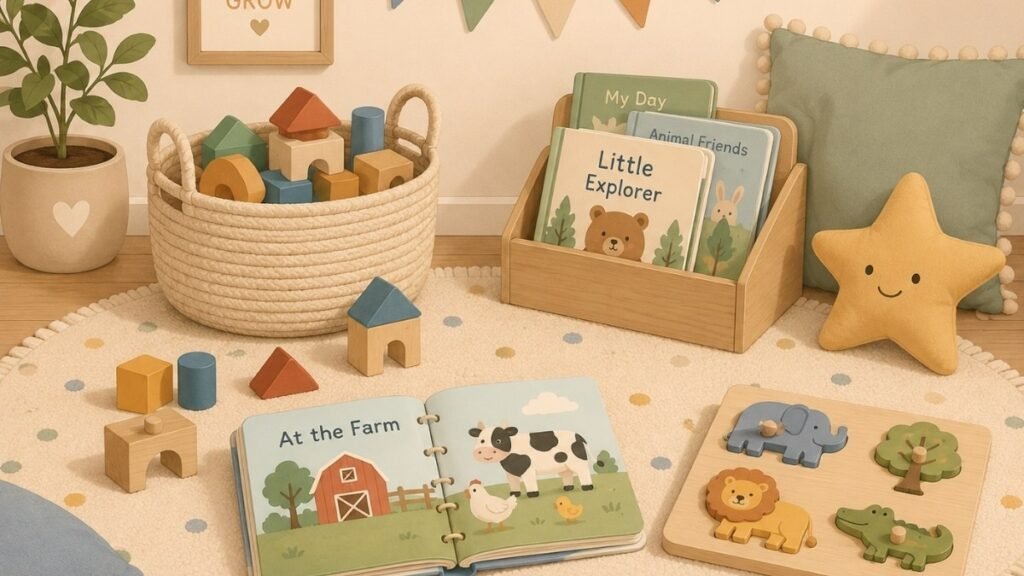
Short answer: busy books, wooden blocks, magnetic tiles, chunky puzzles, and simple art supplies are the most reliable toys for quiet, independent, screen-free play.
Best Quiet Toys
Busy books and magnetic drawing boards are especially good at holding a toddler’s focus without relying on sound or a screen. Because they don’t reset or “finish,” toddlers can return to them again and again across a single day.
Best Independent Play Toys
Wooden blocks, simple building sets, and puzzles work well because they don’t require constant adult involvement once a toddler understands how to use them. These are also some of the same toys that show up repeatedly in the open-ended and building toys for toddlers categories, since independent play and open-ended play often overlap.
Best Travel Toys
Compact busy boards, sticker books, and small magnetic sets travel well for car rides, flights, and restaurant waits, since they’re contained and mess-free. Our travel toys for toddlers guide covers more options built specifically for on-the-go use.
Quiet Toy Checklist
- [ ] No sound, or a mute/volume option
- [ ] Low mess — no loose glitter, beads, or spill-prone parts
- [ ] Genuinely holds attention without adult involvement
- [ ] Compact enough to pack away or travel with easily
In everyday use, many parents find that the toy which actually buys them 20–30 minutes of quiet — while cooking dinner or taking a work call — isn’t the one marketed as an “activity toy.” It’s often something simple, like a sticker book or a set of chunky puzzles the child already knows how to use on their own.
Key takeaway: The best toys engage children without overwhelming parents.
Are Magnetic Tiles Worth Buying for Toddlers?
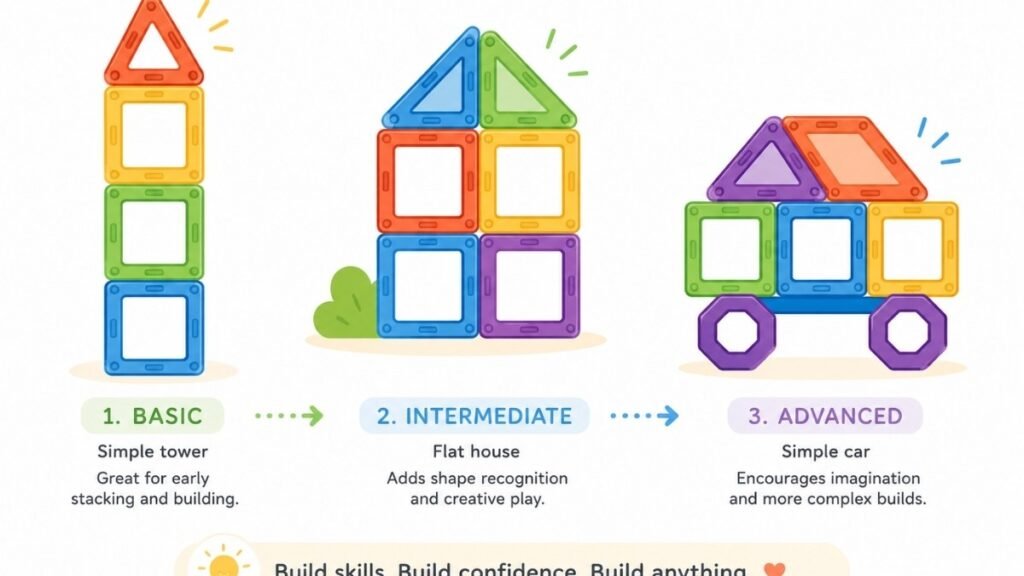
Short answer: yes, for most toddlers around 18–24 months and older, magnetic tiles are one of the better toy investments available — as long as safety and supervision are taken seriously.
Safety First
Magnetic tiles are generally safe for toddlers when the pieces are large, well-sealed, and free of cracks or loose magnets. It’s worth doing a quick inspection every so often, since repeated drops can occasionally weaken the seal on individual tiles.
Brand Comparison
Premium brands tend to use stronger magnets and thicker, more durable plastic, which usually means the set holds up better over years of heavy use. Budget sets can still be a reasonable way to test whether a toddler is genuinely interested in building before investing in a larger collection.
How Long They’ll Last
A quality set of magnetic tiles can realistically stay in rotation for four to eight years, since the way a child plays with them evolves — from simple stacking around age two to more complex structures by age five or six.
Premium vs Budget Magnetic Tiles
| Feature | Premium Brands | Budget Brands |
|---|---|---|
| Magnet strength | Strong, consistent | Variable |
| Durability | High | Moderate |
| Price | Higher | Lower |
| Best for | Long-term family use | Testing interest first |
It’s fairly common for parents to hold off on a full magnetic tile set until closer to age three, even though many sets are labeled for younger toddlers — simply because younger toddlers require closer supervision, and the investment tends to pay off more once a child can build more independently. Even with excellent durability, supervision still matters at the younger end of the age range, since any damaged piece can pose a swallowing risk.
Key takeaway: Magnetic tiles offer excellent long-term value when used safely.
How Can You Give Experience Gifts to Toddlers?
Short answer: experience gifts — like memberships, classes, and future-focused contributions — can be given directly as gift certificates, family passes, or creatively wrapped tickets and vouchers.
Local Memberships
Zoo passes, children’s museum memberships, and indoor playground memberships are easy to purchase directly and tend to get used repeatedly throughout the year, unlike a toy that’s played with once and set aside.
Classes
Swim lessons, music classes, and movement or dance classes make thoughtful gifts, particularly from grandparents or extended family who want to contribute to a child’s development in a lasting way.
Future Gifts
Contributions to an education fund are a less flashy but genuinely valuable option for readers looking for a longer-term gift, especially for milestone occasions like a first birthday.
A simple way to make an experience gift feel exciting to unwrap: put a printed voucher, a small stuffed animal representing the experience (like a plush zoo animal for a zoo pass), or a photo card into a small box. Toddlers won’t understand the gift itself right away, but the moment still feels celebratory for the whole family.
Key takeaway: Experience gifts often create memories that outlast traditional toys.
Best Toddler Gifts by Budget
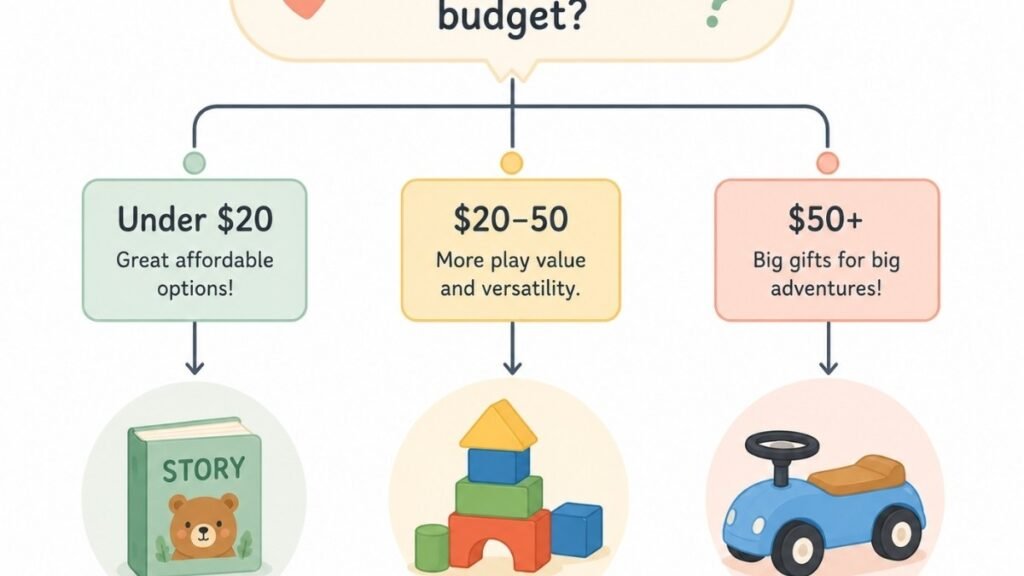
Budget matters, and fortunately, price doesn’t always predict how much a gift actually gets used.
Under $20: Board books, simple shape sorters, chunky puzzles, and washable crayons are reliable, well-used gifts in this range.
$20–50: Solid pretend play props, mid-size building sets, and quality art supplies fit comfortably here without a major investment.
$50+: Larger building or magnetic tile sets, quality ride-on toys, and full play kitchens tend to land in this tier — often as the “main” gift for a birthday, or a bigger contribution from grandparents.
Budget Comparison
| Budget | Best Gift Types | Good For |
|---|---|---|
| Under $20 | Books, puzzles, simple sorters | Stocking stuffers, “just because” gifts |
| $20–50 | Pretend play sets, art supplies | Birthdays, small holidays |
| $50+ | Building sets, tile collections, ride-on toys | Main birthday gift, grandparent gifts |
A higher price can deliver genuinely better long-term value in certain categories — magnetic tiles are a good example, since a larger starter set unlocks far more building possibilities than a small add-on pack. But that’s more the exception than the rule; a well-chosen $15 puzzle can easily outlast a $150 toy that doesn’t fit the child’s interests. For readers exploring affordable options across categories, our guide to affordable educational toys is a helpful next stop.
Key takeaway: Every budget can provide meaningful toddler gifts.
Toddler Gift Safety Checklist Before You Buy
Short answer: before giving any toy to a toddler, check it against ASTM F963 safety standards, confirm it’s free of small or detachable parts, made from non-toxic materials, and appropriately sized for the child’s actual age and stage.
A few practical ways to check safety at home before wrapping anything:
- Do the paper towel roll test. If a toy or piece fits through a standard paper towel roll, it’s considered a choking hazard for children under three.
- Check for BPA-free and non-toxic labeling, especially for anything a toddler is likely to mouth.
- Inspect for sharp edges or splintering, particularly on wooden toys after repeated use.
- Check magnets and batteries regularly for looseness or damage.
- Consider volume levels on electronic toys, and use tape over speakers if needed to reduce noise without disabling the toy.
- Confirm the toy is easy to clean and store, especially for gifts likely to be mouthed or used during meals.
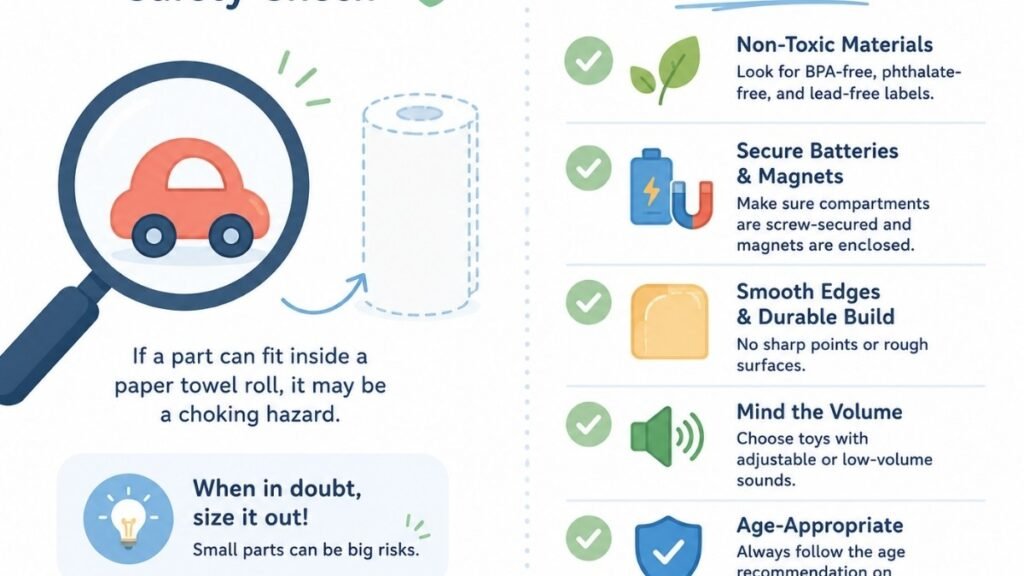
Complete Safety Inspection Checklist
- [ ] Passes the paper towel roll test
- [ ] Labeled non-toxic / BPA-free
- [ ] No sharp edges or splintering
- [ ] Magnets and batteries are secure
- [ ] Volume is reasonable or adjustable
- [ ] Meets ASTM F963 safety standards
- [ ] Age labeling matches the child’s actual stage, not just their birthday
A helpful habit to build into gift-giving season: run a quick, five-minute safety check on any toy before wrapping it, even gifts from trusted family members. Manufacturing standards are generally solid, but individual units can occasionally slip through with a loose part, and a quick check at home closes that gap. If art supplies or sensory materials are part of the gift, it’s worth confirming they qualify as non-toxic toys and play materials before handing them over. For families with both a toddler and a baby, cross-checking sensory toys for babies safety guidance is also worthwhile, since age ranges often overlap in multi-child households.
Key takeaway: No gift is worth buying if it isn’t safe.
Frequently Asked Questions
What are the best gift ideas for toddlers who already have too many toys? Experience-based gifts — museum memberships, swim lessons, music classes — tend to be the most appreciated in this situation, since they don’t add to clutter but still create meaningful shared time. Consumable gifts and personalized keepsakes are also strong choices when toy shelves are already full.
What non-toy gifts can I buy for a 2 or 3-year-old? A learning tower, board books, personalized towels or bedding, and memberships to a zoo or children’s museum are all well-received. These gifts tend to support daily life or ongoing experiences rather than adding another single-use toy to the pile.
What toys will keep a toddler entertained for independent play without noise or screens? Busy books, magnetic drawing boards, chunky puzzles, and simple building sets are the most reliable options. Look for toys that don’t require constant adult involvement and can be put away easily, since that combination is what actually creates real stretches of independent play.
Are magnetic tiles worth buying for a toddler, and at what age can they start playing with them? Yes, for most children starting around 18–24 months, with close supervision at the younger end of that range. Magnetic tiles offer strong long-term play value, especially with premium sets that hold up over years of building.
How can I gift experiences or memberships to a toddler and their family? Zoo passes, children’s museum memberships, and class packages (swim, music, or movement classes) can be purchased directly or as gift certificates. These create repeated, shared experiences rather than a single moment of unwrapping.
What are good travel-friendly toddler gifts for car rides, flights, and restaurants? Compact busy boards, sticker books, and small magnetic or puzzle sets travel well because they’re mess-free, quiet, and easy to pack. Avoid gifts with many loose pieces, since those are difficult to manage in a car seat or on an airplane tray table.
What practical household items or learning tools make great gifts for toddlers? A learning tower, personalized towels or bedding, and simple daily-use items like a step stool can genuinely make family life easier while still feeling like a thoughtful, considered gift.
What art supplies and consumable gifts are safe and clean for toddlers? Chunky, washable crayons, non-toxic paint, and water-drawing books are generally the safest and easiest to manage for toddlers. Checking labels for non-toxic certification is especially important for anything a toddler is likely to mouth or handle repeatedly.
Final Thoughts
The best toddler gift isn’t the most expensive one, and it isn’t necessarily a toy at all. It’s the one that’s genuinely safe, fits where your child is developmentally right now, and either earns a place in their everyday play or adds real value to family life without adding to the clutter. When a toddler already seems to have everything, that’s usually the moment to think beyond the toy aisle — not to stop giving thoughtfully.
🏠 Behind This Guide
Choosing gifts for toddlers isn’t about buying more toys—it’s about choosing the right ones. This guide focuses on three things that matter most to parents:
- 🛡️ Safe Choices — Age-appropriate toys, trusted safety standards, and practical buying tips.
- 🧸 Play That Lasts — Open-ended gifts that grow with toddlers instead of being forgotten after a few days.
- 🌱 Learning Through Play — Toys that naturally encourage creativity, problem-solving, and everyday development.
Because the best toddler gifts aren’t always the biggest or the most expensive.
They’re the ones children keep coming back to.
📚 Continue Exploring Toy Guides
Finding the right gift is just the beginning. Explore more guides to choose toys that match your child’s age, interests, and stage of development.
🎂 Browse Gift Guides by Age
- Best Gifts for 1-Year-Olds
- Best Gifts for 2-Year-Olds
- Best Gifts for 3-Year-Olds
- Best Gifts for 4-Year-Olds
- Best Gifts for 5-Year-Olds
- Best Gifts for 6-Year-Olds
🎁 Seasonal Gift Guides
🧩 Explore More Toy Guides
- Best Toddler Toys: The Complete Guide
- Educational Toys: What Actually Develops Your Child
- Best Baby Toys: From Newborn to 12 Months
❤️ A Final Note
The best toddler gifts aren’t always the biggest or the most expensive—they’re the ones children reach for again and again.
At Toizora, we believe every toy should spark curiosity, support healthy development, and make everyday play more meaningful.
Our goal is simple: helping families choose safe, educational toys with confidence.