
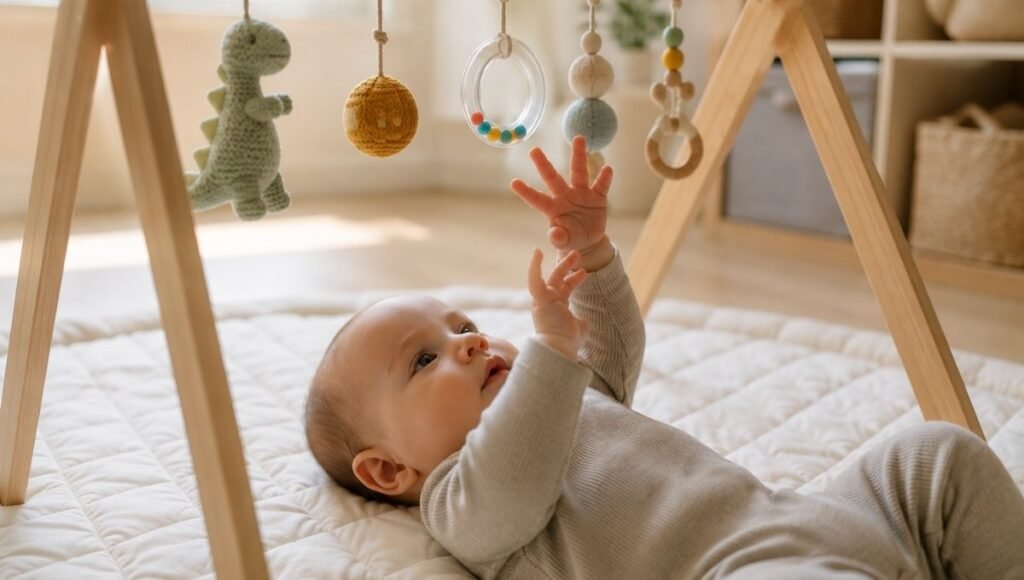
Before my first baby was born, I spent an embarrassing amount of money on toys.
I had things with lights. Things with sounds. Things that claimed to “stimulate neural development” on the box. I had a baby gym that took forty-five minutes to assemble. I had a mobile that played seventeen different lullabies. I had stacking rings, a sensory ball set, a cloth book, two different rattles, and — I am not making this up — a toy that was specifically marketed as a “cognitive development system.”
My daughter ignored all of it for the first three months and stared at the ceiling fan.
This is almost universal. New parents over-buy baby toys because (a) the anxiety of wanting to give your baby everything they need is real, and (b) the baby toy industry is extremely good at making parents feel like the right toy will give their child a meaningful developmental advantage. It mostly won’t. But the wrong toy at the wrong stage can genuinely be a waste of money — and this guide is about helping you avoid exactly that.
The best baby toys aren’t the most expensive or the most feature-packed. They’re the ones matched to where your baby actually is right now — what they can see, what they can hold, what their brain is ready to process. Get that right, and a $10 rattle delivers more developmental value than a $60 electronic contraption.
Key Takeaways
- Newborns can only see clearly at 8–12 inches. This is exactly the distance to a caregiver’s face. High-contrast toys work for newborns not because they’re trendy but because they match the actual capacity of a newborn’s visual system.
- Babies don’t need many toys. Research from Zero to Three consistently shows that presenting too many toys at once reduces the quality of engagement with any single one. 2–3 age-appropriate toys at a time is enough.
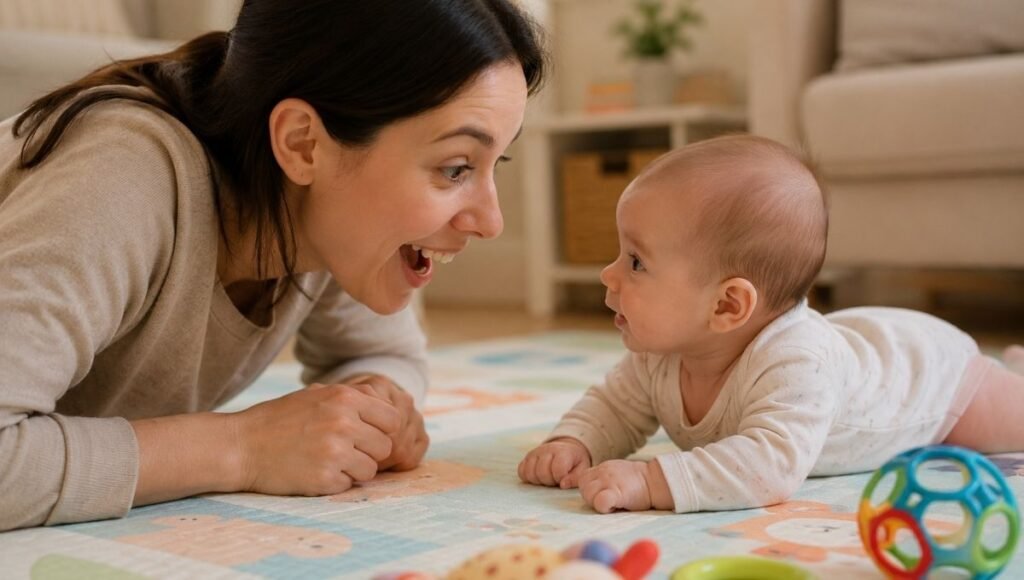
- The best baby toy is you. The American Academy of Pediatrics is unambiguous: responsive caregiver interaction during play produces more developmental benefit than any toy. The toy is the prop; your presence is the teacher.
- Safety is non-negotiable and specific. For babies under 12 months: no parts smaller than 1.75 inches, no button batteries, no strings over 12 inches, no liquid-filled components, BPA-free and phthalate-free materials throughout.
- Every stage has a different answer. The toy that’s perfect at 2 months is boring at 5 months and irrelevant at 9 months. This guide breaks it down by developmental stage so you buy what’s actually useful right now.
Why Most Baby Toy Lists Get This Wrong
Here’s the thing nobody says in the baby toy guides: most babies don’t need what’s being sold to them. Not because toys are bad, but because the marketing cycle has disconnected the toys from the actual developmental stages they’re supposed to serve.
A “developmental mobile” for a newborn is genuinely useful — but only if it has high-contrast patterns and is placed at the right distance. A soft pastel mobile with tiny figurines 18 inches overhead does essentially nothing for a baby who can only see 8–12 inches clearly and needs contrast, not color.
An “educational” toy that talks, sings, and flashes is technically engaging — but engagement isn’t the same as learning. A toy that does all the work doesn’t require the baby to do any of it.
The r/ScienceBasedParenting community has wrestled with this extensively: parents come in overwhelmed by options and leave with a consistent answer — simple, appropriately matched, and minimal. The research backs this up consistently.
So let’s talk about what actually matters, stage by stage.
Best Baby Toys for Newborns (0–3 Months): Almost Nothing
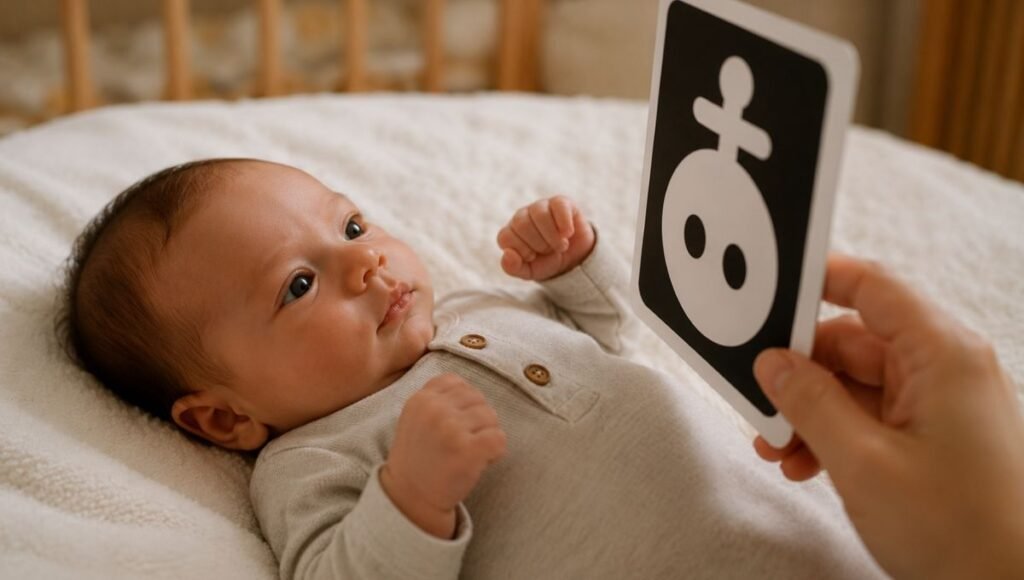
This is hard for new parents to hear, but it’s genuinely true: newborns need almost nothing in the way of purchased toys. What they need is you, your face, your voice, and occasionally a high-contrast visual stimulus.
Here’s why. At birth, a baby’s visual system can focus clearly at 8–12 inches — the distance to your face when you’re holding them. Their color vision is barely functional. What they can perceive clearly is contrast: the boundary between dark and light. This is why high-contrast toys work — they match the actual biology.
Everything else in the newborn toy market — the pastels, the soft colors, the gentle patterns — looks appealing to adult eyes and does very little for newborn ones.
What Actually Works (0–3 Months)
High-contrast black and white books and cards A soft book or set of cards with bold black-and-white geometric patterns, placed 8–12 inches from your baby’s face during alert windows, actively develops the optic nerve and visual processing pathways. This isn’t a metaphor — it’s measurable neurology.
Hold it up during tummy time. Prop it against a pillow during diaper changes. Use it to give your baby something to focus on during those brief alert periods between feeding and sleeping.
A high-contrast mobile Not the musical pastel kind. A mobile with bold black-and-white patterns or high-contrast colors (red reads particularly well for newborns), positioned within 8–12 inches of where your baby can actually see it. Many commercial mobiles are positioned too far away and have colors that newborns can’t yet distinguish — beautiful for the Instagram photo, useless for the baby.
A soft rattle — for you to use At 0–2 months, babies can hear but can’t yet reach for things. A soft rattle that you shake slowly near their ear and across their visual field gives them auditory and visual tracking practice simultaneously. The gentleness matters — sudden loud sounds are genuinely startling and stressful for very young babies.
Your face I mean this completely seriously. Your face — animated, responsive, making expressions and sounds — is the most developmentally potent “toy” a newborn has. Face-to-face interaction at this age is building the social brain architecture that everything else will depend on. No purchased toy comes close.
Infant Toys for 3–6 Months: Reaching, Grasping, Discovery
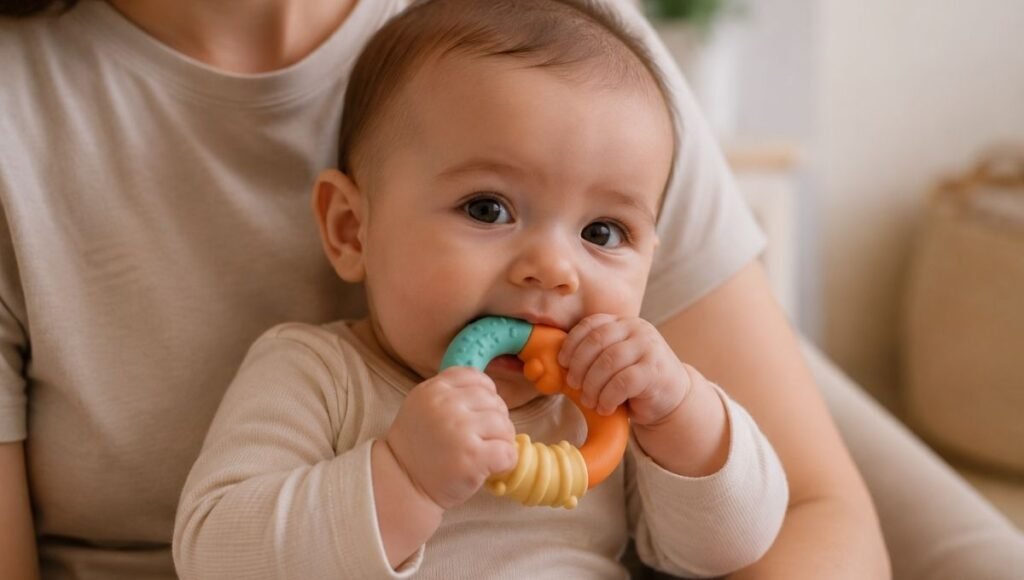
Around 3 months, something shifts dramatically. Your baby starts reaching. Not swiping randomly at the air — actually, intentionally reaching for things they can see. This is one of the most significant motor developments of the first year, and it changes everything about what toys are useful.
This is also when cause-and-effect understanding begins: I hit that thing, and it moved. I shook this thing, and it made a sound. These simple discoveries are profound cognitive events — the beginning of understanding that actions have predictable consequences.
What Actually Works (3–6 Months)
A play gym A play gym — the kind with a mat and a frame with hanging toys — is the workhorse of this stage. The hanging toys give your baby something to reach for, bat at, and eventually grip. When they bat a toy and it swings and makes a sound, they’re running a physics experiment. The mat supports tummy time. This is one of the few baby toys that earns its price over several months of genuine daily use.
Look for a gym with hanging elements at different heights (to challenge reaching in different directions), a mix of textures and sounds among the dangling toys, and a mat large enough to accommodate rolling as your baby’s mobility increases.
Soft rattles designed for small hands By 3–4 months, babies are developing the ability to grasp — and a rattle they can hold, shake, and bring to their mouth satisfies multiple developmental needs simultaneously. Choose rattles with smooth, easy-to-grip shapes (rings and dumbbells work better than irregular shapes), gentle sounds (not loud plastic clickers), and completely safe-for-mouthing materials.
Textured teethers and sensory toys Teething typically begins around 4–6 months, and everything goes in the mouth from here forward. A silicone teether with varied textures is simultaneously a teething tool and a sensory learning experience. Food-grade silicone is the gold standard — easy to sterilize, safe to chew, available in a huge variety of textures.
Safety note: Chill silicone teethers in the refrigerator (not the freezer) for 15 minutes before offering. Frozen teethers can be too hard for delicate gum tissue.
Soft fabric books At 4–5 months, babies can begin to engage with soft books — not “reading” in any conventional sense, but exploring the physical object, turning pages with increasing intentionality, and responding to the simple faces and high-contrast images inside. Choose books with thick, soft pages that can survive mouthing, lift-the-flap elements for fine motor practice, and simple, bold images.
Best Baby Toys for 6–9 Months: Sitting, Exploring, Object Permanence
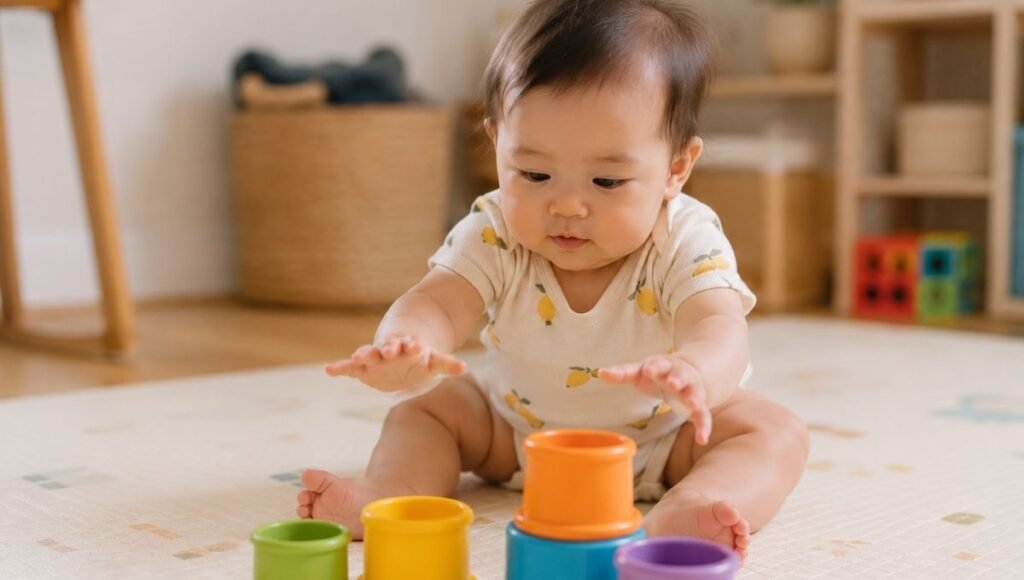
Six months is a developmental pivot point that Reddit parents know well. The baby who needed constant holding has become a baby with opinions, motor skills, and a deeply inconvenient interest in every object in the room that isn’t a toy.
By 6 months, most babies can sit with support, transfer objects between hands, and are developing one of the most cognitively significant concepts of infancy: object permanence. The idea that things continue to exist when they’re out of sight. This is why peek-a-boo becomes fascinating around this age — it’s not just a game, it’s a concept being practiced.
What Actually Works (6–9 Months)
Stacking cups The humble stacking cup is one of the most versatile, developmental, and consistently recommended baby toys that exists. At 6 months, your baby is mostly banging, mouthing, and removing cups from a stack. By 9 months, they’re beginning to attempt nesting. By 12 months, early stacking begins.
One toy. Multiple developmental skills. Long play arc. Low price.
Activity cubes A multi-sided activity cube with different interactive elements on each face — bead mazes, shape sorters, gears, doors — is excellent for this stage when placed in front of a sitting baby. The activities give them something purposeful to do with their hands while their core muscles get a workout from holding the sitting position.
Simple cause-and-effect toys At 6–9 months, the cause-and-effect understanding that began at 3 months has developed significantly. Toys that respond to a specific action — press this, hear that; push this, see that — are now deeply engaging because your baby can now intentionally produce the effect and delight in doing so repeatedly. This repetition isn’t boring to them; it’s scientific verification.
Balls of various textures A small collection of soft balls with varied textures — bumpy, smooth, ridged, squeezable — is a complete sensory learning experience at this age. Rolling them back and forth with a caregiver builds social turn-taking, language, and gross motor coordination simultaneously. Choose balls larger than 1.75 inches in diameter.
Soft books with flaps and textures By 7–8 months, babies are more intentional with books — turning pages, lifting flaps, responding to familiar images with recognition. The language exposure during shared reading at this age has measurable effects on vocabulary at age 2 and beyond, according to research from the American Academy of Pediatrics.
Newborn Toys vs Infant Toys: What Changes and When
This question comes up constantly in parent communities, and the confusion is understandable because the industry labels toys by age range but doesn’t always explain why the range is what it is.
Here’s the developmental logic:
| Age | Primary Development | Toy Needs |
|---|---|---|
| 0–2 months | Visual system development | High-contrast visuals at 8–12 inches |
| 2–4 months | Visual tracking, early grasping | Tracking stimuli, things to swipe at |
| 3–5 months | Intentional reaching, cause-effect begins | Hanging toys to reach, soft rattles to grasp |
| 5–7 months | Grasping, mouthing, sitting beginning | Graspable toys, teethers, activity cube |
| 6–9 months | Object permanence, sitting, transfer | Stacking cups, balls, cause-effect toys |
| 9–12 months | Crawling, pulling up, pincer grasp | Push toys, simple shape sorters, board books |
The key insight: baby toys become inappropriate not when babies outgrow the age label, but when they outgrow the developmental stage the toy addresses. A high-contrast book is “newborn” labeled but stays useful for visual development through about 4–5 months. A shape sorter is labeled “6 months” but becomes genuinely engaging much closer to 12 months for most babies.
Best Infant Toys: The Ones That Actually Earn Their Space
After two children and years of watching parents navigate the baby toy overwhelm, these are the specific toy types that consistently justify their purchase:
Play gym with hanging toys — highest use-per-dollar ratio of any baby product in the 2–6 month window. Gets used daily, multiple times a day, for months.
Stacking cups — use begins at 5–6 months and doesn’t really end until age 4. Different play at every stage.
Silicone teethers in varied shapes — functional from about 3 months onward, used intensively during teething peaks (typically 4–8 months), and safe for mouthing in a way that many other toys aren’t.
Soft fabric books — appropriate from birth (high-contrast) through toddlerhood (reading together). Genuinely one of the best investments in any toy budget.
A soft, gentle rattle — the first interactive toy for most babies. Simple, safe, effective.
What doesn’t earn its space:
Electronic learning systems for babies under 12 months — the AAP is clear that passive electronic stimulation for babies produces significantly less developmental benefit than interactive play with a caregiver.
Musical mobiles with lots of colors and figurines — looks appealing to adults, does little for actual baby development at the stage mobiles are used.
Jumpers and exersaucers for very young babies — these are genuinely controversial in pediatric circles. The AAP advises against sit-in baby walkers. Jumpers, while not explicitly contraindicated, replace floor time that supports neck, core, and motor development. Use sparingly, not as a primary play station.
Safety: What Every Baby Toy Must Meet
This section matters more than any specific product recommendation. A toy that fails basic safety requirements isn’t a baby toy — it’s a hazard.
For all baby toys:
- ASTM F963 compliance — the U.S. toy safety standard, required by law
- CPSC certification — Consumer Product Safety Commission oversight
- BPA-free and phthalate-free for all plastics
- Non-toxic, water-based finishes on any wooden components
The non-negotiable size rule: If any part of a toy — or any piece that could detach — fits through a toilet paper tube (approximately 1.25 inches in diameter), it is a choking hazard for babies under 3 years.
The button battery rule: Button batteries can cause catastrophic internal injuries if swallowed. Any toy with button batteries must have a battery compartment secured with a screw — not snapped shut. Test this before every battery change.
No strings over 12 inches. Strangulation hazard, full stop.
No liquid-filled components. They can leak, harbor bacteria, and be dangerous if punctured.
For mouthing toys specifically:
- Food-grade silicone or natural rubber (100% natural, free from chemical fillers)
- No painted or printed details that could flake
- No small detachable decorative elements
Regular inspection matters. Toys that were safe when purchased can become unsafe through wear. Check all baby toys weekly for cracks, tears, loose parts, or any deterioration.
The “Too Many Toys” Problem (And What to Do Instead)
One of the most consistent findings in the parent communities I follow is this: babies and toddlers who have access to many toys simultaneously often engage more superficially with each one. The overwhelm is real.
The research supports this. Zero to Three’s play research consistently shows that young children benefit from a small, rotating selection of age-appropriate toys rather than a room full of options. A “new” toy to a baby is one they haven’t seen in two weeks.
The practical approach: Keep 3–4 toys accessible at any time. Store the rest. Rotate every 2–3 weeks. When you bring out a stored toy, your baby will engage with it as if it’s new — because to them, it essentially is.
This isn’t deprivation. It’s optimization.
Frequently Asked Questions
What are the best toys for newborns? Newborns benefit most from: a high-contrast black-and-white book or card set (placed 8–12 inches from their face), a high-contrast mobile positioned within their focal range, a soft low-sound rattle for you to use near them, and your own animated, responsive face. Genuinely — that’s the complete list for the first two months.
Are electronic baby toys bad? Not inherently, but they’re frequently over-relied upon. A toy that produces all of its own input without requiring the baby to do anything — that plays music, flashes lights, and demonstrates things without the baby’s participation — is providing entertainment, not developmental learning. Simple cause-and-effect electronic toys (press button → single clear response) are appropriate; passive electronic entertainment is not developmentally useful at this age.
What are the safest materials for baby toys? Food-grade silicone and natural rubber for anything that will be mouthed. BPA-free, phthalate-free plastics for play toys. Non-toxic, water-based finishes on wooden toys. All toys should be ASTM F963 compliant and CPSC certified. For art materials or sensory items used near babies, ACMI non-toxic certification.
How many toys does a baby need? Far fewer than most parents buy. For newborns: 2–3 items maximum. For 3–6 month babies: a play gym plus 3–4 complementary toys. For 6–12 month babies: 5–7 accessible toys, rotated regularly. More toys don’t produce more development — deeper engagement with fewer appropriate toys does.
My baby ignores every toy I offer. Is something wrong? Almost certainly not. Babies have short, variable alert windows — the time when they’re awake, calm, and ready to engage. Most toy play happens in these windows, which can be as short as 20–30 minutes for a newborn. If you’re offering toys during feeding, fussing, or drowsy periods, they’ll be ignored. Timing matters more than the toy itself.
When should I be concerned about my baby’s development? Talk to your pediatrician if your baby isn’t reaching for objects by 4–5 months, isn’t tracking moving objects with their eyes by 3 months, isn’t responding to familiar voices or faces by 2 months, or has lost abilities they previously had. Early developmental support is significantly more effective than waiting — bring up any concerns at your next well-baby visit.
The Bottom Line
The best baby toys are the ones matched to where your baby actually is right now — not where the marketing says they should be, not where you hope they’ll be in three months.
High-contrast visuals for newborns. Reaching and grasping toys at 3 months. Sitting and cause-and-effect toys at 6 months. Simple early problem-solving toys approaching 12 months.
And underneath all of it: your face, your voice, your response to what they’re doing. No toy in any price range replaces that — and no toy needs to.
Related guides:
- Sensory Toys for Babies: A Stage-by-Stage Guide
- Best Toys for 1-Year-Olds
- Best Toys for 6-Month-Olds
- Best Gifts for 1-Year-Olds
- Educational Toys: The Complete Guide
- Fine Motor Skills Toys
References
- American Academy of Pediatrics (AAP). (2024). The Power of Play: A Pediatric Role in Enhancing Development in Young Children. https://www.healthychildren.org
- Zero to Three. (2025). Best Toys for Babies and Toddlers. https://www.zerotothree.org/resource/best-toys-for-babies-toddlers/
- Centers for Disease Control and Prevention (CDC). (2023). Developmental Milestones: 2 Months, 4 Months, 6 Months. https://www.cdc.gov/ncbddd/actearly/milestones/
- Harvard Center on the Developing Child. (2023). Serve and Return Interaction Shapes Brain Circuitry. https://developingchild.harvard.edu
- National Association for the Education of Young Children (NAEYC). (2024). Good Toys for Young Children by Age and Stage. https://www.naeyc.org
- U.S. Consumer Product Safety Commission (CPSC). Toy Safety. https://www.cpsc.gov