
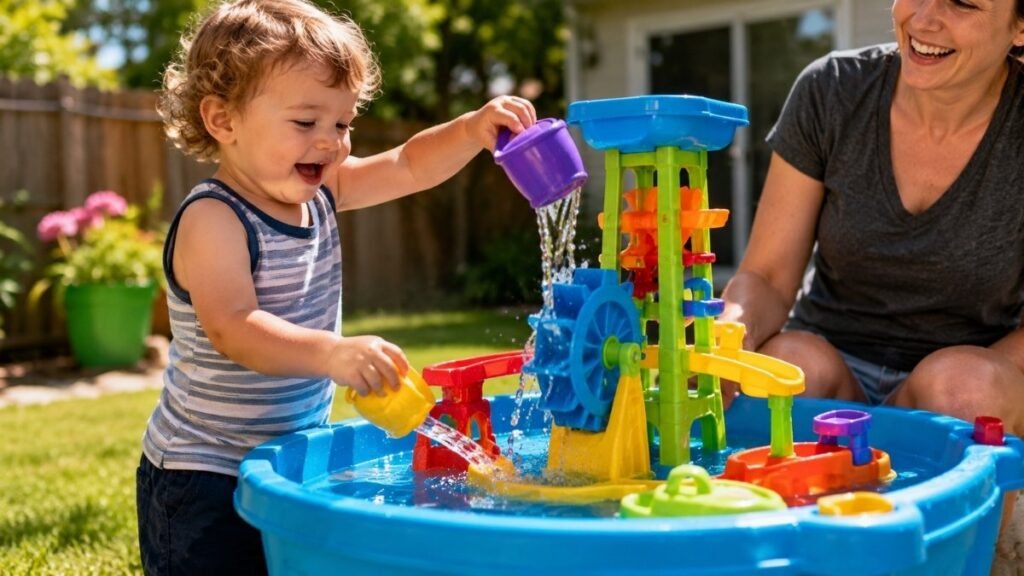
Water tables have earned their place as one of the most popular outdoor toys for toddlers. A simple mix of water, scoops, and spinning wheels can keep kids happily engaged far longer than most toys.
Choosing the right one, however, isn’t as simple. Height, size, stability, cleaning, and age-appropriate features all affect how much use your child will actually get from it.
This guide breaks down how to choose the best water table for kids based on age, safety, available space, and play style, helping you buy with confidence instead of relying on marketing claims.
Quick Answer: Which Water Table Should You Buy?
The right water table depends less on brand and more on your child’s age, your available space, and how many kids will be playing at once. Here’s a fast way to narrow things down before diving into the details:
- Best Overall — a mid-size table with multiple play zones and a water wheel, suited to a wide age range
- Best Budget — a simple single-level table with basic pour-and-scoop features
- Best for Toddlers — a low, stable table with large, easy-to-grip accessories
- Best for Multiple Kids — a larger table with several separate play stations
- Best Small Spaces — a compact or foldable table designed for balconies or patios
- Best Montessori Option — an open-ended table with minimal built-in mechanisms, encouraging independent exploration
- Best Pretend Play — a table designed around a theme, like a boat dock or car wash, that supports imaginative scenarios
Quick Comparison Table
| Category | Best For | Key Feature |
|---|---|---|
| Best Overall | Ages 2–6, general use | Multiple play zones, water wheel |
| Best Budget | Cost-conscious families | Simple pour-and-scoop design |
| Best for Toddlers | Ages 12–24 months | Low height, large stable accessories |
| Best for Multiple Kids | Siblings or playdates | Multiple stations, wider basin |
| Best Small Spaces | Apartments, balconies | Compact or foldable design |
| Best Montessori | Independent, open-ended play | Minimal mechanisms, natural materials |
| Best Pretend Play | Imaginative, story-driven play | Themed design (dock, car wash, etc.) |
Is a Water Table Really Worth It?
The answer is yes—but only when the table matches your child’s age, your available space, and how your child actually likes to play. A well-chosen water table can provide years of sensory and imaginative play, while the wrong one often ends up sitting unused after a few weekends.
Why kids love water tables
Water tables tap into something toddlers are naturally drawn to: predictable cause and effect. Pour water in one spot, watch it move through a wheel or channel, scoop it up, pour it again. That repetition isn’t boring to a toddler — it’s exactly the kind of pattern-based play that supports early problem-solving.
The developmental benefits
Beyond entertainment, water tables support fine motor skills through scooping and pouring, sensory development through temperature and texture, and early cause-and-effect reasoning as kids observe how water moves. For toddlers still building basic coordination, this kind of low-pressure repetition is genuinely valuable — the same category of benefit you’ll see discussed in our guide to sensory toys for babies and toddlers.
Water table vs. kiddie pool vs. DIY sensory bin
A kiddie pool offers more open water play but far less structured, skill-building interaction — it’s mostly splashing rather than pouring, scooping, and directing water flow. A DIY sensory bin (a large tub with water and a few kitchen tools) can replicate a surprising amount of what a water table offers, at a much lower cost, though it lacks the built-in mechanisms like wheels and channels that make dedicated water tables more engaging over time.
Which families benefit most
Families with a consistent outdoor space, a toddler or preschooler with genuine interest in water play, and the ability to manage weekly cleaning tend to get the most long-term value from a water table. Families without much outdoor space, or those unsure whether their child will stay interested, may find a DIY sensory bin or a simple storage tub setup gives nearly the same play value without the investment or storage commitment.
Choose the Right Water Table by Age
The best water table isn’t always the one labeled for your child’s age. Some toddlers are ready for pouring and scooping earlier, while others stay interested longer with a simpler setup. Looking at your child’s developmental stage—not just the age printed on the box—usually leads to a better choice.
12–18 Months
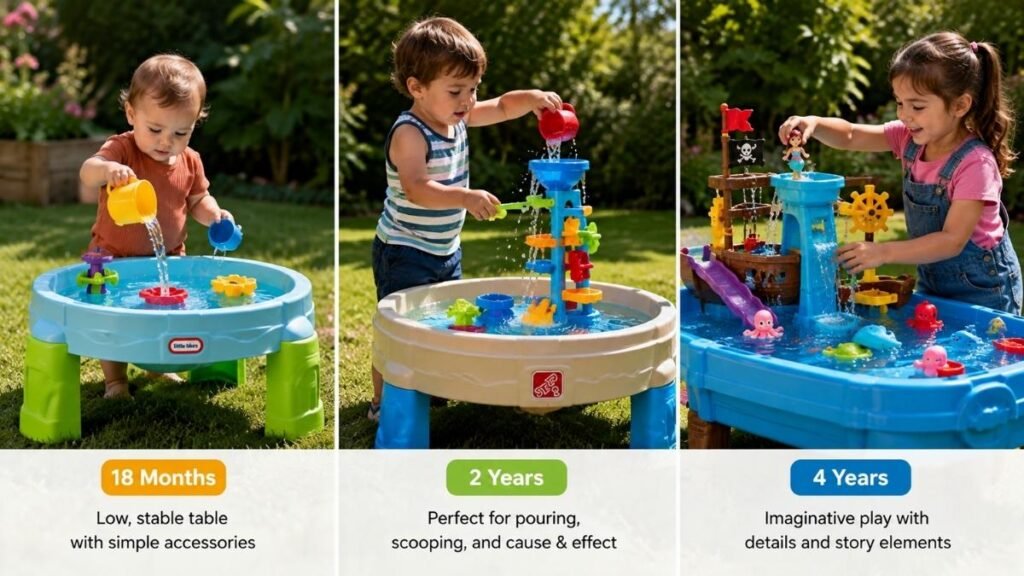
At this age, independent standing is still developing, so stability matters more than features. Look for a low table with a wide, sturdy base and large accessories that are easy to grip — nothing small enough to pose a choking risk if it ends up in a curious mouth.
18 Months–3 Years
This is often the sweet spot for classic water table play — scooping, pouring, and early hand-eye coordination take center stage. Water wheels are especially popular here, since watching cause and effect play out (pour water, watch the wheel spin) tends to hold attention far longer than static features.
3–6 Years
Older toddlers and preschoolers start bringing imagination into the mix — pretend play themes like a boat dock or car wash, multi-level water flow, and cooperative play with siblings or friends become more engaging. Kids this age are also ready to start noticing more complex cause-and-effect patterns, making this a reasonable age to introduce slightly more advanced STEM-style features like locks, gates, or multiple connected channels.
Age & Feature Matrix
| Age Range | Key Skill Focus | Best Features to Look For |
|---|---|---|
| 12–18 months | Balance, stability | Low height, wide base, oversized accessories |
| 18 months–3 years | Pouring, scooping, coordination | Water wheels, simple channels |
| 3–6 years | Pretend play, social play, early STEM | Multi-level flow, themed design, multiple stations |
Parents to notice that a table purchased “for” an 18-month-old doesn’t get much genuine engagement until closer to two years old — not because the table was wrong, but because the coordination needed to pour and scoop with intention is still developing. Developmental readiness, more than the age on the box, tends to determine how quickly a water table becomes a favorite.
What to Look for Before Buying a Water Table
A sturdy base, an easy-to-clean design, and the right size for your child will have a much bigger impact on everyday use than extra accessories or flashy features. It’s easy to get distracted by colorful themes and built-in toys, but those details rarely matter as much once the novelty wears off.
Here’s what actually makes a meaningful difference in day-to-day use:
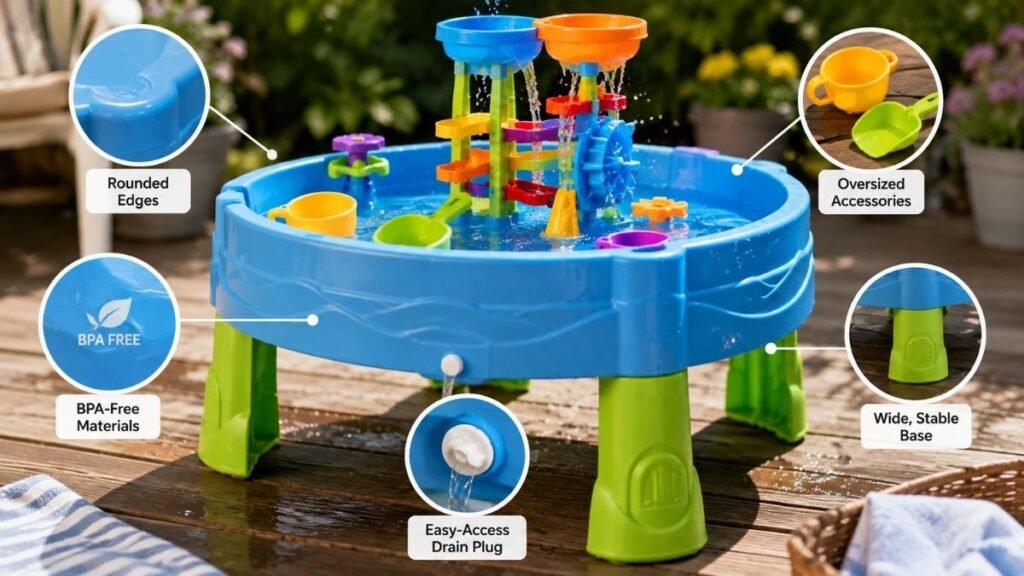
- Stability. A wide, low center of gravity prevents tipping, especially important for younger toddlers who may lean or pull on the edge.
- Safe materials. Look for BPA-free, non-toxic plastic, since toddlers frequently mouth accessories during play.
- Drain plug. A table without an easy-to-access drain plug turns into a real chore at cleanup time — this single feature affects how often the table actually gets used.
- Easy-to-clean design. Fewer tight corners and crevices mean less mold risk and a faster cleaning routine (more on this below).
- Appropriate size. Match the table’s height and footprint to your child’s size and your available space — an oversized table in a small yard creates as much frustration as an undersized one.
- Indoor/outdoor suitability. If you plan to use it indoors occasionally, confirm the base won’t scratch flooring and that spills are easy to contain.
- UV resistance. Tables left outdoors regularly benefit from UV-resistant plastic, which resists fading and cracking over multiple seasons.
- Multi-child capacity. If more than one child will play at once, check the basin width and number of play stations before buying.
- Storage convenience. Foldable or stackable designs make off-season storage significantly easier, particularly for families with limited garage or shed space.
Buying Checklist
- [ ] Base is wide and stable, resistant to tipping
- [ ] Materials are BPA-free and non-toxic
- [ ] Drain plug is easy to access and use
- [ ] Design has minimal tight corners or crevices
- [ ] Size fits both your child and your available space
- [ ] UV-resistant if used outdoors regularly
- [ ] Foldable or stackable for off-season storage
Easy cleaning, stability, and the right size matter more than extra accessories.
Best Water Tables for Kids by Need
The “best” water table usually isn’t the biggest or the most expensive—it’s the one that fits your child’s stage, your available space, and how your family plans to use it. Breaking the options into categories makes it much easier to find the right fit without paying for features you may never use.
Best Overall
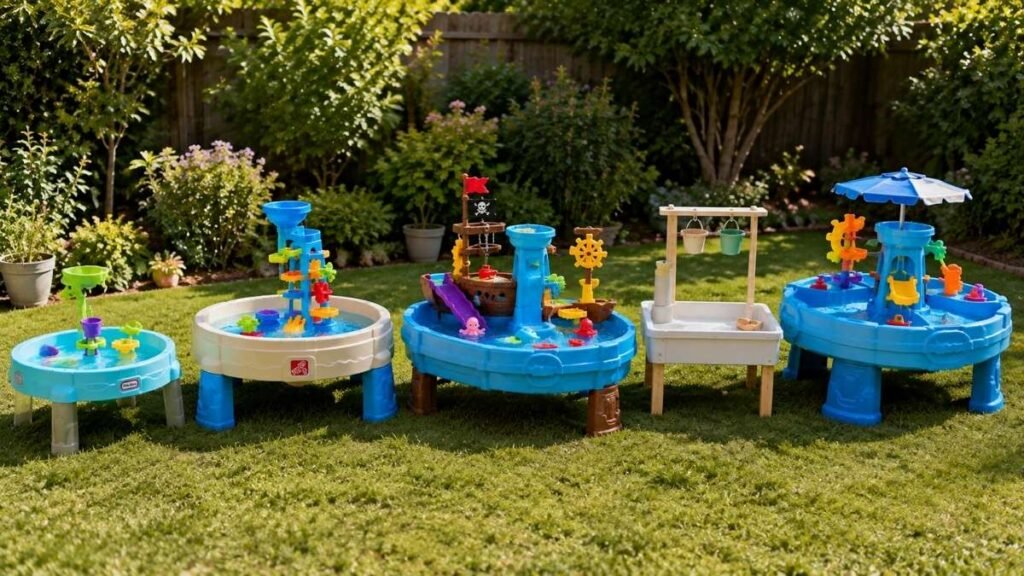
A mid-size table with multiple play zones and a water wheel tends to offer the widest appeal across ages, making it a solid default choice for most families who aren’t shopping for one specific need.
- Recommended Age: 18 months–6 years
- Pros: Versatile across ages, holds attention with varied features
- Cons: Larger footprint, takes up more storage space
- Easy-Clean Score: Moderate — multiple compartments need attention
- Best For: Families wanting one table that grows with their child
Best Budget
A simple, single-level table with basic pour-and-scoop features covers the fundamentals without unnecessary extras.
- Recommended Age: 18 months–4 years
- Pros: Lower cost, simple to clean due to fewer features
- Cons: Less variety may mean shorter attention span over time
- Easy-Clean Score: High — flat, simple design
- Best For: Families testing interest before investing more
Best for Toddlers
A low, stable table with oversized accessories is built specifically around younger toddlers’ balance and grip needs.
- Recommended Age: 12–24 months
- Pros: Prioritizes stability and safety for younger kids
- Cons: May be outgrown in features by age 3
- Easy-Clean Score: High
- Best For: Families with a toddler just starting water play
Best for Multiple Kids
A larger table with several separate play stations reduces the “one spot” conflict that often comes up with siblings or playdates.
- Recommended Age: 2–7 years
- Pros: Reduces sharing conflicts, supports cooperative play
- Cons: Larger size, higher price point
- Easy-Clean Score: Moderate
- Best For: Families with multiple children or frequent playdates
Best Small Spaces
A compact or foldable table is designed to fit balconies, small patios, or apartments without sacrificing core play value.
- Recommended Age: 18 months–5 years
- Pros: Space-efficient, often easier to store
- Cons: Smaller play surface, fewer simultaneous users
- Easy-Clean Score: High
- Best For: Apartment or small-yard families
Best Montessori
An open-ended table with minimal built-in mechanisms encourages independent exploration rather than following one prescribed way to play.
- Recommended Age: 2–6 years
- Pros: Encourages creativity and independent problem-solving
- Cons: May need parent-added accessories for full engagement
- Easy-Clean Score: High — simple design
- Best For: Families prioritizing open-ended, self-directed play
Best Pretend Play
A themed table — such as a boat dock or car wash design — supports imaginative scenarios alongside sensory play.
- Recommended Age: 3–6 years
- Pros: Strong engagement for imaginative play, social play-friendly
- Cons: Theme may lose appeal as interests shift
- Easy-Clean Score: Moderate
- Best For: Preschoolers deep into pretend play
Product Comparison Table
| Category | Recommended Age | Easy-Clean Score | Best For |
|---|---|---|---|
| Best Overall | 18 months–6 years | Moderate | Wide age range, general use |
| Best Budget | 18 months–4 years | High | Testing interest affordably |
| Best for Toddlers | 12–24 months | High | Younger toddlers, safety-first |
| Best for Multiple Kids | 2–7 years | Moderate | Siblings, playdates |
| Best Small Spaces | 18 months–5 years | High | Apartments, small yards |
| Best Montessori | 2–6 years | High | Independent, open-ended play |
| Best Pretend Play | 3–6 years | Moderate | Imaginative, story-driven play |
The best water table depends on your child’s needs — not simply the highest price.
Keep Water Table Play Safe
Water tables may look harmless, but they still require the same close supervision as any activity involving water. A few simple habits—like emptying the table after play and checking for loose parts—can prevent the most common safety risks.
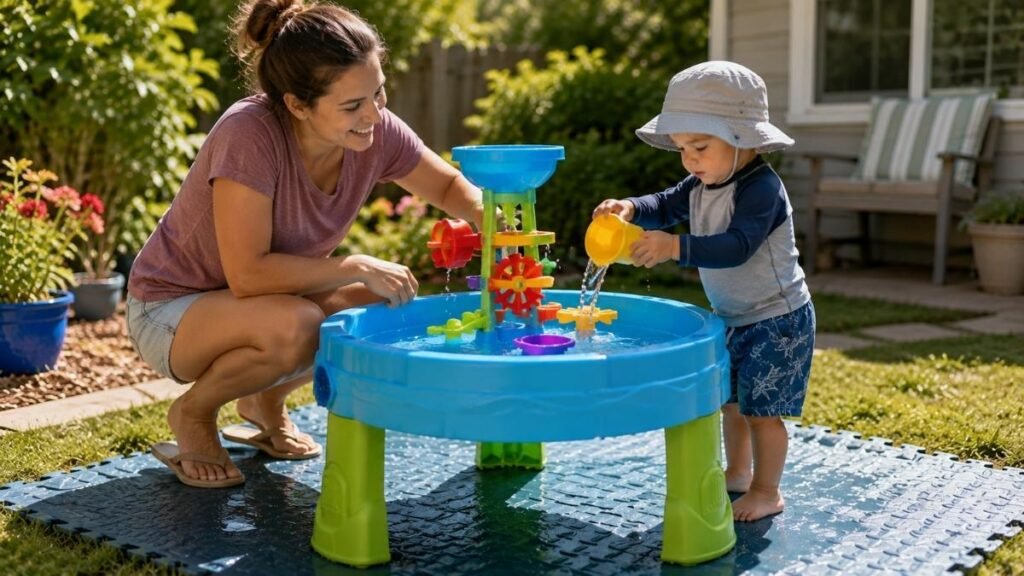
Even a shallow water table carries real risk if left unsupervised — young children can face drowning risk in surprisingly small amounts of standing water. A few non-negotiable habits go a long way:
- Constant supervision. Never leave a toddler alone near a water table, even for a moment, regardless of how shallow it looks.
- Anti-slip precautions. Place the table on grass or a non-slip mat rather than a smooth patio surface, where wet feet can slip easily.
- Tip-over prevention. Check that the base is stable and wide enough to resist tipping, especially once a toddler starts leaning or climbing.
- Small accessory safety. Watch for any small parts that could separate from larger accessories and become a choking hazard.
- Sun protection. Apply sunscreen and consider shade coverage, since water play sessions often run longer than parents initially plan.
- Immediate draining. Drain the table completely after each play session rather than leaving standing water, which reduces both drowning risk and the mold and mosquito issues covered in the next section.
Safety Checklist
- [ ] An adult is supervising at all times during play
- [ ] The table is placed on a non-slip surface
- [ ] The base is stable and resistant to tipping
- [ ] All accessories are checked for small, detachable parts
- [ ] Sunscreen or shade is used for longer sessions
- [ ] Water is fully drained immediately after play
Safe supervision matters more than any product feature.
How to Keep Your Water Table Clean and Mold-Free
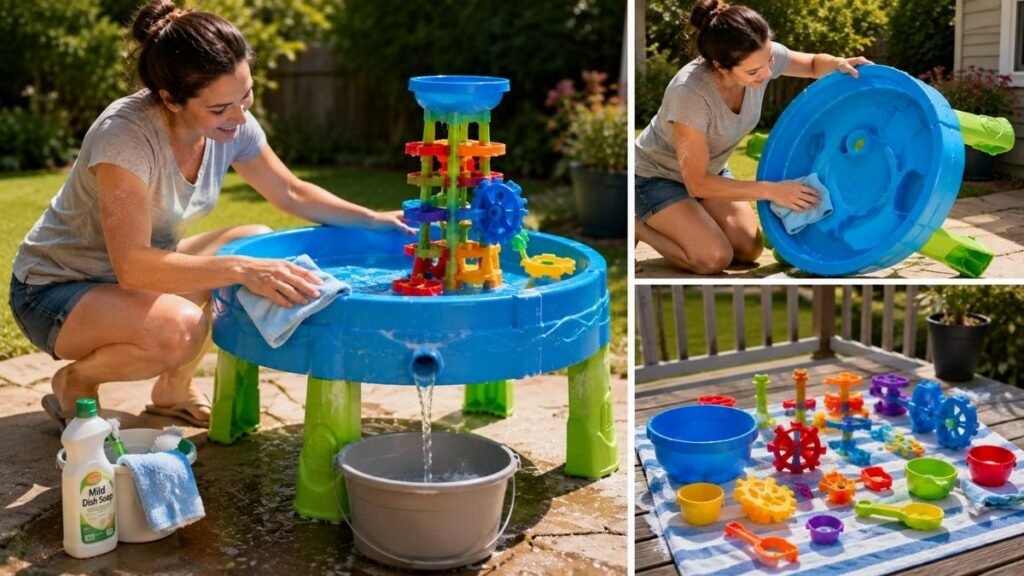
A water table doesn’t become moldy overnight—it happens when small cleanup tasks get skipped over time. Emptying the water after play and giving the table a quick weekly clean will prevent most problems before they start.
Why water tables get moldy so easily
Standing water in a warm, shaded outdoor spot is close to ideal mold-growing conditions, and most water tables have small crevices — around wheels, plugs, and connecting joints — where moisture lingers even after the main basin looks dry.
How to avoid mosquitoes
Mosquitoes can lay eggs in standing water in as little as a few days, which is exactly why draining a water table completely after each session matters more than it might seem. Leaving even an inch of water overnight is enough to create a breeding opportunity in warm weather.
After every play session
Drain the table fully, tip it to remove any water pooled in low spots, and let accessories air dry separately rather than leaving them submerged.
Weekly deep clean
Once a week, wipe down the basin and all accessories with a mild soap and water solution, paying particular attention to crevices around wheels and joints where mold tends to start. Rinse thoroughly and let everything air dry completely before the next use.
Storage between uses
Store the table upside down or covered when not in use for several days, which prevents rainwater or dew from collecting and starting the mold cycle over again.
Is a cover worth buying?
A fitted cover can meaningfully reduce debris, rainwater accumulation, and UV exposure between play sessions, making it a reasonable add-on for families using their table regularly throughout the season rather than only occasionally.
Why squirt toys hide mold most often
Squirt toys and other accessories with small internal chambers are notorious for trapping water long after the main table looks dry, since the water inside isn’t visible and rarely drains on its own — these deserve extra attention during the weekly clean, including a gentle squeeze-dry after rinsing.
Make the Most of Your Water Table
With a few inexpensive accessories and a little seasonal creativity, the same table can stay in regular rotation long after the first summer.
Make play more fun
Simple additions like kitchen tools, measuring cups, funnels, and short lengths of PVC pipe are inexpensive ways to keep play fresh without buying a new table.
Use it all year
Water tables don’t have to be packed away once summer ends. Filling the basin with kinetic sand, rice, dried beans, or even snow and ice in colder months turns the same table into a completely different sensory experience — and moving the setup indoors with a contained filler like rice or sand makes indoor sensory play possible even in winter.
Make it last longer
Seasonal storage — covering or storing the table when it’s not in active use — meaningfully extends its lifespan by reducing UV exposure and weather damage. With the right seasonal adaptations, many families find their water table stays in rotation well through the preschool years rather than being retired after a single summer.
Seasonal Play Ideas
| Season | Filler Material | Play Focus |
|---|---|---|
| Summer | Water | Pouring, scooping, water wheels |
| Fall | Dried beans, rice | Fine motor, sorting |
| Winter (indoor) | Kinetic sand, rice | Indoor sensory play |
| Winter (outdoor, cold climates) | Snow, ice cubes | Temperature exploration |
A water table can become a year-round sensory center instead of a summer-only toy.
Alternatives to a Water Table
Kids care more about pouring and splashing than the table itself. If space or budget is limited, a few simple alternatives can deliver much of the same fun.
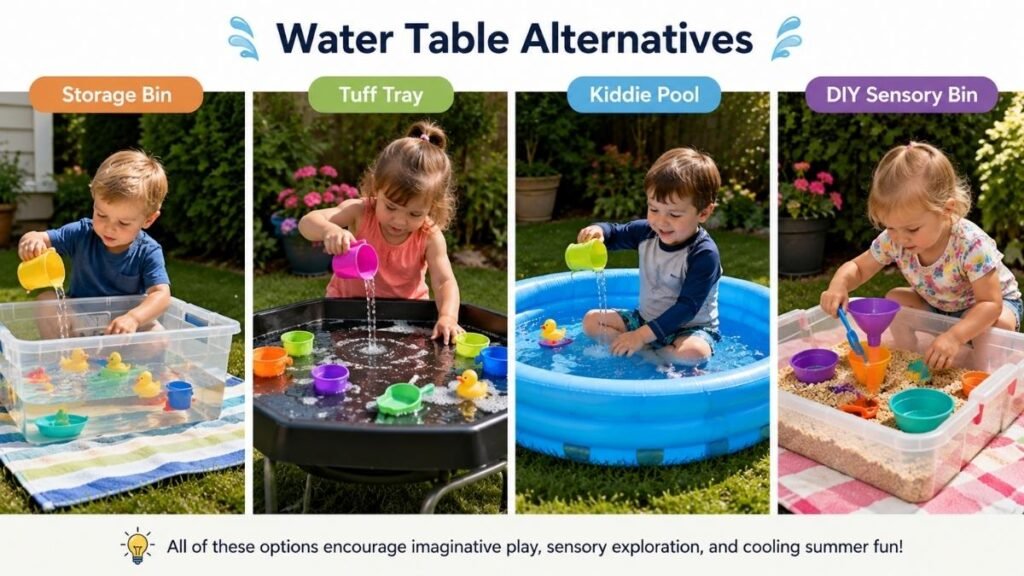
Not every family needs a dedicated water table to get the developmental benefits of water play. A few practical alternatives:
- Storage bin. A large plastic storage bin filled with a couple inches of water offers scoop-and-pour play at a fraction of the cost, and it stores flat when not in use.
- Tuff tray. A shallow, wide tray works well for both water and dry sensory fillers, and its low sides make it especially manageable for younger toddlers.
- Kiddie pool. Better suited to open splashing than structured pour-and-scoop play, but a reasonable choice if that’s the kind of play your child enjoys most.
- DIY sensory bin. Combining a basin with a few kitchen tools recreates much of a water table’s core appeal without any specialized equipment.
- Apartment balcony ideas. A small tuff tray or storage bin, used with close supervision and placed on a non-slip mat, can bring water play to even a compact balcony space.
- Indoor setup. A bin placed on a towel or shower curtain liner allows for supervised indoor water play on rainy days without much cleanup risk. For more indoor-specific ideas, our guide to outdoor toys for toddlers also covers a few sensory options that adapt well between indoor and outdoor use.
Comparison Table
| Option | Cost | Best For | Limitation |
|---|---|---|---|
| Water table | Higher | Structured play, water wheels | Storage space needed |
| Storage bin | Low | Budget-friendly scoop-and-pour | Less structured play |
| Tuff tray | Low–Moderate | Younger toddlers, dry + wet play | Less specialized features |
| Kiddie pool | Low–Moderate | Open splashing | Less skill-building structure |
| DIY sensory bin | Very low | Flexible, customizable play | Requires assembling own tools |
You don’t need a large backyard to enjoy sensory water play.
Frequently Asked Questions
Which water table brand is best and actually worth buying for toddlers? Rather than one single “best” brand, focus on matching the table’s features to your child’s age and your space — a low, stable table with oversized accessories tends to work best for toddlers specifically, regardless of brand.
How do you stop a water table from getting moldy and growing mosquitoes? Drain the table completely after every play session, wipe it down weekly with mild soap and water, and let it fully air dry before storing it covered or upside down between uses.
Is a water table worth it, or should I just use a storage tub or kiddie pool? A water table is worth it if your child enjoys structured pour-and-scoop play and you have space for one; a storage bin or kiddie pool can offer similar sensory value at a lower cost if you’re unsure about long-term interest.
How can I add an automatic water pump to a toddler water table? Small battery-powered or manual water pumps designed for sensory play can typically be added to most open-basin water tables, creating continuous moving water for added cause-and-effect engagement — just be sure any pump used is specifically designed for children’s play equipment.
How can we use a water table in the winter or indoors? Swap water for a dry filler like kinetic sand, rice, or dried beans, and move the table indoors onto a towel or mat for contained, mess-manageable sensory play during colder months.
What are the best cheap accessories to add to a water table? Kitchen tools like measuring cups and funnels, short lengths of PVC pipe, and simple scoops are inexpensive ways to add variety without buying a new table.
At what age can a toddler start playing with a water table safely? Most toddlers are ready around 12–18 months, as long as the table is low and stable and play is closely supervised at all times.
What should you put underneath an indoor water table to catch spills? A large towel, a shower curtain liner, or a plastic splash mat placed underneath the table helps contain spills and makes cleanup significantly faster after indoor sessions.
🏠 Behind This Guide
Choosing the right water table for kids isn’t about finding the biggest model or the one with the most accessories. It’s about finding a table that fits your child’s stage, your available space, and the way your family actually plays.
That’s why this guide focuses on the things that make the biggest difference in everyday use:
- 💧 Age-Appropriate Play — Matching features to your child’s developmental stage.
- 🛡️ Safety & Easy Maintenance — Choosing designs that are stable, simple to clean, and built for regular use.
- 🌿 Long-Term Value — Finding a table your child can enjoy beyond a single summer.
The goal isn’t to buy the most expensive water table.
It’s to choose one your child will come back to again and again.
🌊 Keep the Fun Going
A water table is just one way to encourage active, hands-on play. These related guides can help you choose age-appropriate toys, support your child’s development, and create a safe play environment.
- Best Toys for 2-Year-Olds — Discover engaging toys that encourage curiosity, independent play, and early learning.
- Fine Motor Skills Development — Simple activities and toys that strengthen coordination, grip, and everyday skills.
- Gifts for 3-Year-Olds — Find fun, age-appropriate gift ideas that balance creativity, learning, and active play.
- Non-Toxic Materials for Young Children — Learn what materials to look for when choosing safe toys and everyday products for young children.
❤️ A Final Note
The best toddler gifts aren’t always the biggest or the most expensive—they’re the ones children reach for again and again.
At Toizora, we believe every toy should inspire curiosity, support healthy development, and make everyday play a little more meaningful.
Helping parents and gift-givers choose safe, educational toys with confidence.