
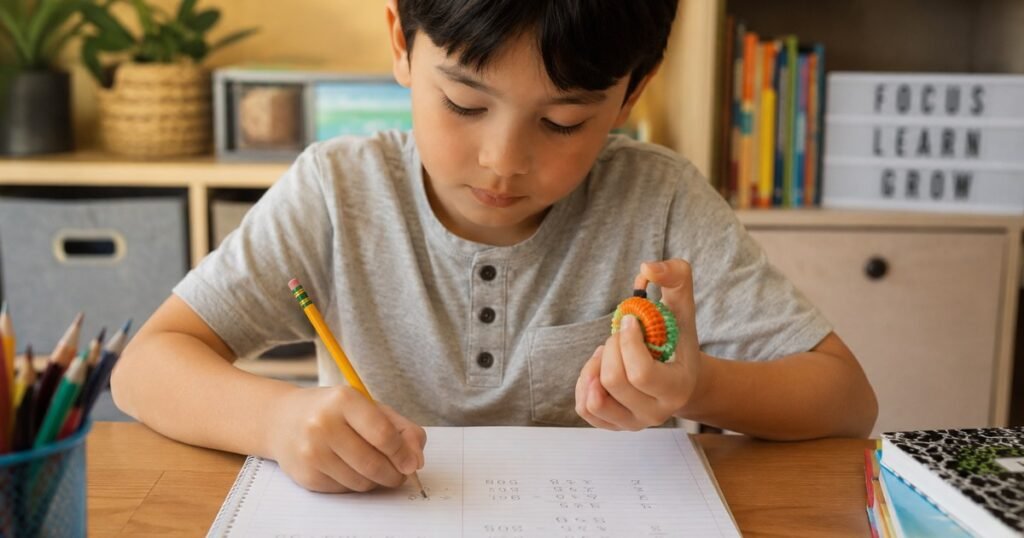
My son went through a phase — around age five — where he chewed through three pencil erasers a week. Not chewing as in “absent-minded nibbling.” Chewing as in methodical, deliberate, focused destruction. I tried everything: reminders, replacement pencils, sticker charts. None of it worked. The chewing continued because the chewing was doing something. He just couldn’t tell me what.
It turns out he was seeking sensory input. His nervous system needed a certain kind of stimulation to stay regulated, and his pencil erasers were providing it. Once I understood that — once I stopped treating it as a behavior problem and started treating it as a sensory need — everything got easier. Including finding the right sensory fidget toy to replace the eraser.
This is the guide I wish I’d had. Not a listicle of trendy fidgets. Not medical advice about ADHD or autism. A genuinely practical, safety-first parent’s guide to what sensory fidget toys actually are, which ones work for which kinds of children, and how to choose one that your specific child will actually use — rather than destroy, lose, or ignore entirely.
Key Takeaways
- Sensory fidget toys are tools, not treatments. They may help some children manage sensory input needs, improve focus, or reduce anxiety-related behaviors. They are not a substitute for professional assessment or therapy when those are needed.
quiet fidget toysare consistently the most requested category in parenting communities — specifically toys that won’t disrupt classrooms, siblings, or parents’ sanity. This guide specifically addresses this.- Not all fidget toys are created safe. Cheap magnetic fidgets, unknown-material squishies, and toys with detachable small parts present real hazards — especially for children who mouth or destroy their fidgets. Safety is covered in detail.
- The best fidget toy is the one your child actually uses. The most sophisticated sensory tool does nothing if your child ignores it. Matching the fidget type to your child’s actual sensory-seeking behavior is the most important factor.
- Age matters more than most parents realize. A fidget toy appropriate for an 8-year-old can be a choking or magnetic hazard for a 3-year-old. Every recommendation in this guide includes clear age guidance.
What Are Sensory Fidget Toys and How Do They Help?
Before we get to specific products, it helps to understand what’s actually happening when a child benefits from a fidget toy — because it changes how you evaluate which type to choose.
How Sensory Input Supports Focus and Calm
The human nervous system is constantly processing sensory information from the environment — touch, sound, movement, temperature, proprioception (body awareness). For most people, this processing happens automatically and in the background. For some children, the processing requires more conscious effort, or requires more input to achieve the same regulated state.
A child who can’t sit still, chews everything, constantly touches textures, or seeks physical pressure isn’t misbehaving. They’re attempting to regulate their nervous system through movement and sensory input. This is called “sensory seeking” — and it’s a normal variation in how nervous systems work.
Sensory fidget toys provide a controlled, safe outlet for this seeking. Instead of chewing a pencil, there’s a food-grade silicone chew toy. Instead of pulling at a shirt collar, there’s a textured ring to run fingers over. The sensory input is the same; the delivery mechanism is safer and more socially appropriate.
Research from the American Journal of Occupational Therapy supports the use of sensory tools including fidgets for children with sensory processing differences, noting that proprioceptive and tactile input can support self-regulation. What the research is careful to say — and what parents should know — is that responses vary significantly between children. What calms one child may agitate another. What your neighbor’s daughter loves may be completely wrong for your son.
This is why choosing the right type of fidget matters more than choosing the “best” fidget.
Different Types of Sensory Fidget Toys (And Who They’re Best For)
Tactile Fidget Toys: For Kids Who Need Touch Feedback
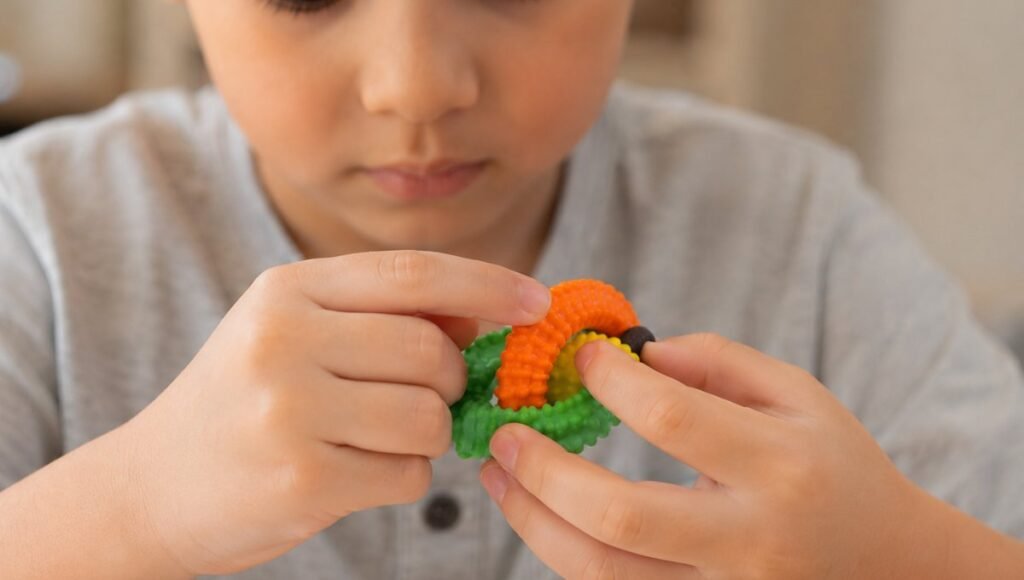
Who this is for: Children who fidget by touching everything — rubbing textures, picking at clothing, pulling at hair or skin, constantly handling nearby objects.
Tactile fidgets work by providing rich, varied texture input to the fingertips — the most sensory-dense part of the human body. The brain receives the stimulation it’s seeking through the fingertips, freeing up cognitive bandwidth for other tasks (like listening in class, or sitting through dinner).
What works:
- Textured silicone rings — smooth on one side, bumped on the other; wearable on a finger
- Stretchy, squishy toys with satisfying resistance — the pulling and pressing action provides proprioceptive feedback
- Textured sensory balls — small enough for a pocket, varied enough to stay interesting
- Fabric fidget squares — patches of different textures sewn together
⚠️ Toizora safety note on squishies: Cheap squishy toys — the kind that are extremely inexpensive and come in novelty shapes — are one of the most common sources of parent complaints in fidget toy discussions. They tear easily, exposing foam filling that shouldn’t be ingested. Some have chemical smells that suggest manufacturing processes you don’t want against a child’s skin all day. If your child mouths or bites their fidgets (many do), cheap squishies are a genuine health concern. Choose squishies made from food-grade silicone rather than foam-filled vinyl.
Quiet Fidget Toys for Classroom and School

This is the most-requested category in every parent forum discussion about fidgets — and for good reason. A fidget toy that clicks, snaps, spins loudly, or pops repeatedly is not a classroom tool. It’s a disruption delivery device.
Who this is for: School-age children (typically 5+) who need sensory input during focused academic tasks but whose fidgeting can’t disrupt the classroom environment.
What actually works quietly:
- Fidget rings — silent, wearable, provide continuous tactile stimulation without requiring attention or making noise. Among the most classroom-friendly options available.
- Small silicone sensory coins or tiles — flat enough for a pocket, completely silent, provide textural input through thumbs or fingers
- Magnetic sliders (for older children, 8+) — sliding magnetic components provide smooth, repetitive motion that many children find deeply regulating. Silent when used correctly.
- Therapy putty — used in desk drawers or pockets, provides significant proprioceptive input with zero noise
- Smooth worry stones — a natural stone with a slight indentation for the thumb; ancient, effective, completely silent
What to avoid for classroom use:
- Clicking fidget cubes (the clicking is the problem)
- Pop-it toys during focused tasks (the sound carries)
- Fidget spinners (visually distracting to both the child and neighbors)
- Anything that requires both hands to operate
Editor’s opinion: The fidget ring is chronically underrated in fidget toy discussions because it doesn’t look exciting. But it’s the most genuinely classroom-appropriate tactile fidget available — wearable, silent, and continuous.
Visual Sensory Toys for Relaxation
Who this is for: Children who calm down by watching slow, predictable movement — lava-lamp watchers, snow-globe shakers, aquarium gazers.
Visual sensory tools work differently from tactile fidgets — rather than providing active sensory input through the hands, they provide calming visual stimulus that supports the parasympathetic nervous system response (the “rest and digest” state).
What works:
- Liquid motion timers — colored liquid falls slowly through a clear container; the predictable, slow movement is genuinely calming for many children
- DIY sensory bottles — a sealed water bottle filled with glitter glue and water; when shaken, the glitter floats slowly down. Takes 5 minutes to make and costs almost nothing.
- Sand art timers — colored sand flowing between compartments; the visual effect is similar to liquid timers but with a tactile sound dimension
These are generally more useful as calm-down tools at home than as classroom fidgets — they require visual attention rather than working alongside another task.
Sensory Chew Toys: When Other Fidgets Aren’t Enough

Who this is for: Children who chew — pencils, shirt collars, hair, fingers, anything within reach. This is one of the most common sensory-seeking behaviors in young children and is often misidentified as a behavior problem rather than a sensory need.
Chewing provides intense proprioceptive input through the jaw, which many children find deeply regulating. The correct response is not to stop the chewing (usually not possible) but to redirect it to something safe.
What works:
- Food-grade silicone chew pendants — worn on a lanyard, always accessible, clearly designed for chewing. Available in multiple textures for different levels of input need.
- Silicone chew bracelets — worn on the wrist, available, discrete
- “Chewelry” — chewable jewelry specifically designed for this purpose
Critical safety information:
- Only purpose-made chew toys are safe for chewing. Never use regular plastic toys, random rubber items, or non-designated silicone products as chew substitutes.
- All chew toys should be food-grade silicone with no BPA, phthalates, or latex
- Inspect chew toys regularly for tears, holes, or pieces coming loose — chewed-off pieces are a choking hazard
- Replace any chew toy showing wear before it becomes a hazard
Best Sensory Fidget Toys by Age
Ages 0–3: Safety Comes First
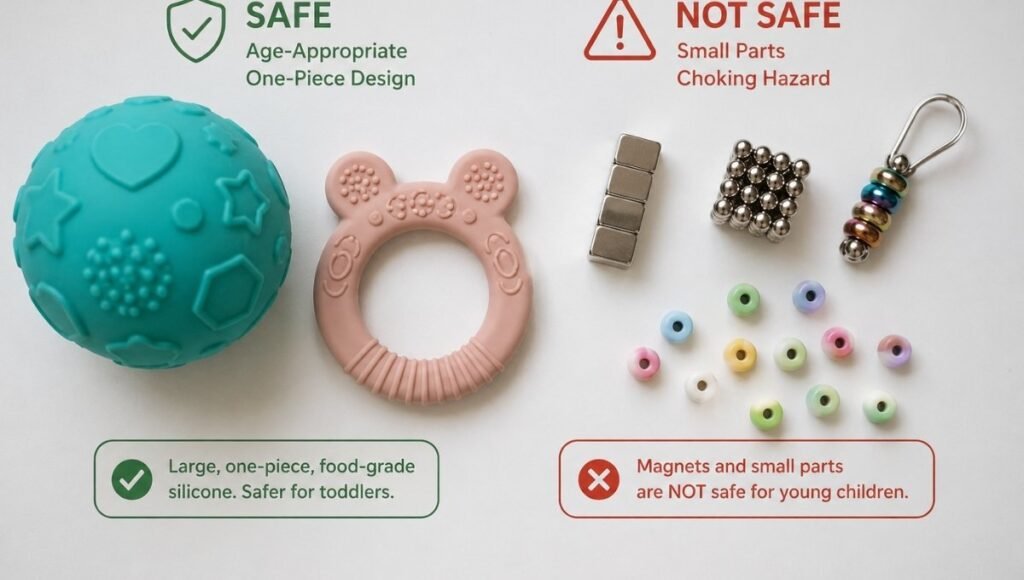
For very young children, the sensory seeking behaviors that fidget toys address look different — mouthing, squeezing, patting, banging. And the safety requirements are much more stringent.
What works (and is safe):
- One-piece food-grade silicone sensory toys — no detachable parts, no small components
- Large textured balls (larger than 1.75 inches diameter) — safe for mouthing, provides tactile and proprioceptive input
- Simple silicone teethers in varied shapes — designed for oral use, food-grade, single piece
What to strictly avoid under age 3:
- Anything with magnets (the powerful rare-earth type are a surgical emergency if two are swallowed)
- Small balls or beads of any kind
- Anything with detachable parts
- Fidget cubes or complex multi-component toys
- Foam-filled squishies
Age 2–3 specifically: Textured silicone sensory squares, large soft sensory balls, and simple squeeze toys are the most appropriate fidget options. Everything else in the fidget toy category is genuinely too advanced and too dangerous for this age.
Ages 3–6: Building Fine Motor Skills
From 3 to 6, children have the fine motor development for more complex fidget interactions — and the focus demands of preschool and early school years mean sensory regulation becomes increasingly relevant.
What works:
- Pop toys (silicone bubble pop sheets) — satisfying tactile and auditory feedback, appropriate for this age, though not classroom-appropriate
- Squeeze toys with varying resistance — builds hand strength while providing proprioceptive input
- Simple sensory rings — wearable, safe, appropriate level of complexity
- Fidget spinners with large, safe finger placement (not the tiny version with small bearings)
Fine motor benefit: Many fidgets appropriate for this age also build the hand strength and coordination that supports pencil grip development. The squeeze-and-release motion of resistance toys works the exact same intrinsic hand muscles that fine motor specialists target.
Ages 7+: School-Friendly Focus Tools
By 7, children are in full-time school environments where sensory needs and classroom expectations need to coexist. The priorities shift to quiet, pocket-sized, and durable.
What works:
- Fidget rings — silent, wearable, discrete
- Therapy putty — kept in a pocket or desk, provides strong proprioceptive input
- Smooth sensory coins — pocket-sized, silent, tactile
- Magnetic sliders (with appropriate age supervision) — smooth, satisfying, relatively quiet
- Worry stones — natural, silent, and require no explanation to teachers
Best Sensory Fidget Toys Compared
| Toy Type | Best For | Noise Level | Cleaning | Age | Safety Notes |
|---|---|---|---|---|---|
| Silicone fidget ring | Tactile seeking, classroom | Silent ⭐⭐⭐⭐⭐ | Easy — soap and water | 3+ | Check for tears regularly |
| Silicone chew pendant | Oral sensory seeking | Silent ⭐⭐⭐⭐⭐ | Easy — dishwasher safe | 2+ | Replace at first sign of wear |
| Squeeze ball (silicone) | Stress, anxiety, hand strength | Very quiet ⭐⭐⭐⭐ | Easy | 3+ | Check fill material |
| Magnetic slider | Repetitive motion seeking | Quiet ⭐⭐⭐⭐ | Easy | 8+ | Keep away from under-5s |
| Pop it (silicone) | Tactile + auditory | Moderate ⭐⭐⭐ | Easy — washable | 3+ | Not for classrooms |
| Liquid motion timer | Visual calming | Silent ⭐⭐⭐⭐⭐ | Wipe clean | 3+ | Keep out of reach when not in use |
| Therapy putty | Strong proprioceptive needs | Silent ⭐⭐⭐⭐⭐ | Difficult | 5+ | Keep off fabric |
| Worry stone | Mild tactile seeking | Silent ⭐⭐⭐⭐⭐ | Easy | 5+ | Natural material, no safety concerns |
Sensory Fidget Toys for ADHD and Autism: What Parents Should Know
This section addresses the parents who are searching specifically for fidget tools for children with ADHD or autism spectrum disorder — and it requires a careful, honest framing.
What the research shows: Occupational therapists working with children with ADHD and autism frequently incorporate sensory tools — including fidgets — as part of broader sensory diet programs. The research on fidget toys specifically (as distinct from broader sensory interventions) shows mixed results: some children show improved focus and reduced anxiety-related behaviors; others show no significant benefit; a small number show increased distraction.
What this means practically: A fidget toy is not a treatment for ADHD or autism. It is one potential tool among many. Whether a specific fidget helps your specific child requires observation — try it, watch what happens, adjust accordingly.
Why some children seek repetitive sensory input: Children with sensory processing differences, ADHD, or autism often have nervous systems that require more or different sensory input to achieve a regulated state. The repetitive motion of a fidget — spinning, squeezing, clicking, chewing — provides the proprioceptive and tactile input that helps some of these children stay regulated enough to engage with their environment.
The most important thing: Every child’s sensory profile is different. The fidget that works brilliantly for one child with ADHD may do nothing for another with the same diagnosis. Match the fidget type to the specific sensory behavior you’re observing in your child — not to the diagnosis.
If you’re concerned about your child’s sensory processing, focus, or behavior, an occupational therapy evaluation is the most useful next step. OTs can assess your child’s specific sensory profile and recommend targeted interventions, of which fidget toys may be one component.
Sensory Fidget Toy Safety Guide: Avoid These Mistakes
This is the section most fidget toy guides skip — and the most important one for parents.
Be Careful With Magnetic Fidgets
Magnetic fidget rings, cubes, and sliders are popular with older children and adults — and present a serious hazard for younger children in the household.
The specific risk: Small, powerful neodymium (rare-earth) magnets, if two separate magnets are swallowed, can attract to each other through intestinal walls and cause life-threatening internal injuries. This is not a theoretical risk — it has caused numerous pediatric surgical emergencies.
Safe practices:
- Never allow magnetic fidget toys around children under 8 — not even supervised use if a younger sibling is present
- Store magnetic fidgets completely out of reach when not in use
- Choose fidgets with fully enclosed magnets that cannot come loose
- If you suspect a child has swallowed magnets, seek emergency medical care immediately
Avoid Strong Chemical Smells
Any fidget toy that has a strong chemical or plastic smell when you open it should be returned. This smell indicates volatile organic compounds (VOCs) from manufacturing processes — compounds you don’t want a child handling all day, and absolutely don’t want in their mouth.
This is most common with extremely cheap fidget toys from unknown manufacturers. Choose products from established brands that disclose their materials, and check for ASTM F963 compliance.
Check Durability Before Buying
One of the most consistent complaints in parent communities about fidget toys is poor durability — squishies that tear within a week, spinners that break on the first drop, pop toys that lose their pop after two days.
The durability issue is both a practical problem and a safety one. A torn squishy exposes foam filling. A broken spinner has sharp edges. A disintegrating chew toy has pieces.
What to check:
- Read recent reviews specifically for durability comments
- For chew toys especially: choose products with warranties and clear replacement policies
- For all fidgets: inspect weekly and replace at first sign of significant wear
How to Choose the Right Sensory Fidget Toy for Your Child
Use this decision guide based on what you’re actually observing:
If your child chews everything (pencils, shirt collars, hair, fingers): → Start with a food-grade silicone chew pendant or bracelet → Match texture intensity to how hard they chew (lighter textures for mild chewing, firmer textures for aggressive chewing)
If your child constantly touches and handles things: → Textured silicone fidget ring or sensory coin → Small textured sensory ball for pocket
If your child needs something for school focus: → Silent fidget ring (wearable, no attention required) → Smooth worry stone for pocket → Therapy putty in a small container
If your child is anxious or stressed: → Slow, repetitive motion fidgets: liquid timer, smooth sensory stone, resistance squeeze toy → Avoid high-stimulation fidgets (loud, fast-moving, visually busy) — these can increase activation rather than calming
If your child is under 3: → Large one-piece food-grade silicone sensory toy only → Nothing with magnets, small parts, or complex components
If nothing seems to work: → Consider an occupational therapy evaluation — an OT can assess your child’s specific sensory profile and recommend targeted tools
Frequently Asked Questions
Do sensory fidget toys actually help kids focus? For some children, yes — particularly those who are sensory-seeking and whose fidgeting behavior indicates a need for proprioceptive or tactile input. The research is clearest for children with sensory processing differences, ADHD, or autism, but many neurotypical children also benefit. The key is matching the fidget type to the specific sensory need, and accepting that it won’t work for every child.
What fidget toys are best for ADHD? There’s no single best fidget for ADHD because sensory profiles vary significantly between individuals. Generally, proprioceptive fidgets (squeeze toys, therapy putty, resistance tools) and subtle tactile fidgets (fidget rings, smooth stones) are most commonly recommended by occupational therapists for children with ADHD. Avoid visually distracting fidgets, which can increase distraction rather than reduce it.
What sensory fidget toys are allowed in classrooms? Silent, small, and non-distracting: fidget rings, small silicone sensory coins, smooth worry stones, and therapy putty. Most teachers are open to fidgets when they’re genuinely quiet and not visually distracting to other students. The best approach is to discuss with the teacher before introducing any fidget to the classroom.
Are magnetic fidget toys safe for children? Only for children 8 and older, and never in households where younger children could access them. Small powerful magnets are a serious pediatric hazard. Keep magnetic fidgets completely out of reach of children under 8, and seek emergency care immediately if a young child may have swallowed separate magnets.
What age are sensory fidget toys suitable for? Simple one-piece food-grade silicone fidgets (sensory balls, teethers) from age 1+. Basic squeeze and texture toys from age 2–3. Pop toys and wearable silicone fidgets from age 3+. Complex multi-component fidgets from age 5–6. Magnetic fidgets from age 8+ only.
Why does my child destroy or chew every fidget toy? This is extremely common and usually indicates that the fidget isn’t providing enough sensory input for your child’s specific needs. If a child is destroying texture toys, try a firmer resistance toy. If they’re chewing non-chew fidgets, switch to a purpose-made chew toy in the appropriate hardness level. Children who destroy fidgets quickly are often sensory seekers who need high-intensity input — matching the intensity is more important than replacing the toy repeatedly.
How do I clean silicone sensory toys? Most solid food-grade silicone fidgets can be washed with soap and water, and many are dishwasher-safe on the top rack. Chew toys especially should be cleaned daily given their use. Avoid bleach-based cleaners, which can degrade silicone over time. Check manufacturer instructions for any toy with moving parts or components.
The Bottom Line: The Best Sensory Toy Is the One Your Child Actually Uses
The most popular fidget toy, the highest-rated product, the most expensive sensory tool — none of it matters if your child ignores it after the first five minutes.
The best sensory fidget toy is the one that matches what your specific child is actually doing — chewing, touching, squeezing, watching — and provides a safe, appropriate version of that same input. It’s quiet enough for the environment where they need it. It’s durable enough to survive their use patterns. And it’s safe enough that you don’t have to watch them with it constantly.
Start simple. Start safe. Watch what your child actually does with it. Adjust from there.
And if nothing you try seems to help — or if your child’s sensory needs feel significant and pervasive — an occupational therapy evaluation is genuinely the most useful next step. Not because something is “wrong,” but because a professional assessment gives you a real roadmap rather than a trial-and-error guessing process.
Related guides:
- Sensory Toys for Babies: A Stage-by-Stage Guide
- Fine Motor Skills Toys
- Best Toys for 2-Year-Olds
- Rainy Day Activities for Kids
- Educational Toys: The Complete Guide
🧸 Toizora Play Notes: The Research Behind This Guide
The best toy is not always the newest trend, the most colorful design, or the one every child online seems to have.
It is the one that helps you better understand what your child is looking for — whether that is movement, comfort, focus, or simply a small way to feel more regulated during a busy day.
This guide is built around child development research, sensory play principles, and safety recommendations from trusted organizations.
Research on sensory processing helps explain why some children seek certain textures, movements, or repetitive actions, while guidance from organizations such as the American Academy of Pediatrics (AAP) and Consumer Product Safety Commission (CPSC) helps shape safer toy choices.
A helpful fidget toy does not change who a child is.
It simply gives them a better tool for what they may already be trying to do.
Toizora creates research-informed toy guides designed to help families choose toys with more purpose, safety, and understanding.
This article is for educational purposes only and does not replace advice from a pediatrician, occupational therapist, or qualified professional.