
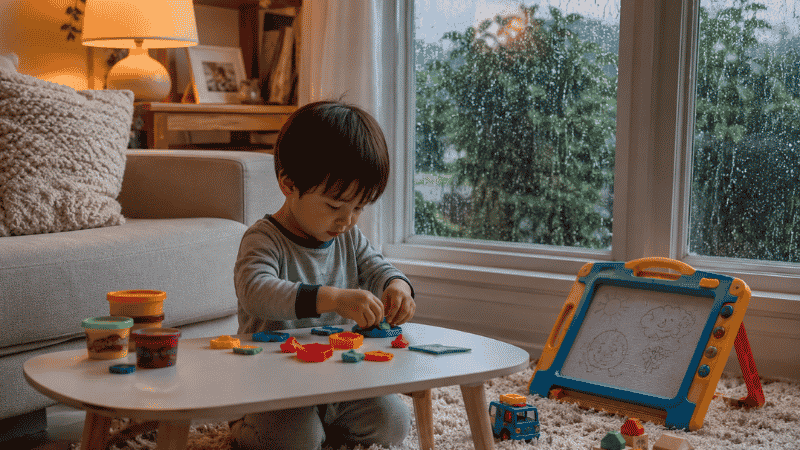
It’s raining. Again.
You checked the forecast this morning hoping for a miracle, and instead got a solid wall of grey stretching all the way to Thursday. Your child has already announced they’re bored — approximately eleven minutes after waking up. The living room looks like someone ran a toy audit and rejected everything. And it’s only 8:47 AM.
If you’re reading this in that exact moment: hello. I see you. I have been you, more times than I care to admit.
Rainy day activities for kids are one of those things every parent thinks they’ll be “more prepared for” — and then somehow never quite are when the actual rain arrives. The ideas that seemed so clever when you pinned them on a Sunday evening become mysteriously difficult to execute when you’re standing in a cluttered kitchen at 9 AM with a restless four-year-old pulling on your arm.
This guide is the realistic version. Activities that actually work, toys that earn their space, honest guidance on what age enjoys what — and a few ideas that don’t require you to have pre-purchased seventeen craft supplies or turned your bathtub into a science lab.
Key Takeaways
- Rainy days are genuinely stressful — and you’re not failing if your child is bored. Boredom is actually developmentally productive when channeled well; research from the American Academy of Pediatrics confirms that unstructured time builds creativity and problem-solving skills.
- You don’t need elaborate activities. Most of the indoor play that actually sustains toddlers for meaningful stretches comes from simple, open-ended toys and setups — not Pinterest-worthy craft projects requiring 12 ingredients.
- Age-matching matters more than effort. A setup that works brilliantly for a 4-year-old will bore a 2-year-old and frustrate a 6-year-old. This guide organizes ideas by age specifically for this reason.
- The rotation trick saves everyone. Putting toys “away” for a few weeks and reintroducing them on a rainy day makes them feel genuinely new again. Zero cost, high impact.
- The mess ceiling is real. Be honest with yourself about how much cleanup you’re willing to do, and choose activities accordingly. A beautiful sensory bin is not worth it if the thought of the aftermath fills you with dread.
Why Rainy Days Feel So Hard (It’s Not Just You)
Here’s something that rarely gets acknowledged: rainy days are genuinely hard for parents, not because kids are more difficult indoors, but because the outdoor escape valve disappears entirely.
On a normal day, even fifteen minutes outside changes the atmosphere of a household. Kids who’ve run, jumped, and touched actual grass are measurably more regulated and easier to engage in calmer play afterward. When that’s gone — when there’s nowhere to send the energy — the whole dynamic shifts.
Child psychologist Dr. Stuart Brown, founder of the National Institute for Play, has written extensively about the relationship between physical play and emotional regulation in children. The short version: kids who can’t move tend to escalate. This isn’t behavior problems — it’s biology.
So the most important thing on a rainy day isn’t finding the cleverest activity. It’s finding ways to move first, and then leveraging the (slightly) calmer state that follows. Keep this principle in mind as you read the sections below.
Rainy Day Activities for Toddlers (Ages 1–3): Go Simple, Go Physical First
Toddlers on rainy days need one thing above all else: movement. The indoor equivalent of running outside is messier and louder, but it matters.
The Living Room Obstacle Course
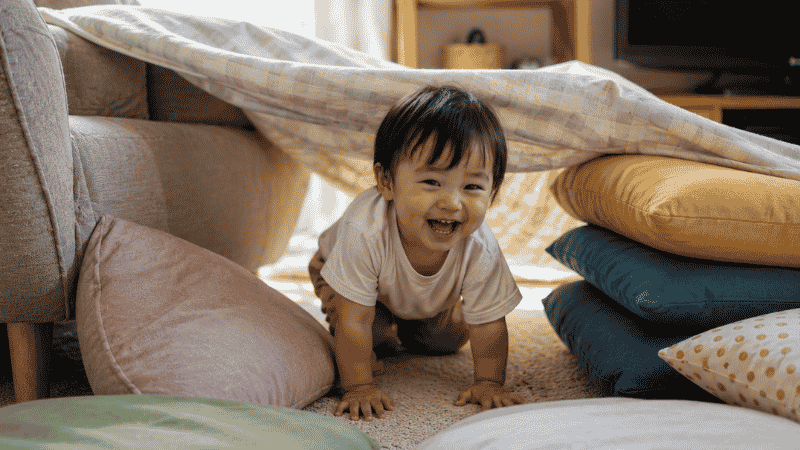
Push the coffee table to one side, arrange couch cushions on the floor, create a tunnel from a blanket draped over two chairs, and put a soft landing zone of pillows at the end. Add a pillow to hop over and a strip of painter’s tape on the floor to balance-walk along.
This costs nothing, takes about five minutes to set up, and will occupy a toddler for 20–30 minutes of serious physical engagement. The developmental benefits — balance, coordination, body awareness, sequencing — are real. And when they knock it all down, rebuilding it is part of the game.
Editor’s opinion: This is genuinely the best rainy day activity for toddlers under 3, and it’s almost never on lists because it’s too simple-looking. Don’t underestimate it.
Indoor Activities for Toddlers: Sensory Bins
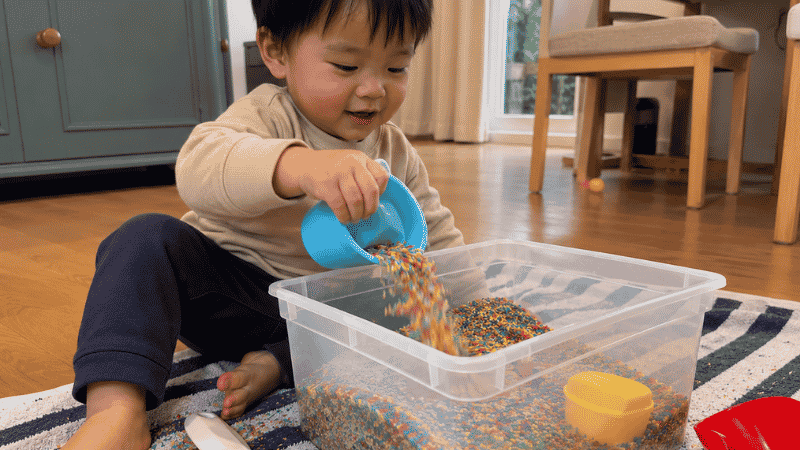
A clear plastic bin, a base filler, and a few tools — that’s it. The “base” is the most important choice:
- Uncooked rice or dried pasta — the classic option, endlessly satisfying to pour and scoop
- Kinetic sand — more contained than regular sand, holds shapes
- Water — the simplest sensory option of all, best done with a towel on the floor underneath
- Dried beans — great for sorting and scooping with larger utensils
Add a few cups, spoons, small toys, or muffin tins and let them explore. The engagement you get from a sensory bin is often significantly longer than from any designed toy — because the child is directing the entire experience themselves.
Mess ceiling check: Rice on floors sweeps up easily. Water needs a towel layer. Kinetic sand is mostly self-contained. Know your limits before you start.
Play Dough: The Underrated Rainy Day Anchor
If there’s one indoor toy for toddlers I’d recommend buying specifically for rainy day reserves, it’s a fresh, unopened set of Play-Doh.
Here’s the key: keep a pack specifically for rainy days and don’t open it until you need it. The novelty of fresh colors and the specific smell of new Play-Doh genuinely creates excitement in a way that the same old dried-out tub does not. From ages 18 months to 5 years, a fresh Play-Doh setup can buy you 30–45 minutes of focused independent play.
Add cookie cutters, a rolling pin, and plastic scissors for older toddlers. Give younger ones just the dough and their hands — that’s already a complete activity.
Rainy Day Activities for Kids Ages 3–5: The Imagination Years
Three to five is when imagination peaks — and rainy days, handled well, are actually excellent imagination fuel. When there’s nowhere to go and nothing specific scheduled, elaborate pretend scenarios naturally emerge. Your job is to provide props and then mostly get out of the way.
Build a Fort and Commit to It
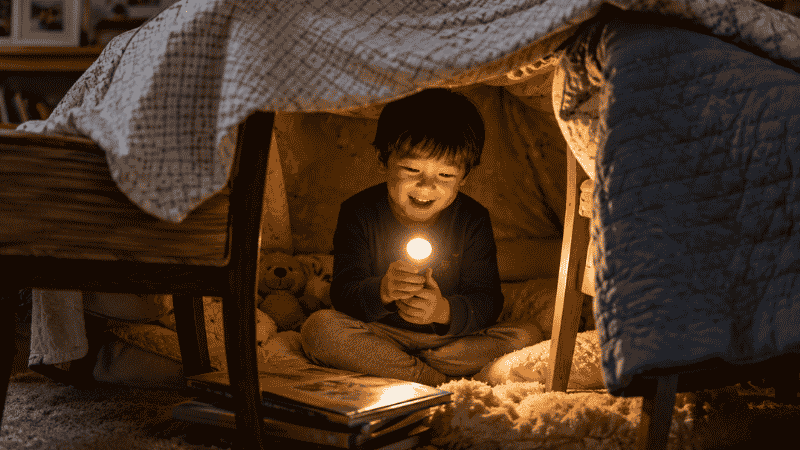
Every parent has made a half-hearted blanket fort that collapsed within the first ten minutes. The version that actually works requires committing to structure: use binder clips to attach blankets to furniture, run a string across two points and drape a sheet over it, or invest in a tunnel tent that sets up in seconds.
The fort itself is only the beginning. What transforms it from a 10-minute novelty to a 2-hour event is giving it a purpose: it’s a spaceship, a veterinary hospital, a bakery, a hideout. Hand your child a flashlight, a few relevant props, and a concept — and then let the narrative take over.
Real parent note: The flashlight is genuinely the most underrated accessory for indoor play. Everything becomes more exciting in a dimly lit space with a flashlight. Everything.
Activities to Keep Toddlers Busy: The Art Setup
There’s a difference between handing a child crayons and paper, and setting up an art space that invites sustained engagement.
The setup matters. A dedicated surface at their height, good quality supplies laid out intentionally (not dumped from a box), and a specific starting prompt (“Can you draw our house from outside?” or “What does a dragon eating spaghetti look like?”) changes the entire trajectory of the activity.
Best art supplies for rainy day setup (3–5 years):
- Washable watercolors with real pigment (not thin school sets)
- Thick paper that won’t buckle — cardstock or watercolor paper
- Masking tape to attach paper to the table so it doesn’t slide
- A jar of water, paper towels, a dedicated “paint shirt” already out and waiting
The setup signal — the paint shirt, the special paper — tells your child that this is an occasion. That framing creates more engagement than the supplies themselves.
Baking and Cooking Together
Rainy days are one of the best opportunities to cook together — not because the food particularly needs to be made, but because cooking is an extraordinarily developmental activity that happens to keep kids occupied for a surprisingly long time.
For 3–5 year olds: measuring and pouring ingredients, stirring, rolling dough, using cookie cutters. For 4+: reading simple recipe steps, counting ingredients, understanding cause and effect (“the baking soda makes it rise”).
Simple banana muffins, homemade pizza dough, no-bake cookies, pancakes — the easier the recipe, the more your child can actually participate rather than watch.
This counts as math, science, reading readiness, and fine motor development. Also you get food at the end. Solid rainy day investment.
Rainy Day Activities for Kids Ages 5–8: Real Challenges, Real Projects
By five, children are ready for rainy day activities that have more structure, more complexity, and a finished product they’re genuinely proud of. This is the age when a rainy day can become the occasion for a project that spans the whole day — or even multiple days.
LEGO: The Rainy Day Classic for Good Reason
There’s a reason LEGO appears on every rainy day list ever written. A new set (or even an old set reintroduced from storage) provides structured challenge, clear progress markers, and the genuine satisfaction of completing something real.
For 5–6 year olds: LEGO City 5+ sets, LEGO Creator 3-in-1 (one box that builds three different models)
For 7–8 year olds: LEGO Technic Junior, LEGO Architecture starter sets, or revisiting old sets with the challenge of building something original
Rainy day strategy: Buy a set that’s been on their radar but never opened, and save it specifically for a rainy day. The anticipation plus the novelty creates a level of engagement that a familiar toy simply can’t match.
Science Experiments
At this age, “science experiments” cross the threshold from “magic show” to “genuine curiosity about why things work.” Rainy days are excellent for this because there’s no time pressure and no competing outdoor activity.
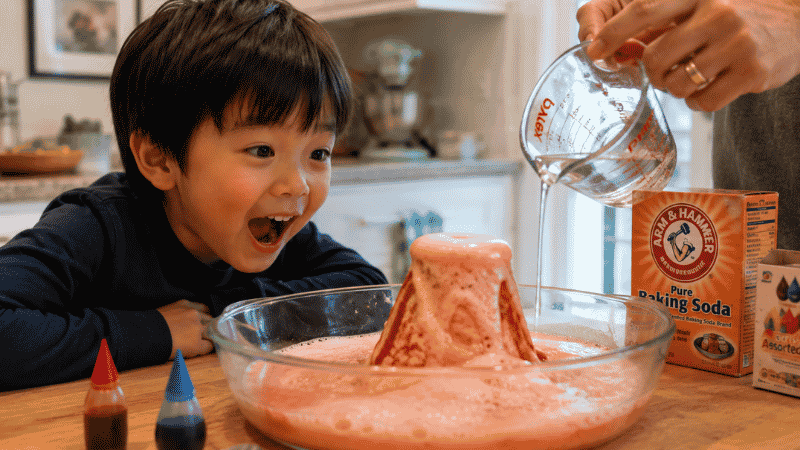
Easy home science experiments requiring minimal supplies:
Baking soda + vinegar volcano: Classic, always works, endlessly repeatable with variable amounts. Add food coloring for visual interest.
Dancing raisins: Drop raisins into carbonated water and watch them rise and fall as bubbles attach and detach. Simple explanation: buoyancy and gas. Endlessly fascinating to kids who’ve never seen it.
Oobleck (cornstarch + water): This one requires some mess tolerance, but the non-Newtonian fluid properties (it acts solid when hit, liquid when handled gently) are genuinely astonishing even to adults. A solid 30 minutes of exploration for most kids.
Egg in a bottle: For 7–8 year olds with close adult supervision. Place a hard-boiled peeled egg on the mouth of a glass bottle, drop a burning piece of paper inside, and watch the egg get sucked in as the air cools. The physics explanation afterward is the real gift.
Board Game Deep Dives
A rainy day is the ideal occasion to actually learn a board game that’s been sitting on the shelf — not just play a fast round, but really learn the rules, play multiple times, develop strategy.
For 5–6 year olds: Sleeping Queens, Blokus, Sequence for Kids
For 7–8 year olds: Ticket to Ride (the simpler versions), Pandemic (the junior version is genuinely excellent), Sushi Go!
The multi-round experience of a rainy day game session is different from a quick weeknight play — kids develop real strategic thinking when they have time to play the same game four times in a row.
The Busy Toys for Toddlers Worth Having on Standby
Some toys are specifically worth keeping in reserve for rainy days — not because they’re expensive or complex, but because novelty is genuinely motivating and a toy that hasn’t been seen in three weeks feels like a new toy.
The Rainy Day Toy Reserve:
Magnetic drawing board — Quiet, mess-free, resets instantly. Works from 18 months through age 6 in different ways. Buy this once and use it for years.
Busy board (for under 3) — Buckles, zippers, velcro, buttons. The mechanical fascination that defines 12–24 months means a good busy board can occupy a young toddler for genuinely impressive stretches.
Marble run (for 3.5+) — Building it is the engineering challenge; watching it work is the reward. A moderate-complexity marble run is one of the highest-value indoor toys for toddlers in the preschool years.
Floor puzzle (large format) — A 100-piece floor puzzle spread out on the living room floor becomes a whole-day project. Return to it in stages. There’s something genuinely satisfying about the scale.
Sticker activity books — The reusable kind (Melissa & Doug’s sticker scenes) where stickers can be repositioned repeatedly. One book, many sessions of engagement.
The 10-Minute Rainy Day Fix (When You Have No Time to Set Up)
Sometimes you don’t have 20 minutes to construct an obstacle course. Sometimes you need something to work right now, with zero prep, while something is also happening on the stove.
These are your 10-minute no-prep options:
“I Spy” with whatever is in the room — No materials, no setup. Works from age 2 upward. Start it yourself and hand it off.
Fill a pot and give them spoons — For under-2s, a pot of water on a towel on the kitchen floor with a few plastic cups and spoons is a complete sensory activity. Zero prep.
Tape activities — Painter’s tape on the floor creates roads for toy cars, balance beams, hopscotch, letter tracing. Peel off when done.
Sorting and organizing — Give a toddler a muffin tin and a pile of small objects of different colors or sizes and ask them to sort. This sounds too simple and is consistently more engaging than it sounds.
Building challenge — “Can you build the tallest tower you can with whatever you find?” Suddenly blocks that were “boring” become competitive engineering.
Frequently Asked Questions
What are the best rainy day activities for kids? The most reliable rainy day activities for kids match the age and energy level of your specific child. For toddlers: living room obstacle courses, sensory bins, Play-Doh. For preschoolers: fort building, art setups, simple baking. For school-age kids: LEGO projects, science experiments, board game deep dives. The activities that sustain engagement longest are almost always ones where the child is in control of the outcome.
How do I keep a toddler entertained indoors all day? The rotation strategy is your most powerful tool: plan for 4–5 different activity types across the day, and switch before boredom fully sets in rather than after meltdown begins. Move first (obstacle course, dance party), then create (art, Play-Doh), then explore (sensory bin, science), then imagine (fort, pretend play). Snacks are also doing real work in between.
What are good indoor activities for toddlers on rainy days without making a mess? Magnetic drawing boards, reusable sticker books, LEGO DUPLO, simple puzzles, and finger puppets are all mess-free or minimal-mess options. Play-Doh with a placema under it is contained. The absolute no-mess option is always a fort with a flashlight and some props — zero cleanup, high engagement.
How do I encourage independent play indoors? Set up the activity and then physically step away. The hardest part of independent play is the first two minutes — once a child is genuinely engaged, they usually continue. Don’t hover. If they call for you, respond briefly and redirect: “I see you’re building a tower — what are you going to add next?” Then leave again.
My toddler won’t do any activities — they just want to watch TV. What do I do? This is extremely common on rainy days. Screens are high-stimulation and require no effort, making them more immediately appealing than anything else. The most effective approach: set a clear screen limit before it starts (not mid-show), have the next activity genuinely set up and ready to go before the screen goes off, and be prepared to play alongside them for the first five minutes to get engagement started.
What should I have stocked for rainy days? A minimal but effective rainy day kit: one fresh set of Play-Doh (kept sealed), a magnetic drawing board, one new or forgotten puzzle, watercolor paints and cardstock, baking soda and vinegar, painter’s tape, and a few books. Total cost under $40 if you spread it over time. Worth it every single time it rains.
The Bottom Line
Rainy day activities for kids don’t have to be elaborate. They don’t have to be Instagrammable. They don’t have to involve 14 ingredients or an hour of adult involvement.
They just have to meet your child where they are — physically, developmentally, emotionally — and give them something real to do with their hands and their imagination.
Move first. Set up simply. Rotate before meltdown. And give yourself permission to let some of the day be genuinely unstructured.
The boredom that feels like failure is often the pause before something genuinely creative happens — if you give it long enough.
Looking for more specific toy recommendations? Browse our guides:
- Best Toys for 2-Year-Olds
- Best Toys for 3-Year-Olds
- Best STEM Toys for Kids
- Best Travel Toys for Toddlers
References
- American Academy of Pediatrics (AAP). (2024). The Power of Play: A Pediatric Role in Enhancing Development in Young Children. https://www.healthychildren.org
- Brown, S. (National Institute for Play). (2023). Play Science — The Patterns of Play. https://www.nifplay.org/science/
- Zero to Three. (2025). Boredom and Creativity in Early Childhood. https://www.zerotothree.org
- Centers for Disease Control and Prevention (CDC). (2023). Developmental Milestones. https://www.cdc.gov/ncbddd/actearly/milestones/
- National Association for the Education of Young Children (NAEYC). (2024). Good Toys for Young Children by Age and Stage. https://www.naeyc.org/resources/topics/play/toys