
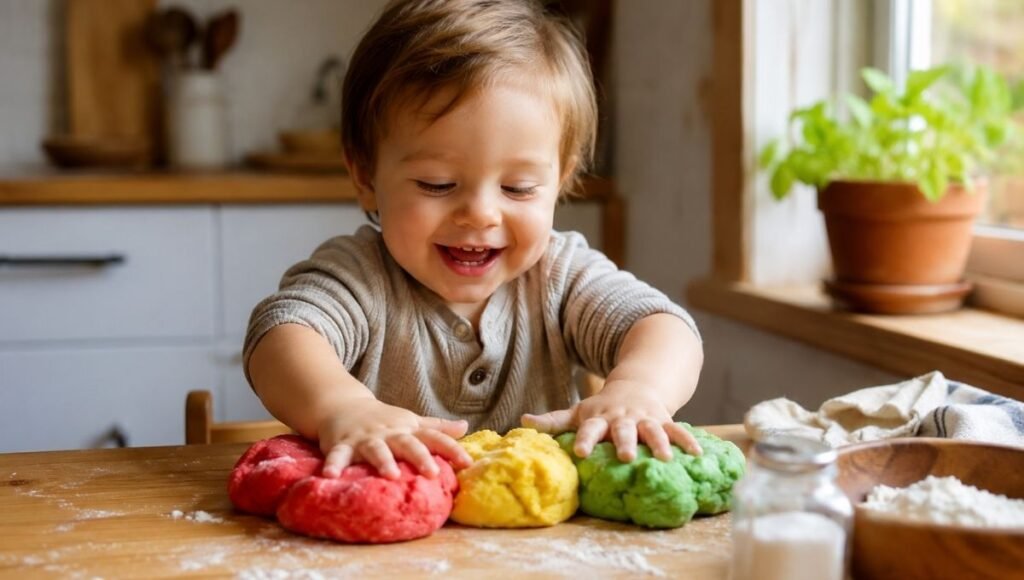
My toddler ate play dough. Not a nibble — a deliberate, enthusiastic mouthful, delivered with eye contact and a look that clearly said “what are you going to do about it?”
If you’ve been there, you know the specific quality of panic that follows. Not the “call poison control immediately” panic — more the “I genuinely don’t know what’s in this stuff and I’m now very aware that I should” panic. Because here’s the thing: most commercial play dough brands don’t fully disclose their ingredients. They list it as “non-toxic” on the can — a claim that’s somewhat regulated but doesn’t mean what parents assume it means.
Non-toxic means the product won’t cause serious harm in the quantities a child might ingest. It doesn’t mean it’s made from wholesome ingredients. It doesn’t mean there are no synthetic dyes, preservatives, or fragrances. And it definitely doesn’t mean you’d be comfortable if your toddler ate a tablespoon of it.
This guide gives you the honest picture: what’s actually in commercial play dough, what “non-toxic” really means for children who mouth everything, which brands genuinely earn the label, and — for parents who want complete peace of mind — a simple homemade non toxic play dough recipe that takes under 15 minutes and costs almost nothing.
Key Takeaways
- “Non-toxic” is not the same as “safe to eat.” ASTM D-4236, the U.S. non-toxic standard for art materials, means a product won’t cause acute harm at typical exposure levels — not that it’s made from food-safe ingredients.
- Standard Play-Doh is not dangerous but does contain undisclosed proprietary ingredients, synthetic dyes, and preservatives that many parents prefer to avoid — especially for children under 2 who still mouth everything.
- Homemade play dough is genuinely safer and takes under 15 minutes. The classic cooked recipe (flour, salt, cream of tartar, oil, water) produces a dough that’s food-safe by default, lasts 2–3 months, and costs almost nothing.
- Play dough has real developmental value. Squeezing, rolling, and pinching clay builds the exact fine motor muscles needed for pencil grip and writing — and has a measurably calming effect on many children.
- If your child eats a small piece of standard commercial play dough, don’t panic. Call Poison Control (1-800-222-1222 in the U.S.) if concerned, but in most cases a small amount of standard play dough causes no serious harm — primarily because of the high salt content, which tastes extremely unpleasant and deters further consumption.
What’s Actually in Commercial Play Dough?
The frustrating truth is: we don’t fully know. Hasbro’s Play-Doh formula is a proprietary recipe, meaning the full ingredient list isn’t publicly disclosed. What we do know from partial disclosures and independent testing is that standard Play-Doh contains:
- Water, salt, and flour (the base)
- Mineral oil (as a softener)
- Synthetic dyes (including FD&C colors)
- Borax or boric acid derivatives (as a preservative in some formulas)
- Artificial fragrances
None of these ingredients are acutely dangerous at the amounts a child might ingest during play. That’s what the “non-toxic” label reflects. But “not acutely dangerous” is a different bar than “safe for a child who regularly puts things in their mouth.”
Borax in particular has received attention in the parenting community. The CDC classifies borax as a substance that can cause irritation and, in large amounts, more serious effects. The amounts present in play dough are generally considered too small to cause harm — but many parents prefer to avoid it entirely, especially for very young children.
The synthetic dye concern is slightly different. Several FD&C dyes used in commercial play dough have been associated with hypersensitivity reactions in sensitive children, and some parents report contact dermatitis from extended play. Again — not common, not dangerous, but real enough to be worth knowing about.
Editor’s opinion: Standard Play-Doh isn’t the bogeyman. It’s a reasonable toy choice for most children. But if your child has allergies, eczema, or sensitive skin — or if they’re under 18 months and definitely mouthing everything — a cleaner alternative is worth the minimal extra effort.
What Does “Non-Toxic Play Dough” Actually Mean?
In the U.S., art materials marketed as “non-toxic” must comply with ASTM D-4236 and be reviewed by a toxicologist. The AP (Approved Product) certification from the Art and Creative Materials Institute (ACMI) is the standard you’re looking for.
But here’s the important nuance: ASTM D-4236 non-toxic certification applies to the product as used in normal art-making contexts — not to a child who eats it. A product can be legitimately non-toxic in art use while still containing ingredients that aren’t appropriate for regular ingestion.
What “non-toxic play dough” should mean for parents:
- ACMI AP certified
- No borax or boric acid
- No synthetic fragrances (linked to skin irritation and potential respiratory sensitivity)
- Disclosed ingredient list (if a brand won’t list their ingredients, that’s a red flag)
- Food-safe dyes (natural dyes or FDA-approved food colorings)
- No known allergens (or clearly labeled if present — wheat/gluten is common in flour-based doughs)
What it doesn’t have to mean:
- Edible (even food-safe play dough shouldn’t be eaten in large quantities due to salt content)
- Organic (organic certification is about farming practices, not safety)
- Completely natural (some synthetic ingredients are safe; some natural ingredients can be irritating)
Non-Toxic Baby Toys and Play Dough: Age-Specific Guidance
Under 18 Months: Skip Store-Bought Entirely
For babies and very young toddlers who are still in full oral exploration mode, standard commercial play dough isn’t the right choice. At this age, everything goes in the mouth — and it’s going to stay that way for a while regardless of how many times you redirect it.
If you want to introduce play dough to a child under 18 months, homemade is the way to go. Specifically, an edible-base recipe using only food-safe ingredients means that when (not if) they eat some, you can watch calmly rather than calculate salt content.
A simple baby-safe option: plain cooked oatmeal or mashed potato dough. These have minimal play life but maximum safety for the very youngest explorers.
18 Months–3 Years: The Main Play Dough Window
This is when play dough really earns its place. Two to three-year-olds have the fine motor development to make intentional shapes, the imagination to assign them meaning (a snake! a birthday cake! a “muddy puddle” for toy cars), and — gradually — less oral exploration than before.
For this age, either a clean commercial brand or homemade is appropriate. The key is choosing something where you’re comfortable with whatever ends up in your toddler’s mouth, because it will.
3–6 Years: Full Play Dough Engagement
By three, most children have moved past habitual mouthing. Play dough at this stage becomes genuinely creative — rolling, cutting, building, sculpting. The developmental focus shifts from sensory exploration toward fine motor precision and imaginative play.
Standard commercial options are more appropriate at this age. The oral ingestion risk is lower, and the wider variety of commercial doughs (scented, textured, color-mixing) offers play experiences that homemade versions may not easily replicate.
The Best Non-Toxic Play Dough Brands (With Honest Assessment)
Play-Doh (Hasbro)
The standard. Widely available, affordable, good texture, consistent quality. ACMI AP certified. The concerns (undisclosed ingredients, synthetic dyes, possible borax derivatives) are real but shouldn’t alarm most parents of children over 18 months who aren’t mouthing habitually.
Best for: Ages 2+ without specific sensitivities. Skip if: Your child has eczema, allergies, or still mouths regularly.
Crayola Dough
Similar profile to Play-Doh. ACMI AP certified, soft texture, good color range. The ingredient disclosure is also incomplete, but the product has a long safety record.
Dough Parlour
Canadian brand, 100% food-grade ingredients, fully disclosed recipe, made with natural scents. More expensive than Play-Doh but genuinely cleaner. Founded by a mom and preschool teacher — which tells you something about the intended audience.
Best for: Parents who want a clean commercial option without making their own.
Kinetic Sand (Spin Master)
Not technically play dough, but frequently mentioned in the same conversations. Made from sand and a small percentage of polydimethylsiloxane (a food-grade silicone). Certified non-toxic. Less appropriate for oral-exploration ages than flour-based doughs.
Homemade (see recipe below)
Genuinely the cleanest option. Complete ingredient control, food-safe by default, costs almost nothing, and lasts 2–3 months with proper storage. Takes 10–15 minutes. If you have 15 minutes and a saucepan, this is almost always the right choice for children under 3.
Non-Toxic Play Dough Recipe: The Classic Cooked Version
This is the recipe I’ve made for my own children more times than I can count. It produces a smooth, pliable, non-sticky dough that lasts 2–3 months in an airtight container. Every ingredient is food-safe.
What You Need
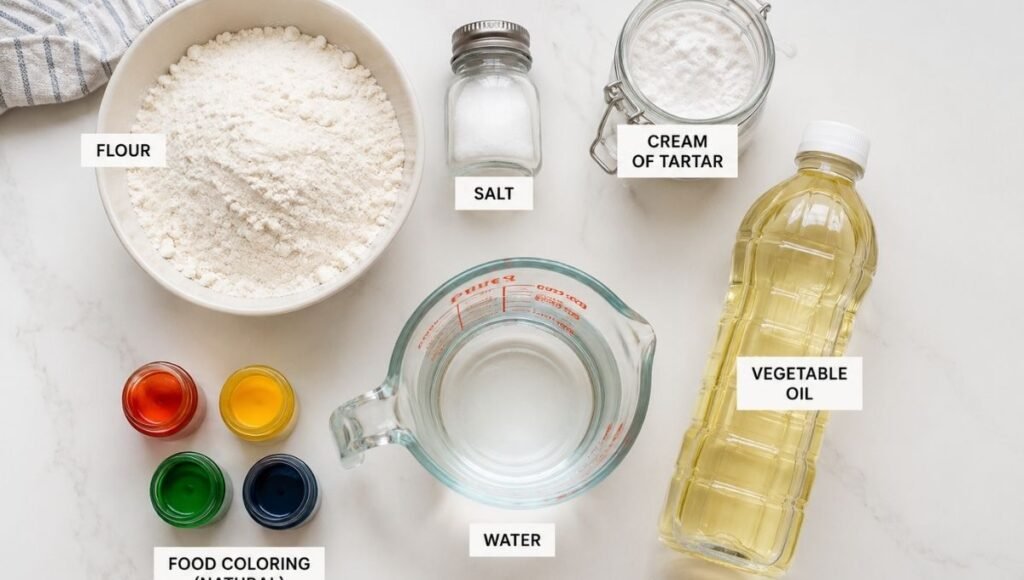
- 2 cups all-purpose flour
- ½ cup fine salt
- 2 teaspoons cream of tartar
- 2 tablespoons vegetable oil (or coconut oil)
- 1½ cups boiling water
- Food coloring (gel food coloring gives the most vibrant colors with the least liquid)
Optional additions:
- 1 teaspoon vanilla extract (pleasant scent, completely safe)
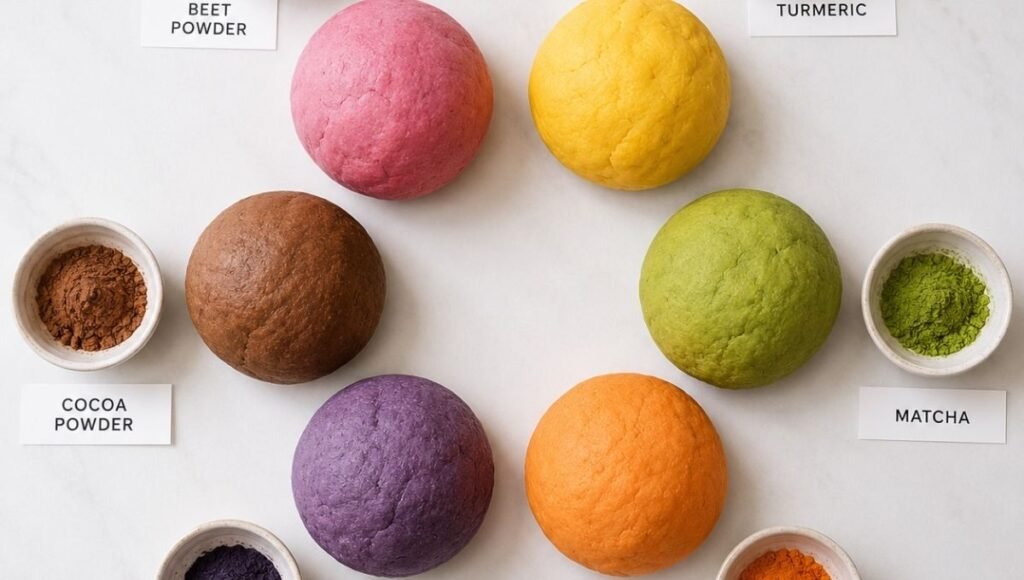
- Natural color alternatives: beet powder (pink/red), turmeric (yellow), matcha (green), spirulina (blue-green)
How to Make It
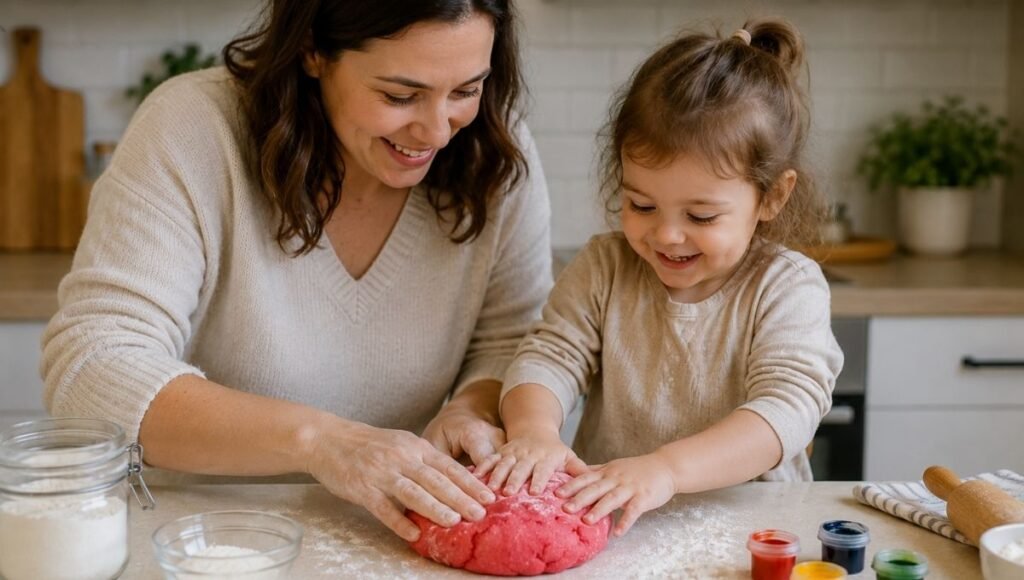
Step 1: Combine flour, salt, and cream of tartar in a medium saucepan. Stir to mix.
Step 2: Add oil and boiling water. Stir vigorously — it will look lumpy at first. Keep stirring.
Step 3: Cook over medium heat, stirring constantly, until the mixture comes together as a smooth ball and pulls away from the sides of the pan. This takes 2–4 minutes. Don’t stop stirring.
Step 4: Remove from heat. Turn out onto a clean surface and let cool for 3–5 minutes (it will be very hot).
Step 5: Once cool enough to handle, knead for 2–3 minutes until smooth and elastic. If using gel food coloring, add it during kneading — fold the dough over the color repeatedly until evenly distributed.
Step 6: Store in an airtight container or sealed zip-lock bag at room temperature. Keeps 2–3 months.
Total time: Under 15 minutes.
Why Cream of Tartar?
Cream of tartar (potassium bitartrate) is the ingredient most people skip when they don’t have it — and the ingredient most responsible for the dough’s longevity and texture. It acts as a natural preservative that keeps the dough from molding, and it produces that smooth, non-sticky texture that makes play dough satisfying to work with. Don’t skip it.
It’s available in the baking aisle of any grocery store, usually near the baking powder.
No-Cook Alternative (When You Have 5 Minutes)
If you need play dough immediately and don’t have time to cook:
- 1 cup flour
- ¼ cup salt
- ½ cup warm water
- 2 teaspoons vegetable oil
- Food coloring
Mix everything together, knead until smooth. This version is softer and less elastic than the cooked version, and it won’t last as long (1–2 weeks maximum). But it takes 5 minutes and requires no heat.
Important safety note: If using raw flour for a no-cook dough, heat-treat the flour first. The CDC recommends not consuming raw flour due to potential E. coli contamination. Spread flour on a baking sheet and bake at 350°F for 5 minutes, or microwave in 30-second intervals until it reaches 165°F throughout.
Natural Color Options for Non-Toxic Play Dough
For parents who want to avoid food coloring entirely, natural colorants work beautifully:
| Color | Natural Source | Notes |
|---|---|---|
| Red/Pink | Beet powder or beet juice | Vibrant, slightly earthy smell |
| Yellow | Turmeric | Very vibrant, can stain surfaces/hands temporarily |
| Green | Matcha powder or spinach juice | Subtle, pleasant |
| Blue-Green | Spirulina powder | Earthy smell, interesting texture |
| Orange | Carrot juice | Subtle, fades over time |
| Purple | Blueberry juice | Beautiful color, fades to grey over days |
| Brown | Cocoa powder | Smells amazing, children love it |
Natural colors are generally less vibrant and less stable than synthetic food coloring — colors will fade over time and vary batch to batch. If you want reliable, bright color, gel food coloring is the most practical choice and remains food-safe.
Play Dough and Development: Why It’s Worth the Effort
Play dough isn’t just a sensory activity that keeps toddlers busy (though it does that very effectively). The developmental case for it is genuinely strong.
Fine motor development: Squeezing, rolling, pinching, and pressing clay directly builds the intrinsic hand muscles — the small muscles inside the palm that control precise finger movement. These are the same muscles that pencil-holding and writing require. Research consistently links sensory play including clay and play dough to fine motor readiness.
Calming and self-regulation: The rhythmic, repetitive action of kneading and rolling activates the sensory processing system in a way that many children find genuinely calming. Occupational therapists frequently recommend play dough as a sensory regulation tool for children who are dysregulated or overstimulated.
Creative and language development: When a toddler makes a “snake” and announces it to you, they’re practicing both creativity and language simultaneously. The play dough is the prompt; the narration is the development.
Math and science concepts: Rolling equal-sized balls, comparing lengths of “snakes,” pressing tools to create patterns — all of this introduces early mathematical concepts (measurement, comparison, pattern) through hands-on exploration.
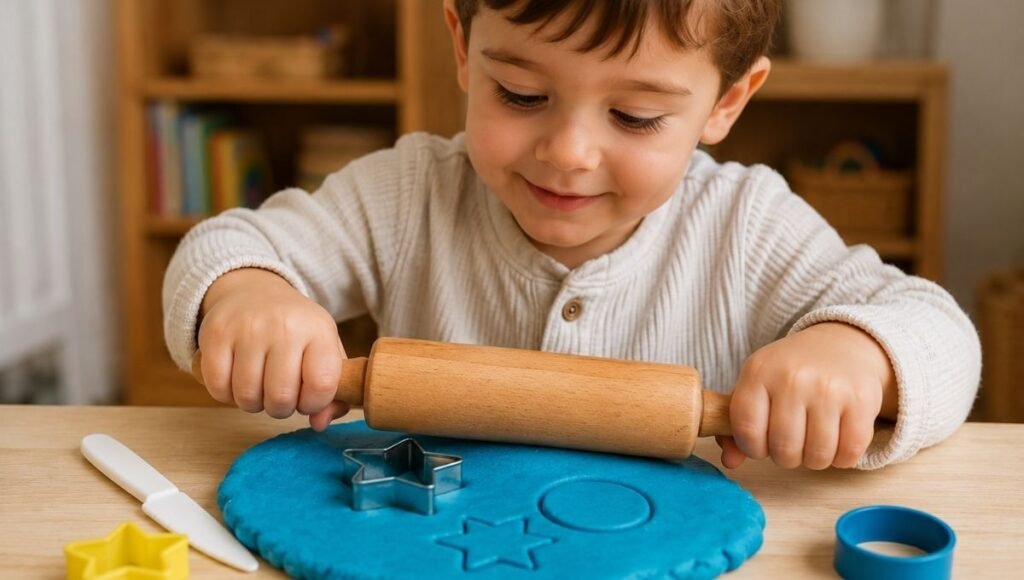
What to Do If Your Child Eats Play Dough
Homemade play dough (standard recipe): This is essentially a very salty flour-and-salt mixture. A small amount won’t cause harm. Large amounts of salt can cause problems — if your child eats more than a few tablespoons, call your pediatrician or Poison Control.
Commercial Play-Doh: A small bite is not an emergency. The very salty taste is a strong deterrent. Call Poison Control (1-800-222-1222) if you’re concerned or if your child ate a significant amount.
Kinetic sand: Not designed for ingestion. A small amount is unlikely to cause serious harm, but call Poison Control for guidance.
Homemade edible/taste-safe dough: If you specifically made a taste-safe version, a child eating some is not a concern. Monitor for any unusual reactions and contact your pediatrician if concerned.
Signs that warrant medical attention: Difficulty swallowing, choking, significant vomiting, severe abdominal pain, or any indication that a child ate a large amount of any play dough.
Frequently Asked Questions
Is Play-Doh non-toxic? Standard Play-Doh is certified non-toxic under ASTM D-4236 and carries ACMI AP certification. This means it won’t cause serious harm at typical art-use exposure levels. It does contain undisclosed proprietary ingredients, synthetic dyes, and preservatives that some parents prefer to avoid, particularly for children under 2 or those with sensitivities.
What’s the safest play dough for babies? For children under 18 months, homemade play dough using only food-safe ingredients is the safest choice. A simple cooked recipe (flour, salt, cream of tartar, oil, water, and food coloring) is completely food-safe in small amounts and takes under 15 minutes to make.
Does homemade play dough last as long as store-bought? The cooked homemade recipe with cream of tartar lasts 2–3 months in an airtight container — comparable to an opened container of commercial play dough. No-cook versions last 1–2 weeks. Store at room temperature (not the refrigerator, which can introduce moisture and cause mold).
Is play dough safe for children with gluten allergies? Standard play dough (commercial and most homemade recipes) contains wheat flour and is not safe for children with celiac disease or severe gluten sensitivity even if they don’t eat it, because contact with the skin can cause reactions. Gluten-free alternatives exist: use gluten-free flour in homemade recipes, or look for specifically gluten-free commercial options.
Why does my homemade play dough go sticky or crumbly? Sticky dough: too much water. Knead in more flour gradually. Crumbly dough: too little water. Knead in a few drops of water at a time until pliable. Storing in the refrigerator can cause condensation and stickiness — keep at room temperature in a sealed container.
What age can children start playing with play dough? Most sources suggest 18 months as the appropriate starting age for supervised commercial play dough play. Taste-safe homemade versions can be introduced earlier, from around 12 months, for children who are ready for supervised sensory exploration. Always supervise children under 3 during play dough play.
The Bottom Line
Non toxic play dough is one of those parenting topics where the marketing creates more anxiety than the actual risk justifies. Standard commercial play dough isn’t dangerous. The concerns around undisclosed ingredients, synthetic dyes, and possible borax are real but not alarming for most children most of the time.
But for parents who want complete peace of mind — especially for children under 2, children with sensitivities, or children who are still very much in the “everything goes in my mouth” phase — homemade is genuinely better, genuinely easy, and genuinely worth the 15 minutes.
A bag of flour, some salt, cream of tartar, oil, and food coloring. That’s it. You know every single ingredient. Your toddler can help make it. And when they inevitably eat some — you can just watch, calmly, without reaching for your phone.
That particular peace of mind is worth the extra effort.
Related guides:
- Best Fine Motor Skills Toys
- Sensory Toys for Babies
- Rainy Day Activities for Kids
- Best Toys for 2-Year-Olds
- Best Toys for 3-Year-Olds
References
- Centers for Disease Control and Prevention (CDC). (2023). Raw Flour Safety. https://www.cdc.gov/foodsafety/communication/no-raw-dough.html
- Art and Creative Materials Institute (ACMI). ACMI AP Non-Toxic Certification. https://acmiart.org
- U.S. National Library of Medicine / MedlinePlus. Borax Poisoning. https://medlineplus.gov/ency/article/002484.htm
- American Academy of Pediatrics (AAP). (2024). Sensory Play and Fine Motor Development. https://www.healthychildren.org
- Poison Control Center. 1-800-222-1222 (U.S. National Poison Control Hotline)
- U.S. Consumer Product Safety Commission (CPSC). Art Materials Safety. https://www.cpsc.gov