
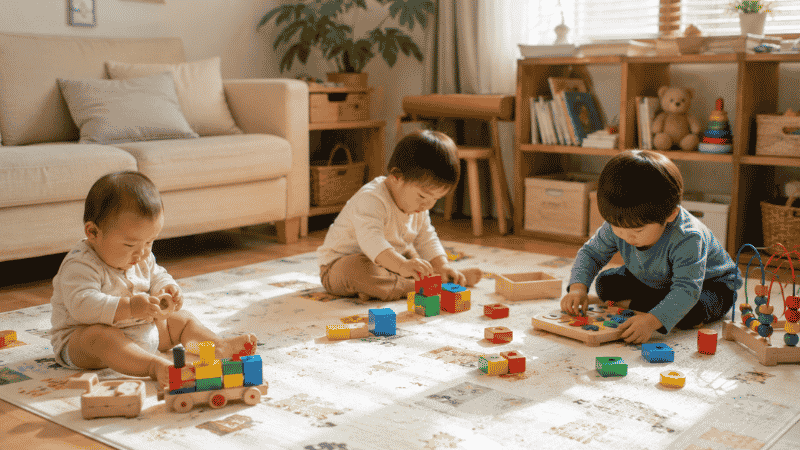
If you’ve ever stood in a toy aisle with a toddler-sized budget and a genuinely bewildered expression, this guide is for you.
Toddler toys are one of the most confusing categories in all of parenting. Your child is changing so fast — what works brilliantly at 14 months can be boring at 18 months and frustrating at 24. The toy that’s “educational” on the box might do nothing for your specific child. And the thing they love most might be a wooden spoon and a pot lid.
Here’s what I’ve learned after two children and years of thinking critically about which toys actually earn their floor space: the secret isn’t finding the perfect toy. It’s understanding where your toddler is developmentally right now — and choosing something that meets them there.
This guide covers everything you need to know about choosing the best toys for toddlers from 12 months to 36 months. We’ll walk through the developmental picture at each stage, the toy categories that genuinely deliver, our specific age-by-age recommendations, safety essentials, and what to skip. No recycled Amazon lists. Just honest, development-first guidance from a parent who’s made all the expensive mistakes so you don’t have to.
Key Takeaways
- Toddlerhood spans 12–36 months — a period of more rapid development than almost any other phase of childhood. A toy that’s perfect at 12 months can be completely wrong at 24 months.
- Open-ended beats single-use, every time. Research from NAEYC consistently shows that simple, open-ended toys (blocks, stacking cups, play dough) produce more complex play and language development than single-function electronic toys.
- You are the most important toy. The American Academy of Pediatrics confirms that caregiver interaction during play doubles the developmental benefit of any toy. No product replaces that.
- Safety standards are non-negotiable. All toddler toys should meet ASTM F963 and CPSC compliance. Everything goes in the mouth — BPA-free, phthalate-free, and no small parts are the baseline, not extras.
- Less is genuinely more. Research consistently shows that toddlers play more creatively and for longer with a small, curated selection of toys than with an overwhelming number. Rotate rather than accumulate.
What Is a Toddler, Really? Understanding the Developmental Window
The word “toddler” technically covers ages 1–3 — but inside that two-year window, your child transforms more dramatically than at almost any other stage of life.
At 12 months, most toddlers are just starting to walk, saying one or two words, and using their mouths to explore everything they can get their hands on. At 36 months, that same child can carry on a conversation, dress themselves (sometimes), draw recognizable shapes, engage in elaborate pretend play, and navigate the rules of simple games with other children.
That gap is enormous. And it means that “toddler toys” isn’t one category — it’s three distinct developmental stages that happen to share a name.
According to the Cleveland Clinic’s developmental milestone guide (updated 2025), toddler development unfolds across five interconnected domains simultaneously:
- Physical development — walking, running, climbing, fine motor control
- Cognitive development — problem-solving, cause-and-effect, early math concepts
- Language development — vocabulary explosion, two-word phrases, full sentences
- Social-emotional development — independence, parallel play, beginning empathy
- Sensory development — touch, sound, movement, proprioception
The best toddler toys support multiple domains at once — and shift as your child moves through each stage.
The 3 Stages of Toddler Play: A Quick Reference
Before we get to specific recommendations, here’s the developmental map that should guide every toy purchase:
Stage 1: Young Toddler (12–18 Months)
The Mission: Cause and effect. “I do something, something happens.”
Your young toddler is learning that their actions produce results — and this discovery is endlessly fascinating to them. They’re also developing intentional reaching and grasping, beginning to walk (or already walking), and entering the “everything goes in the mouth” phase at full intensity.
Toys that work: Cause-and-effect toys with clear single-action responses, stacking rings and cups, push walkers, simple shape sorters, soft fabric books, rattles with satisfying sounds.
Toys that don’t work yet: Anything requiring multi-step interactions, complex puzzles, games with rules.
Stage 2: Middle Toddler (18–24 Months)
The Mission: “Me do it.” Independence and imitation.
The famous “terrible twos” often begin before age two. Your toddler has discovered their own will — and they want to exercise it constantly. They’re also entering parallel play (playing near other children but not yet with them), beginning to imitate everything you do, and experiencing a vocabulary explosion that can add several new words per day.
Toys that work: Play kitchens and pretend play props, simple shape sorters (3–5 shapes), stacking and building toys, magnetic drawing boards, simple puzzles with knob handles, outdoor active toys.
Toys that don’t work yet: Games with complex rules, multi-step building sets, competitive games.
Stage 3: Older Toddler (24–36 Months)
The Mission: Imagination and social complexity.
By two and a half, your toddler’s play has become intentional and narrative. They’re assigning meaning to objects (a banana is a phone), beginning to play cooperatively with other children for short periods, and developing the attention span to sustain one activity for 5–8 minutes with the right toy. Language has transformed — most are speaking in sentences of four or more words.
Toys that work: Pretend play sets, magnetic tiles, simple building sets (DUPLO), art supplies, simple floor puzzles, cooperative board games, outdoor active toys.
Toys that almost work: Simple competitive games (better at 3+), marble runs (fine at 2.5+ with supervision).
Best Toddler Toys by Category
Building and Construction Toys
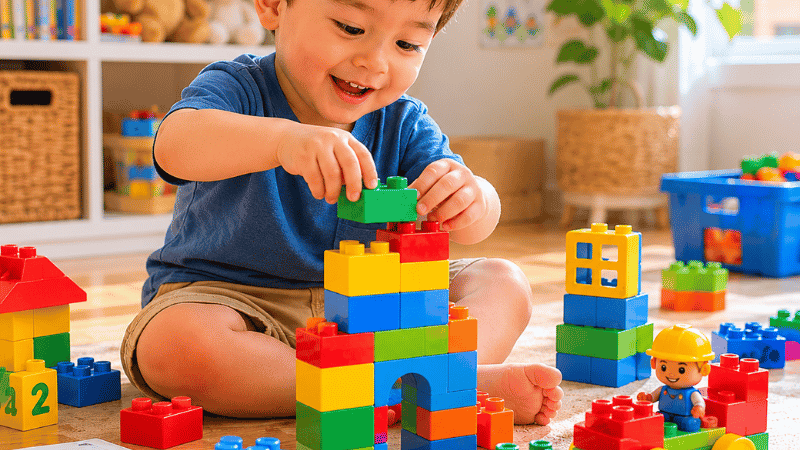
Building toys are the developmental workhorses of toddlerhood — and they work across the entire 12–36 month range, with use that evolves naturally as skills develop.
Why they matter: Block play has been extensively researched. A landmark study published in the Journal of Early Childhood Research found that complex block play in early childhood directly improves math learning — particularly spatial reasoning, which underpins later mathematical thinking. NAEYC consistently identifies blocks as the single most developmentally valuable toy category for young children.
What to choose:
For 12–18 months: Large, smooth stacking cups and rings. Soft DUPLO-sized blocks. Anything your toddler can grasp, stack, and knock down with satisfaction.
For 18–24 months: LEGO DUPLO (the large brick version — eight times larger than standard LEGO and completely safe). These connect with a satisfying click that gives young toddlers the “success” feeling they need to stay engaged.
For 24–36 months: Magnetic tiles (Magna-Tiles or similar) — one of the highest-value toy investments across all of toddlerhood. At two, children click them together and make flat shapes. By three, they’re building enclosures and simple 3D structures. The developmental arc of this single toy is extraordinary.
What to avoid: Standard LEGO bricks (choking hazard under age 4), building sets with too many tiny pieces, complex sets that require adult assembly before play can begin.
→ For detailed age-specific recommendations, see our guides to Best Toys for 1-Year-Olds, Best Toys for 2-Year-Olds, and Best Toys for 3-Year-Olds.
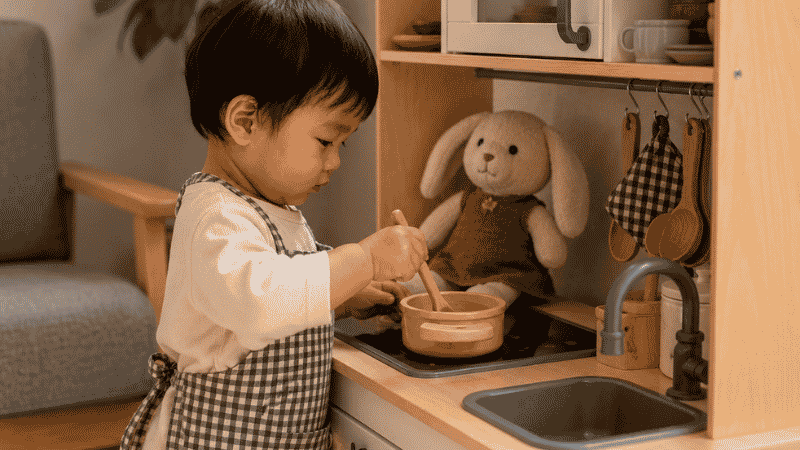
Pretend Play Toys
Pretend play is one of the most developmentally significant activities of toddlerhood — and it begins earlier than most parents realize. Even at 15–18 months, many toddlers are beginning to assign meaning to objects (using a block as a “phone”) and imitate adult behaviors they’ve observed.
By 24–36 months, pretend play becomes the primary vehicle through which toddlers process emotions, practice social scripts, develop language, and build empathy. According to Zero to Three, pretend play at this stage directly supports language development, emotional regulation, and early social competence.
Why it matters: When your toddler feeds their stuffed bunny, puts it to bed, or takes its temperature with a toy thermometer, they’re doing something developmentally profound. They’re practicing empathy, sequencing (first this, then that), and emotional regulation — all simultaneously.
Best pretend play toys for toddlers:
Play kitchen: The single most-used pretend play toy in our house. Position it near your real kitchen so your toddler can “cook alongside you” while you make actual meals. The parallel play and language opportunities are extraordinary.
Baby dolls: For all genders. At this age, nurturing play — feeding, rocking, putting to bed — builds empathy and emotional processing in ways that few other toys can.
Simple tool and doctor kits: At 2–3, children are processing anxiety about doctor visits and other adult experiences. A wooden doctor kit lets them be the one in control — and research consistently shows that this kind of role play helps children work through fears and difficult experiences.
Play food and kitchen accessories: Cut-and-velcro food sets are particularly effective because the cutting action satisfies the “I can do it myself” drive precisely.
Sensory and Fine Motor Toys
Toddlers learn through their senses — and the right sensory toys build the fine motor skills that will eventually support writing, self-care, and academic tasks.
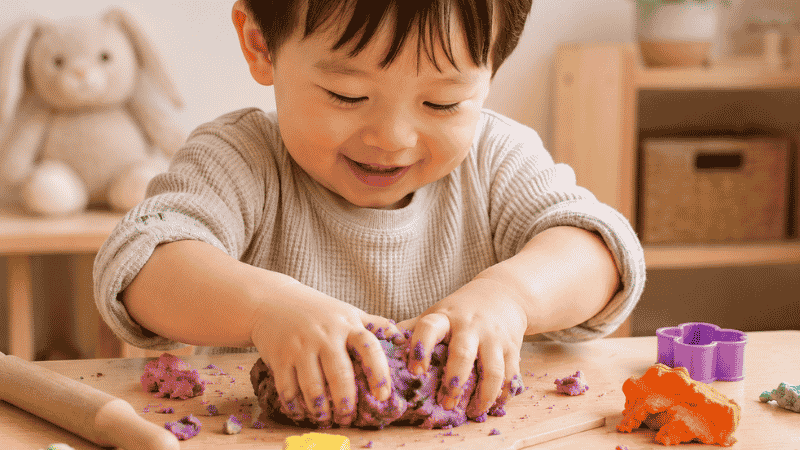
Play dough: One of the best fine motor investments you can make. Squeezing, rolling, pinching, and pressing clay builds the exact hand strength that prepares children for holding a pencil. It also has a genuinely calming effect — the rhythmic, repetitive motion of kneading activates self-regulation pathways.
Stacking and sorting toys: Shape sorters, stacking rings, nesting cups — these are the classics for a reason. They build spatial reasoning, problem-solving, and fine motor precision across the entire toddler range.
Sensory bins and textured toys: Water tables, sand play, textured balls, and fabric toys with varied surfaces all provide the tactile input toddlers crave. These aren’t just entertainment — sensory play builds neural pathways that support cognitive development.
Art supplies: Large-grip crayons, washable finger paints, and simple watercolors introduce toddlers to intentional mark-making — the precursor to drawing and eventually writing. Choose washable, non-toxic options and let the process, not the product, be the point.
→ For babies approaching toddlerhood, see our Sensory Toys for Babies Guide.
Active Play and Gross Motor Toys
Toddlers need to move — and when they don’t get enough physical activity, sleep, mood, and learning all suffer. The right toddler toys for active play channel that extraordinary energy productively.
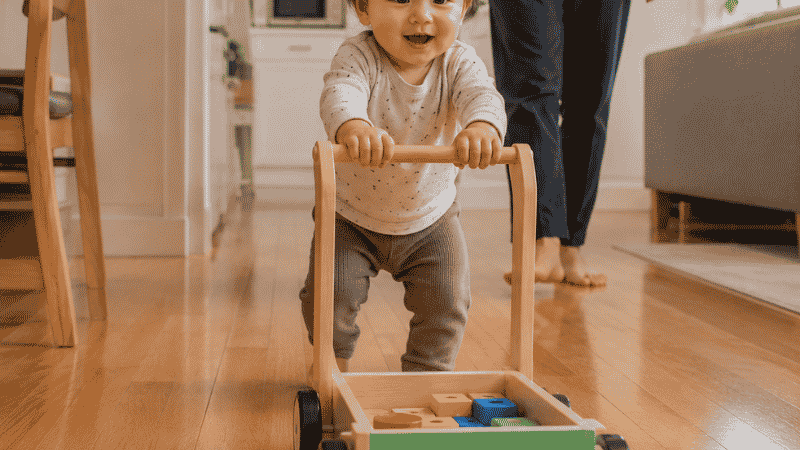
Push walkers: For young toddlers (12–18 months) who are learning to walk, a sturdy push walker with adjustable wheel resistance is one of the most valuable toys you can buy. Look for a wide, stable base that won’t tip easily.
Balance bikes: Twelve to eighteen months is an ideal time to introduce a balance bike — and children who start early typically ride pedal bikes without training wheels by age 3.5–4. Choose a bike where your toddler’s feet rest flat on the ground with a slight knee bend.
Always pair with a properly fitted helmet from the very first ride.
Ride-on toys: For toddlers who aren’t quite ready for a balance bike, a simple foot-propelled ride-on builds leg strength, coordination, and spatial awareness.
Balls: Simple, versatile, and extraordinarily developmental. Rolling a soft ball back and forth with a caregiver builds social turn-taking, language, and gross motor coordination simultaneously. Choose balls larger than 1.75 inches in diameter.
Outdoor exploration: Sand and water tables, simple garden tools designed for small hands, and outdoor climbing equipment appropriate for their age all support physical development and sensory exploration.
Wooden Toys for Toddlers: Why Material Matters
You’ll notice that many of the best toddler toys are made from wood — and there are good reasons for this beyond aesthetics.
Quality wooden toys tend to be:
- More durable: They survive the throwing, biting, and general enthusiastic destruction that toddlers apply to everything
- Safer for mouthing: Natural wood with non-toxic, water-based finishes is among the safest materials for frequent mouth contact
- More open-ended: Wooden toys rarely have buttons, batteries, or single functions — they invite the child to do the work
- Longer-lasting: A good set of wooden unit blocks will be played with from age 1 to age 8 with different kinds of play at each stage
This doesn’t mean all plastic toys are bad — BPA-free, phthalate-free plastics are safe, and some excellent toys (DUPLO, magnetic tiles) are plastic. But when in doubt, wood often delivers better developmental value and longer play life.
Developmental Toys That Actually Develop Something
The word “developmental” has become almost as meaningless as “educational” in the toy industry. Every toy box claims developmental benefits. Most of them aren’t lying — but they’re not telling the full story either.
A genuinely developmental toy for toddlers shares these qualities (based on NAEYC research guidelines):
1. It requires the child to do something. Not just watch, listen, or press a button that triggers an automated response. The child’s action should produce the result — and the child should have to figure out how.
2. It can be used in multiple ways. A toy with one function loses interest quickly. A set of stacking cups can be stacked, nested, used as containers, sorted, and incorporated into water play. That multi-use quality is what creates lasting play.
3. It grows with the child. The best developmental toys for toddlers are ones that remain interesting as skills develop — not ones that become too easy within weeks.
4. It invites language. Whether or not it’s a “language toy,” the best developmental toys give you and your toddler something to talk about together. That caregiver-child conversation is where language development actually happens.
Toys for Toddler Boys and Toys for Toddler Girls: Let’s Address This
When parents search for “toys for toddler boys” or “toys for toddler girls,” they’re usually looking for gift ideas or trying to match their child’s interests. Both are completely valid.
But here’s what the developmental research consistently shows: there are no meaningful cognitive differences between boys and girls in toddlerhood when it comes to what they need from their toys. Every toddler benefits from pretend play, building toys, active physical play, sensory exploration, and creative art — regardless of gender.
The research does show that children begin to internalize gender expectations as early as age 2–3, largely through what they observe adults doing and what toys they’re given. Limiting a toddler to a narrow range of “gender-appropriate” toys is, in developmental terms, limiting their opportunities to build skills.
Practical guidance:
- Follow your child’s genuine interests, whatever they are
- Offer a range of play types: building, pretend play, active play, sensory, creative
- Resist defaulting to color-coded marketing as a proxy for what your child will enjoy
- Remember that the child who loves both trucks and dolls isn’t unusual — they’re building a broader range of cognitive and social skills
Toddler Toy Safety: The Complete Guide
Toddlers put everything in their mouths. They throw things. They climb on them. They test every toy to its absolute structural limit. Safety at this age requires more than just checking an age label.
The Non-Negotiable Safety Checklist
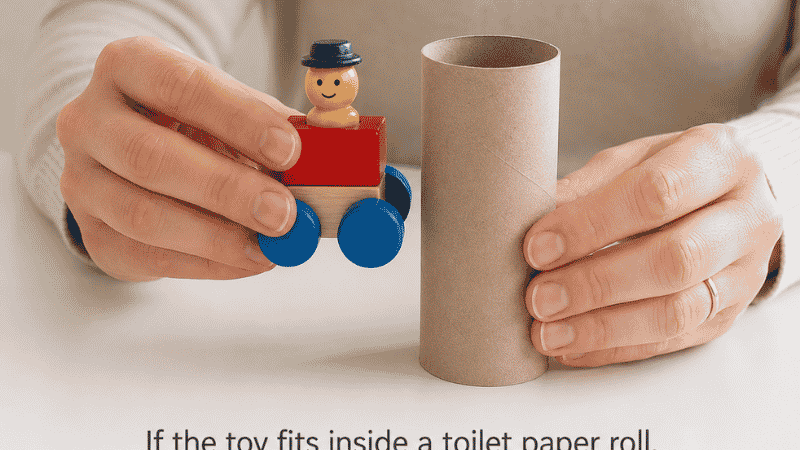
Size: The toilet paper roll test. If any part of a toy (or any part that could break off) fits through a toilet paper roll (approximately 1.25 inches in diameter), it’s a choking hazard. Apply this before every purchase.
Materials:
- BPA-free and phthalate-free for all plastics
- Non-toxic, water-based paint or natural beeswax finish for wooden toys
- Food-grade silicone for teethers and mouthing toys
- Machine washable or easily cleaned for fabric toys
Construction:
- No button batteries (or battery compartments secured with screws — not just snapped)
- No strings or cords longer than 12 inches
- No liquid-filled components
- Firm stitching on all fabric toys — no loose eyes, buttons, or decorative elements
Powerful magnets: Small neodymium magnets (the powerful rare-earth kind) are extremely dangerous if two are swallowed separately — they can attract through intestinal walls and cause life-threatening injuries. This is not a choking hazard; it’s a surgical emergency. Never allow toddlers access to toys with small powerful magnets.
Certifications to Look For
- ASTM F963: The U.S. toy safety standard, required for all toys sold in America
- CPSC compliance: Enforced by the Consumer Product Safety Commission
- BPA-free labeling: Verified, not just implied
Regular Inspection
Check all toddler toys weekly for cracks, tears, loose parts, or deterioration. A toy that was safe when purchased can become unsafe through normal wear.
What NOT to Buy: The Toddler Toy Honest Avoid List
Loud electronic toys that do the thinking for your toddler If a toy talks, sings, and flashes without any input from your child, it’s entertainment — not education. Research consistently shows that passive electronic stimulation produces significantly less language and cognitive development than simple interactive toys that require the child’s participation.
Sit-in baby walkers The American Academy of Pediatrics advises against sit-in baby walkers (the kind where the baby is suspended in a seat). They can delay walking development and are a serious tip-and-fall hazard on stairs. Push walkers are completely different and are excellent.
Sets with 50+ tiny pieces These are cleanup nightmares and choking hazards simultaneously. Simpler is consistently better for toddlers — fewer pieces means deeper engagement with each one.
Screen-based “educational” devices The AAP recommends limiting screen time to one hour per day of high-quality content for children ages 2–5, and avoiding screens entirely (except video calls) for children under 2. A dedicated learning tablet is still a screen, and at this age, hands-on physical play produces measurably better developmental outcomes.
Anything with a “this is what a [boy/girl] toy looks like” vibe Not for developmental reasons — but because it usually means you’re paying for branding rather than quality. The pink version and the blue version of the same toy are often identical in function; save your money for a better toy instead.
Age-by-Age Quick Reference Guide
12–18 Months: The Young Toddler
Best picks: Push walker, stacking rings, soft fabric books, cause-and-effect toy (gentle sound/light response), large smooth blocks, simple rattle, safe teether, textured sensory balls
Skip for now: Standard LEGO, complex shape sorters (too many shapes), toys with small parts
→ Full guide: Best Toys for 1-Year-Olds
18–24 Months: The “Me Do It” Stage
Best picks: LEGO DUPLO, play kitchen, baby doll, simple shape sorter (3–5 shapes), magnetic drawing board, play dough, simple floor puzzle (4–6 pieces), balance bike + helmet, stacking cups
Skip for now: Games with rules, marble runs, anything requiring adult assembly
→ Full guide: Best Toys for 2-Year-Olds
24–36 Months: The Imagination Age
Best picks: Magnetic tiles, doctor/vet kit, dress-up clothes, wooden unit blocks, simple floor puzzle (12–24 pieces), art supplies (washable crayons, finger paint), cooperative board game, outdoor scooter + helmet, play food set
Skip for now: Standard LEGO (unless showing signs of readiness), complex competitive games
→ Full guide: Best Toys for 3-Year-Olds
If You Only Have 10 Minutes: The Master Quick-Pick List
Single best toy investment for any toddler: Magnetic tiles (Magna-Tiles 32-piece — works from age 2 through age 8+)
Best for a 1-year-old: Push walker + stacking rings set
Best for a 2-year-old: LEGO DUPLO Classic Brick Box + play kitchen
Best for a 3-year-old: Magnetic tiles + wooden doctor kit
Best budget toddler gift (any age): Play-Doh 10-color pack — genuinely developmental, endlessly reusable, under $15
Best outdoor toddler toy: Balance bike + properly fitted helmet
Best for language development: Any soft book you’ll read together, every day
Best developmental toys overall: Wooden unit blocks (stays useful from age 1 to age 8)
Frequently Asked Questions
What are the best toddler toys overall? The toys that consistently earn the highest developmental return across the toddler years are: magnetic tiles, LEGO DUPLO, wooden unit blocks, play kitchens, baby dolls, play dough, simple puzzles, and balance bikes. All of these are open-ended, safe, and have a long developmental arc that keeps them useful as your child grows.
How many toys does a toddler need? Far fewer than most people think. Research shows that toddlers play more creatively and for longer with a small, curated selection of 6–10 accessible toys than with an overwhelming number. Store others and rotate them every few weeks — a “new” toy to a toddler is one they haven’t seen in a month.
Are wooden toys better for toddlers? Often yes, but not always. Quality wooden toys tend to be more durable, safer for mouthing, and more open-ended than their plastic equivalents. However, excellent toddler toys also come in BPA-free plastic (DUPLO, magnetic tiles). Focus on the toy’s qualities rather than the material.
What’s the difference between toddler toys and baby toys? Baby toys are designed primarily for sensory stimulation and early motor development — they’re simple, safe for mouthing, and don’t require intentional interaction. Toddler toys begin to introduce cause-and-effect, problem-solving, pretend play, and social interaction. The crossover typically happens around 12 months, but always follow your specific child’s developmental stage rather than the age label.
Are electronic learning toys good for toddlers? Simple cause-and-effect electronic toys (press button → gentle sound) are appropriate. Toys that perform passively without requiring child input, or that have multiple simultaneous inputs and flashing lights, are less developmentally valuable and can overwhelm younger toddlers. At this age, simple always outperforms complex.
What toys help toddlers talk? Any toy that gives you and your toddler something to talk about together. Play kitchens, pretend play sets, board books, stacking toys, and building sets all naturally prompt caregiver narration and back-and-forth conversation — which is where language development actually happens.
When should I be concerned about my toddler’s development? Talk to your pediatrician if your toddler isn’t walking by 18 months, isn’t using at least 50 words by 24 months, shows no interest in pretend play by 30 months, or has lost skills they previously had. Early identification of developmental differences allows for early support, which makes a significant difference.
The Bottom Line
The very best toddler toys share a simple quality: they invite your child to do something, figure something out, or create something — and then they grow with your child as those abilities develop.
You don’t need to fill a playroom. You need a handful of well-chosen, safe, open-ended toys — and your own presence on the floor beside them.
That part costs nothing. And it’s still the most powerful developmental tool in the room.
Explore our complete age-by-age series:
- Best Toys for 6-Month-Olds — the stage just before toddlerhood
- Best Toys for 1-Year-Olds — the young toddler
- Best Toys for 2-Year-Olds — the “me do it” stage
- Best Toys for 3-Year-Olds — the imagination age
- Best Toys for 4-Year-Olds — kindergarten preparation
- Best Toys for 5-Year-Olds — the kindergarten year
- Best Sensory Toys for Babies — sensory development in the first year
References
- Centers for Disease Control and Prevention (CDC). (2023). Developmental Milestones: 12 Months, 2 Years, 3 Years. https://www.cdc.gov/ncbddd/actearly/milestones/
- American Academy of Pediatrics (AAP). (2024). The Power of Play: A Pediatric Role in Enhancing Development in Young Children. https://www.healthychildren.org
- National Association for the Education of Young Children (NAEYC). (2024). Good Toys for Young Children by Age and Stage. https://www.naeyc.org/resources/topics/play/toys
- Zero to Three. (2025). Best Toys for Babies and Toddlers. https://www.zerotothree.org/resource/best-toys-for-babies-toddlers/
- Bower, C., et al. (2017). The effect of block play on mathematics achievement. Journal of Early Childhood Research.
- Cleveland Clinic. (2025). Toddler Developmental Milestones. https://my.clevelandclinic.org/health/articles/22625-toddler-developmental-milestones
- Harvard Center on the Developing Child. (2023). Brain Architecture. https://developingchild.harvard.edu
- U.S. Consumer Product Safety Commission (CPSC). Toy Safety. https://www.cpsc.gov/Safety-Education/Safety-Guides/Toys