
Six months. Half a year. And somehow, this tiny person who spent their first weeks mostly sleeping and eating has transformed into someone who grabs everything in reach, rolls across the room with surprising speed, and looks at you with an expression that says, very clearly, “entertain me.”
If you’re shopping for the best toys for 6 month old babies and feeling genuinely confused by the options — welcome to a club with millions of members. The baby toy market at this age is overwhelming, full of flashing, singing, buzzing gadgets that all claim to be “developmentally essential.” Most of them aren’t.
Here’s what I’ve learned: six months is a pivot point. Your baby has left the purely sensory newborn stage behind. They’re sitting up with support, reaching with intention, transferring objects from hand to hand, and starting to understand that when they do something, something happens. That cause-and-effect discovery is one of the biggest cognitive leaps of the first year — and the right toys can actively support it.
This guide covers exactly what your 6-month-old needs from their toys, which types deliver real developmental value, what’s safe, and — honestly — what’s a waste of money at this stage.
Key Takeaways
- Six months is a motor milestone explosion. According to the CDC, most 6-month-olds are pushing up on arms during tummy time, sitting with support, and beginning to transfer objects between hands — all of which change what toys are useful.
- Cause and effect is the cognitive headline. When your baby drops a toy and watches it fall, shakes a rattle and hears a sound, or presses a button and sees a light — they’re learning that their actions produce predictable results. This is a foundational cognitive concept.
- The best toys for 6 month old babies work across multiple skills at once. Look for toys that engage two or more developmental areas simultaneously — fine motor + sensory, or visual + cause-and-effect.
- Safety is non-negotiable. Everything goes in the mouth at this age. BPA-free, phthalate-free, no small parts, no button batteries, no liquid-filled components. These are the baseline, not optional extras.
- You are still the most important toy. The American Academy of Pediatrics confirms that responsive caregiver interaction during play doubles the developmental benefit of any toy. No product replaces that.
What’s Actually Happening at 6 Months: Understanding the Developmental Moment
Before we talk about specific toys, let’s understand what your baby’s brain and body are working on right now — because this context makes every shopping decision clearer.
At six months, most babies are:
- Sitting with support (and beginning to develop the core strength to sit independently, which typically happens around 7–8 months)
- Rolling in both directions — and using rolling to get where they want to go
- Reaching intentionally — not just swiping randomly, but aiming for specific objects
- Transferring objects hand to hand — a fine motor milestone that requires bilateral coordination
- Mouthing everything — this is still primary exploration at this age, not a habit to break
- Responding to faces and voices with growing social engagement
- Beginning to understand object permanence — the concept that things exist even when you can’t see them (peek-a-boo is suddenly fascinating for this reason)
The best toys for 6 month old babies are ones that meet your child at these specific milestones — not toys designed for a 3-month-old who isn’t reaching yet, and not toys designed for a 12-month-old who’s cruising furniture.
Best Toys for 6-Month-Olds: The Categories That Actually Work
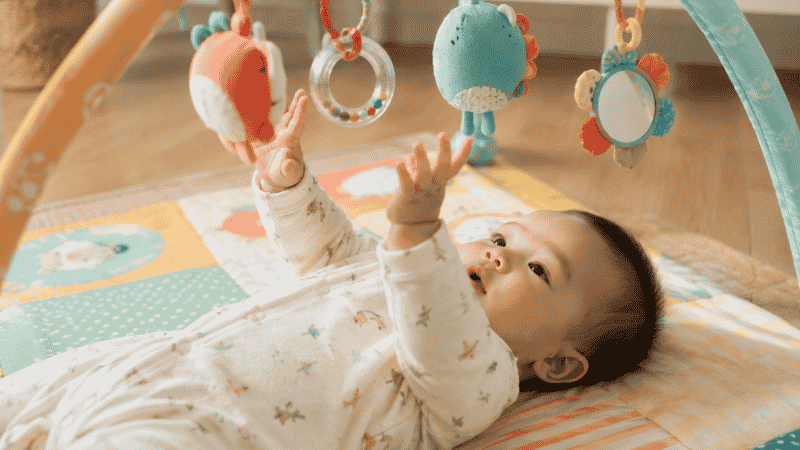
Play Gyms and Activity Mats: Still the Workhorse
You might think your baby has outgrown the play gym — they haven’t. At 6 months, a good play gym becomes even more useful because your baby can now reach intentionally for hanging toys, bat them with coordination, and begin to sit at the edge of the mat and explore the elements from a new position.
Look for a play gym with:
- Hanging elements at varying heights to encourage different reaching directions
- A mix of textures, sounds, and visual contrasts among the dangling toys
- A mat large enough that your baby can roll without rolling off
- Removable toys they can hold and explore independently
If you’re buying for the first time at 6 months, look for a play gym that’s designed to grow with your baby — one that works for tummy time, back play, and early sitting, so you get more than a few weeks of use.
Toys for 6 Month Old Babies: The Rattle Upgrade
Your newborn rattle was designed for passive sound and easy grasping. At six months, your baby is ready for something more engaging. Look for rattles that:
- Have interesting textures on different surfaces (bumps, ridges, smooth sections)
- Produce a satisfying but not loud sound when shaken
- Are easy to transfer between hands (a good ring or dumbbell shape works well)
- Are completely safe for mouthing — one-piece construction with no detachable parts
The Manhattan Toy Winkel is a perennial recommendation for this age: its looping tubes are easy to grasp from any angle, satisfying to mouth, and the gentle rattle is appropriate for sensitive baby ears.
Soft Stacking Rings and Cups
At 6 months, your baby won’t be stacking yet — but they will be holding, mouthing, banging, and passing rings from hand to hand. These simple toys are ideal for this because:
- They’re safe in the mouth (choose BPA-free silicone or soft fabric rings)
- They require two-handed coordination to hold and manipulate
- They’re light enough for small hands to manage confidently
- In a few months, they’ll naturally evolve into stacking play — long developmental arc
A classic stacking ring set is one of the best-value toys you can buy at this stage precisely because it stays useful for so long.
Textured Sensory Balls
At 6 months, babies are not throwing balls — but they are very interested in picking them up, squeezing them, mouthing them, and watching them roll when they accidentally drop them. A small set of soft, textured balls of slightly different sizes delivers:
- Tactile sensory exploration (different textures on different balls)
- Fine motor practice (gripping round objects is harder than gripping rattles)
- Early cause-and-effect learning (drop it → it rolls → interesting!)
- Safe mouthing texture for teething comfort
Choose balls that are larger than 1.75 inches in diameter — small enough for baby hands to grip, large enough that they can’t be swallowed.
Best Toys for 6-Month-Olds That Support Sitting Development
Six months is when babies are actively building the core strength and balance needed to sit independently. The right toys can support this milestone by giving babies a reason to hold their position and reach.
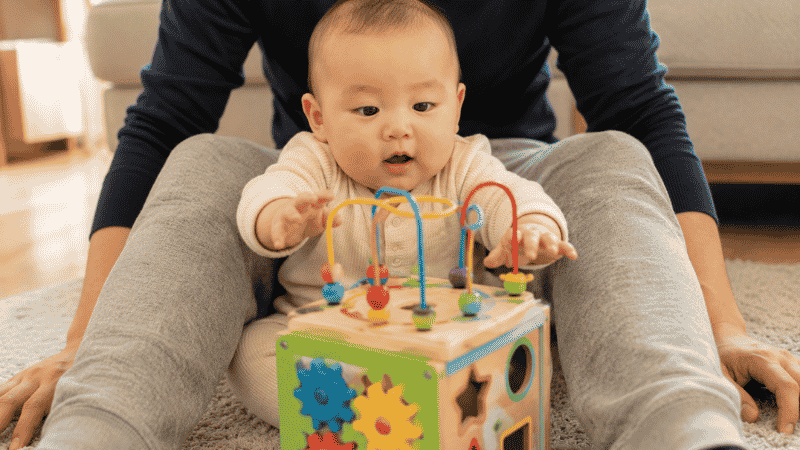
Toys for 6 Month Old Sitting Practice: Activity Cubes
An activity cube — the kind with different interactive elements on each side — is excellent for this stage when positioned just in front of a baby who is sitting with support. The activities give them a reason to stay upright and engaged while their core muscles get a workout.
Look for activity cubes with:
- Large, easy-to-manipulate elements (no tiny buttons or small spinning pieces)
- BPA-free materials throughout
- A sturdy base that won’t tip when your baby leans on it
- Elements at a height appropriate for a sitting 6-month-old
Soft Books with Textures and Flaps
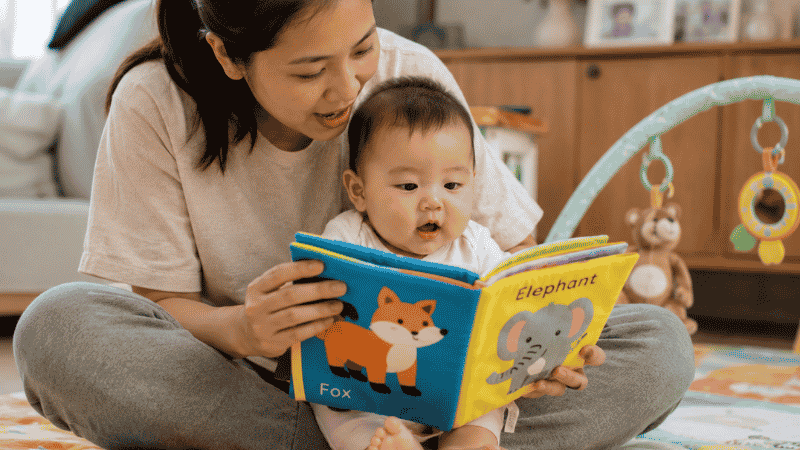
Fabric books with lift-the-flap elements and varied textures are perfect for 6-month-old sitting play. Your baby will mouth the pages (that’s fine — choose washable options), turn them with developing fine motor control, and respond to the simple images of faces and animals.
Read alongside your baby and narrate: “There’s the cat! What does the cat say?” Even though they can’t respond verbally yet, this back-and-forth interaction is building language foundations that will matter enormously in the coming months.
Best Toys for 6-Month-Olds During Tummy Time
Tummy time is still essential at 6 months — it builds the arm, shoulder, and neck strength needed for crawling, which typically arrives between 7–10 months. The difference now is that your baby has more tolerance for it and can engage actively with what’s in front of them.
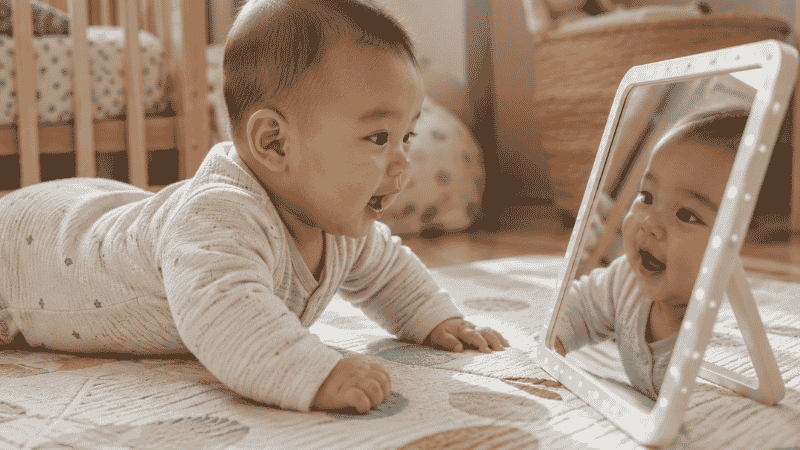
Tummy Time Mirrors
A soft, shatter-resistant floor mirror placed in front of your baby during tummy time gives them something genuinely fascinating to look at while their neck muscles work. Babies at this age are deeply interested in faces — including their own — and a mirror provides visual engagement that makes tummy time sessions longer and more productive.
Toys for 3 Month Old vs Toys for 6 Month Old: What Changes
If you’ve been using simpler newborn toys, now is a natural time to reassess. The key differences in what 6-month-olds need compared to 3-month-olds:
| Stage | 3 Months | 6 Months |
|---|---|---|
| Motor | Batting, grasping beginning | Intentional reaching, hand-to-hand transfer |
| Visual | High-contrast patterns | Moving objects, faces, mirrors |
| Cognitive | Basic cause-and-effect | More complex sequences, object permanence beginning |
| Sensory | Touch and sound | Touch, sound + taste (mouthing everything) |
| Social | Responds to voices | Active engagement, turn-taking beginning |
Toys that work well at 3 months (simple high-contrast books, soft rattles) are still appropriate, but your 6-month-old is ready for more complexity.
Teething Toys for 6-Month-Olds: What’s Safe and What Works
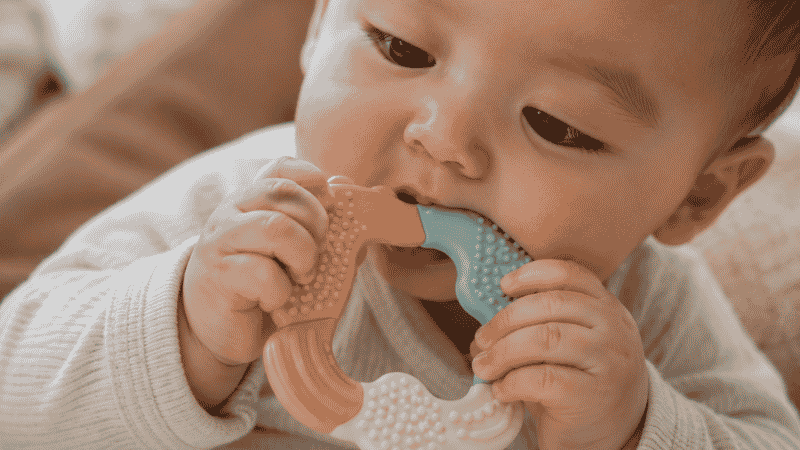
Teething typically begins somewhere between 4–7 months, and at 6 months, most babies are either actively teething or will be very soon. Everything goes in the mouth at this age — which means your teething toy standards should apply to every toy you choose, not just dedicated teethers.
What Makes a Safe Teether
Material safety:
- Food-grade silicone: The gold standard. Soft, durable, available in many textures, easy to clean, completely free of BPA and phthalates.
- Natural rubber: Excellent option. Look for 100% natural rubber without chemical fillers (Sophie la Giraffe is the most famous example, though check for any recent safety updates before purchasing).
- Avoid: Liquid-filled teethers (can leak or be punctured), hard plastic teethers that could injure gums, teethers with small detachable parts, painted designs that can flake.
Temperature guidance:
- Chilling a silicone teether in the refrigerator (not freezer) for 15 minutes before offering soothes inflamed gums effectively.
- Never freeze a teether solid. Extreme cold can damage delicate gum tissue and cause discomfort rather than relief.
Multi-purpose teethers: At 6 months, the best teethers double as sensory toys — varied textures, easy to grip, satisfying to manipulate even beyond the teething phase. A good teether isn’t single-use; it’s a developmental tool that happens to soothe gums.
Safety at 6 Months: The Complete Checklist
Six-month-olds put everything in their mouths. This is developmentally normal and expected — it’s how they explore. Your safety checklist for every single toy at this age:
Size: No parts that fit through a toilet paper tube. If any piece of a toy — or any piece that could break off — fits through a toilet paper tube (approximately 1.25 inches in diameter), it’s a choking hazard.
Materials:
- BPA-free and phthalate-free for all plastics
- Non-toxic, water-based finishes on any painted surfaces
- Food-grade silicone or natural rubber for teething toys
- Machine washable or easily wiped clean for fabric toys
Construction:
- No button batteries (or battery compartments secured with screws)
- No strings or cords longer than 12 inches
- No liquid-filled chambers
- Firm stitching with no loose eyes, buttons, or decorative elements
Certifications:
- ASTM F963 (required U.S. toy safety standard)
- CPSC compliance
- BPA-free labeling verified (not just implied)
Regular inspection: Check all toys weekly for cracks, tears, loose parts, or deterioration. A toy that was safe when purchased can become unsafe through normal wear.
Toys for 9 Month Old Babies: What to Plan For Next
Shopping ahead? Here’s what changes as your baby approaches 9 months and why it matters for your toy purchases now:
At 9 months, most babies are:
- Sitting independently
- Crawling or close to it
- Beginning to pull to stand
- Developing the pincer grasp (picking up small objects with thumb and index finger)
- Waving, clapping, beginning to understand simple words
This means toys that will serve you at 9 months include: simple shape sorters (not yet solvable, but interesting to mouth and manipulate), push walkers, simple stacking cups (beginning to nest and stack), and pull-to-stand activity toys.
The good news: most of the toys that work at 6 months — stacking rings, textured balls, soft books, activity cubes — remain useful at 9 months with a different kind of play. You don’t need to replace everything; you just need to add a few new challenges.
What NOT to Buy for a 6-Month-Old
Loud electronic toys with multiple flashing lights Six-month-olds are still easily overstimulated. Toys with sudden loud sounds, fast-strobing lights, or multiple simultaneous sensory inputs can cause distress rather than delight. Simple cause-and-effect is the goal — press button, hear gentle sound — not sensory overload.
Toys with complex multi-step interactions Your baby’s working memory and attention span are still developing. A toy that requires multiple steps to produce a result will just be frustrating. Keep it: one action, one clear result.
Anything with small parts or decorative elements that can detach This seems obvious, but many toys marketed for babies have small decorative pieces — embroidered eyes, plastic decorations, small bells — that can come loose under persistent mouthing. Inspect every toy carefully before offering it.
Jumpers and walkers (the sit-in kind) The American Academy of Pediatrics advises against sit-in baby walkers because they can delay walking development and pose significant safety risks (particularly on stairs). Skip these entirely — a play gym or floor time with appropriate toys is far more developmentally valuable.
Walker wagons before your baby is pulling to stand Push walkers are excellent toys — but not at 6 months, when your baby isn’t standing yet. Save these for when your baby is pulling up on furniture (typically 8–10 months). Using them too early creates frustration rather than developmental benefit.
If You Only Have 10 Minutes: The Quick-Pick Summary
Birthday or shower gift needed now? Here’s the shortlist:
- Best overall: Manhattan Toy Winkel Rattle + activity mat combination
- Best for tummy time: Soft tummy time mirror + textured sensory ball set
- Best for sitting play: Simple wooden or plastic activity cube (BPA-free)
- Best teether: Food-grade silicone teether with varied textures
- Best fabric toy: Soft crinkle book with lift-the-flap elements
- Best value: Stacking rings (soft silicone or classic plastic, BPA-free)
- Best budget pick: Oball Classic (easy grip, gentle rattle, completely safe)
Frequently Asked Questions
What are the best toys for 6-month-old babies? At 6 months, the most developmentally useful toys are ones that support the milestones your baby is actively working on: sitting with support, intentional reaching, hand-to-hand transfer, and early cause-and-effect understanding. Rattles with varied textures, soft stacking rings, activity mats, tummy time mirrors, and safe teethers all deliver strong developmental value at this stage.
What toys help 6-month-olds develop? Toys that engage fine motor skills (reaching, grasping, transferring), support tummy time and core development, and introduce cause-and-effect concepts are most valuable. Simple cause-and-effect toys — shake it and hear a sound, press it and see a light — directly support the cognitive development happening at this age.
Are electronic toys okay for 6-month-olds? Simple electronic toys with one clear cause-and-effect interaction (press button → gentle sound) are appropriate. Avoid toys with multiple flashing lights, loud sudden sounds, or complex interactions. The AAP notes that passive entertainment — toys that perform for your baby without requiring their input — is significantly less developmentally valuable than interactive play.
What’s the difference between toys for 3-month-olds and 6-month-olds? At 3 months, babies are primarily visual and auditory — they respond to high-contrast patterns and gentle sounds but don’t yet reach intentionally. At 6 months, they’re active participants: reaching, grasping, mouthing, and transferring objects between hands. Six-month-old toys need to support this active engagement rather than just provide visual or auditory stimulation.
How many toys does a 6-month-old need? Fewer than you might think. Research consistently shows that babies engage more deeply with a small, curated selection of toys than with an overwhelming number. 4–6 accessible toys at a time is plenty — rotate others in storage every few weeks to keep things feeling fresh.
When should I be concerned about my 6-month-old’s development? Talk to your pediatrician if your 6-month-old isn’t reaching for objects, doesn’t respond to sounds, shows no interest in faces, can’t support any weight on their legs when held upright, or has lost skills they previously had. Early developmental support makes a significant difference — don’t wait to raise concerns.
What’s the best gift for a 6-month-old baby? Practical gifts that parents will actually use: a quality activity mat with hanging toys, a set of safe teethers, a soft fabric book, or a classic stacking ring set. The most appreciated baby gifts at this stage are ones that are clearly safe, genuinely developmental, and thoughtfully chosen — not the loudest or most elaborate toy on the shelf.
The Bottom Line
Shopping for the best toys for 6 month old babies doesn’t require an overwhelming investment in the flashiest products on the shelf. It requires understanding this specific developmental moment — what your baby can do right now, what they’re working toward, and what kind of input their rapidly developing brain is hungry for.
Simple, safe, and appropriately challenging. A toy that invites your baby to reach, grasp, transfer, mouth, and discover that their actions produce results. A toy that stays interesting for more than two minutes.
And then — sit on the floor with them. Talk about what they’re doing. Follow their lead. That part costs nothing, and it’s still the most powerful developmental tool in the room.
Ready for what comes next? Read our guide to the Best Toys for 1-Year-Olds for when your baby approaches their first birthday, or explore our complete Sensory Toys for Babies Guide for the full first-year sensory picture.
References
- Centers for Disease Control and Prevention (CDC). (2023). Developmental Milestones: 6 Months. https://www.cdc.gov/ncbddd/actearly/milestones/milestones-6mo.html
- American Academy of Pediatrics (AAP). (2024). The Power of Play: A Pediatric Role in Enhancing Development in Young Children. https://www.healthychildren.org
- Zero to Three. (2025). Best Toys for Babies and Toddlers. https://www.zerotothree.org/resource/best-toys-for-babies-toddlers/
- Harvard Center on the Developing Child. (2023). Serve and Return Interaction Shapes Brain Circuitry. https://developingchild.harvard.edu
- U.S. Consumer Product Safety Commission (CPSC). Toy Safety. https://www.cpsc.gov/Safety-Education/Safety-Guides/Toys
- National Association for the Education of Young Children (NAEYC). (2024). Good Toys for Young Children by Age and Stage. https://www.naeyc.org/resources/topics/play/toys