
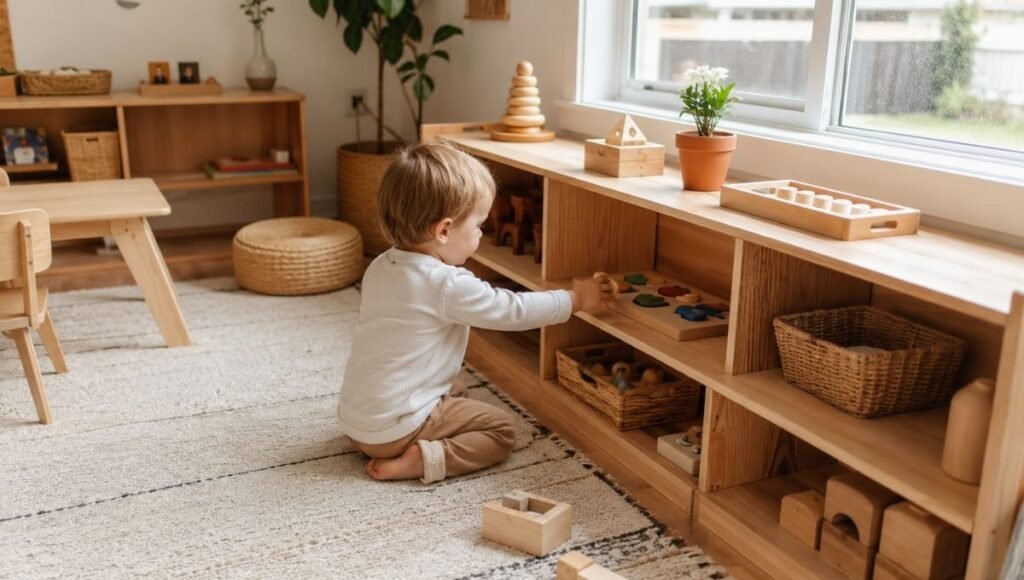
You’ve probably seen the word “Montessori” on everything from wooden toy sets to children’s furniture to Instagram nurseries with color-sorted bookshelves and open toy displays. And if you’re anything like me when I first encountered it, you had one of two reactions: either “this is exactly what I’ve been looking for” or “this feels a little precious.”
Here’s the thing — both reactions are valid. Because the idea of Montessori toys is genuinely excellent. And the marketing of Montessori toys has become so oversaturated that the word has almost lost its meaning.
A toy doesn’t become a Montessori toy by being made of wood. It doesn’t qualify just because it’s beige. A plastic shape sorter can be more genuinely Montessori than an expensive hand-painted wooden toy from an aesthetically curated small shop — if the plastic one actually follows the principles and the wooden one just looks the part.
This guide is about cutting through the aesthetics to the actual substance: what Montessori toys genuinely develop, what makes one authentically Montessori versus just Montessori-adjacent, and which specific toys earn their place at each developmental stage from birth through age 6.
Key Takeaways
- Maria Montessori was a physician, not a toy designer. Her approach — developed in the early 1900s with working-class children in Rome — was based on scientific observation of how children actually learn. The toys that carry her name today should reflect that observation, not just an aesthetic.
- The defining characteristic of a Montessori toy is that the child does the work. The toy provides an invitation and responds to the child’s actions. It doesn’t perform for the child, reward randomly, or replace the child’s thinking with its own output.
- “Isolation of difficulty” is the key design principle. Genuine Montessori materials are designed to teach one concept at a time, clearly. This is why they’re often simple, clean, and single-purpose — not because of aesthetics, but because complexity obscures the learning.
- Real Montessori toys have a “control of error.” The best ones are self-correcting — the child can tell without adult help whether they’ve succeeded or not. This is how Montessori builds independence: children learn from the material itself, not from adult approval.
- Safety and material quality are non-negotiable. Montessori philosophy emphasizes natural, sensory-rich materials for good reason. Wood, cotton, wool, and food-grade silicone provide authentic tactile feedback that plastic often doesn’t — and they’re generally safer for children who still mouth objects.
What Maria Montessori Actually Said (And What She Didn’t)
Before we get to the toys, a brief note on the philosophy — because it changes how you evaluate every product marketed with this name.
Maria Montessori (1870–1952) was Italy’s first female physician. She developed her educational method through direct scientific observation of children, not theoretical framework. Her core insight was radical for her time and remains true today: children have an intrinsic drive to learn, and the adult’s role is to prepare an environment that supports that drive rather than direct or control it.
Her famous phrase was “Help me do it myself.” Not “let me show you how” — “help me do it myself.”
This distinction matters for toy selection. A Montessori toy is one that:
- Invites purposeful activity — there’s something specific to do with it
- Provides sensory feedback — the child feels, hears, or sees the result of their action
- Builds toward independence — mastery of the toy increases capability in real life
- Follows the child’s developmental stage — matches where the child actually is, not where we wish they were
What it doesn’t require:
- Natural wood (though natural materials are preferred for sensory reasons)
- Neutral or earthy colors (though excessive visual stimulation can be distracting)
- A price tag that signals quality
- An Instagram-worthy aesthetic
Montessori Infant Toys: Birth to 3 Months
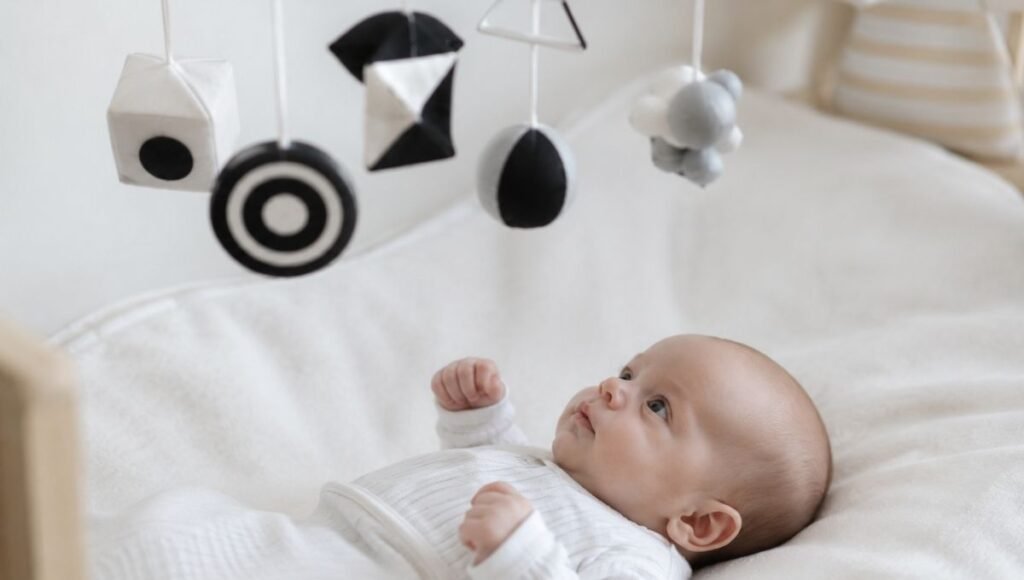
The Montessori approach to infancy is the most counterintuitive for modern parents: less is more, dramatically more than most people expect.
A newborn’s job is to orient to the world — to begin tracking light and movement, to respond to familiar voices, to feel the feedback of their own body. The best Montessori materials for this stage are almost embarrassingly simple.
High-contrast mobiles (Munari Mobile) The Munari mobile — named after artist Bruno Munari — is the classic Montessori infant toy. It’s a mobile of black, white, and grey geometric shapes, positioned within the infant’s focal range (approximately 8–12 inches). That’s it. No music, no lights, no movement other than the natural air currents in the room.
Why does this work? Because a newborn’s visual system isn’t yet developed for color. What it can perceive is contrast. The Munari mobile provides exactly the visual input the developing optic nerve is ready for — not what looks pretty to the adult hanging it up.
Grasping toys (wooden rings and rattles) From about 6–8 weeks, babies begin to develop voluntary grasping. A simple, smooth wooden ring or rattle — something the baby can accidentally contact with their hand and feel a response — introduces the earliest cause-and-effect understanding. The material matters here: wood provides a different tactile experience than plastic, and that sensory differentiation is genuinely part of the learning.
What to look for: Smooth, splinter-free wood with non-toxic, water-based finish. No painted elements that could flake. No button batteries. Nothing small enough to be a choking hazard.
Montessori Toys for Babies: 3–9 Months
As babies develop intentional grasping and begin to hold their heads up, the Montessori approach introduces materials that directly support these emerging capacities — always slightly ahead of mastery, never beyond reach.
The Object Permanence Box
One of the most famous Montessori infant materials. A simple wooden box with a hole on top and an open front — the child drops a ball through the hole and watches it reappear in a tray or roll out the front.
This directly exercises the object permanence concept — understanding that things continue to exist when they’re not visible — which Jean Piaget identified as one of the foundational cognitive achievements of the first year. At 6 months, babies are beginning to develop this understanding, and the object permanence box provides the exact right challenge: one clear action, one clear result, self-correcting (you know immediately whether the ball went through the right hole).
Treasure Baskets
A Montessori approach to sensory exploration for babies who can sit supported (around 6 months). A low, open basket filled with 10–12 objects of varied materials — a wooden ring, a metal spoon, a smooth stone, a piece of soft fabric, a pinecone, a small brush.
The learning is entirely in the baby’s hands. They reach in, grasp, explore, taste, examine, and move on. No adult demonstration required. The variety of materials provides rich sensory input — weight, texture, temperature, smell — that a basket of commercial toys often can’t replicate.
Safety note: Supervise treasure basket play closely and inspect all objects before offering. Nothing smaller than 1.75 inches in diameter. No sharp edges. No objects that could break apart.
Montessori Toys 1 Year Old: 12–18 Months
At 12 months, most babies are standing, beginning to walk, and developing the intense “I want to do things” drive that defines toddlerhood. Montessori materials at this stage honor that drive by providing real activities — things that actually work, not just simulations.
Simple Puzzles (Knob Puzzles)
A classic Montessori beginner puzzle: 3–5 large pieces with wooden knobs, each fitting into a specific space in a tray. The “control of error” is built in — either the piece fits or it doesn’t. No adult needs to say “that’s wrong.”
For 12–15 month olds: 2–3 piece puzzles with very clear shape differentiation (circle, triangle, square). For 15–18 months: 4–6 piece puzzles with more variation.
The knob specifically matters: it develops the pincer grip (thumb and index finger) that directly prepares for pencil holding. This isn’t incidental — it’s designed.
Stacking and Nesting Materials
The classic Montessori cylinder blocks are the original stacking materials — 10 wooden cylinders of graduating size that fit into corresponding holes. The home equivalent (stacking rings, nesting cups) follows the same principle: one concept clearly (size ordering), self-correcting, open-ended in how the child uses it.
Push Toys and Walking Materials
At 12–18 months, the gross motor work of learning to walk is primary. A sturdy push cart — weighted appropriately so it doesn’t slide away too fast — supports this work without replacing it. Montessori philosophy is clear: don’t lift children to heights they can’t reach themselves, and don’t hold them up longer than they need. Let the development happen at its own pace.
Montessori Toys for Toddlers: 18 Months–3 Years
This is when Montessori materials really show their value, because this is when toddlers are simultaneously the most driven to be independent and the most frustrated when they can’t manage it. The Montessori environment at this age is specifically designed to give that independence drive somewhere real to go.
Practical Life Materials
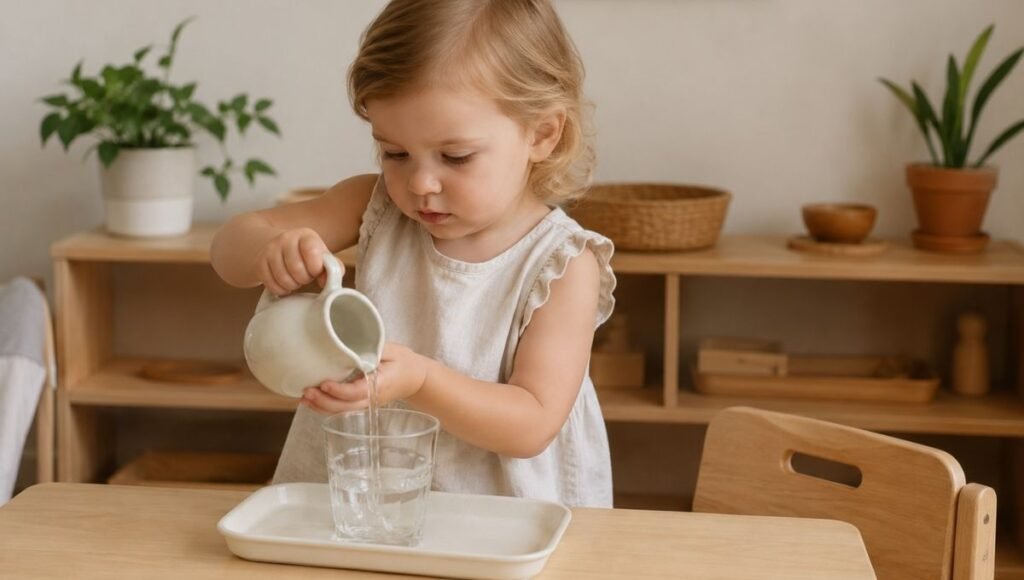
Montessori’s most distinctive contribution to toddler education is the “practical life” area — real tools and activities for real tasks. Pouring, spooning, sorting, folding, buttoning, threading.
For home use, this looks like:
- A small pitcher sized for toddler hands (for pouring water into a cup)
- A spooning activity (transferring small objects between two containers)
- A dressing frame (a small frame with buttons, zippers, or velcro for practice)
- Simple sorting trays
These are “toys” only loosely — they’re activities that develop real competence. When your toddler pours their own water successfully, they’re not just playing. They’re developing the fine motor control, concentration span, and self-confidence that Montessori identified as the foundations of later learning.
Montessori Wooden Toys: The Case for Natural Materials
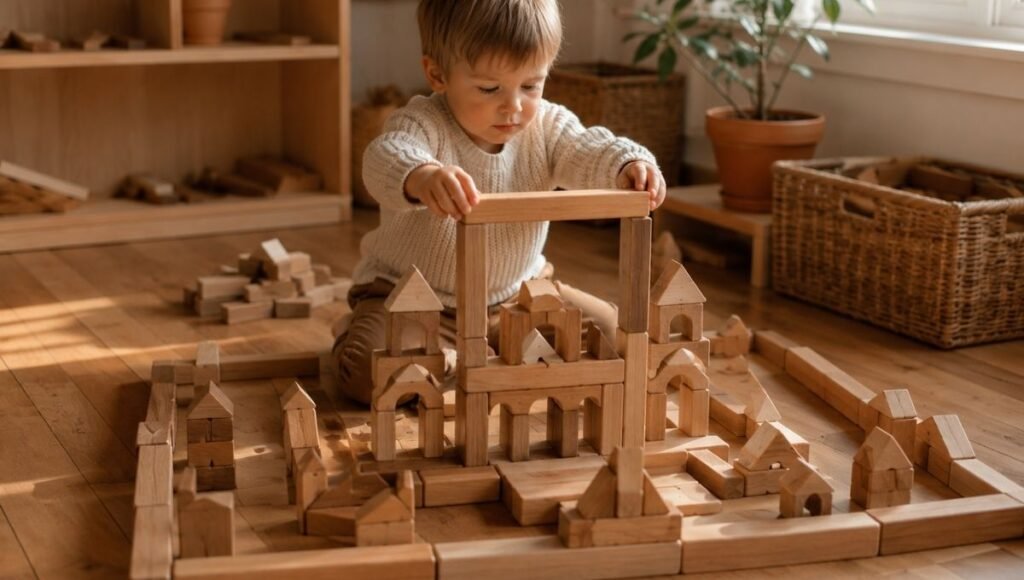
At the toddler stage, the preference for wooden materials becomes most evident in terms of actual developmental benefit rather than aesthetics.
Wood provides:
- Authentic weight — heavier than equivalent plastic, which develops the proprioceptive sense (body awareness)
- Natural texture variation — grain, temperature, and surface feel that engages tactile exploration
- Sound feedback — wood-on-wood sounds differently from plastic, adding an auditory dimension to building play
- Durability — quality wooden toys outlast plastic under enthusiastic toddler use, making them better long-term investments
The specific wooden toys that have the strongest Montessori lineage:
- Unit blocks (proportionally related wooden blocks — the mathematically precise kind)
- Knob and frame puzzles
- Bead stringing materials (graduated beads for sequencing)
- Sorting and classification materials
- Natural art materials (beeswax crayons, watercolors with natural pigments)
Open-Ended Construction Materials
Wooden unit blocks are the Montessori construction material par excellence — and the research on their developmental value is among the strongest in all of early childhood education. A 2017 study in the Journal of Early Childhood Research found direct links between complex block play and mathematical achievement. The proportional relationships encoded in unit blocks (double blocks are exactly twice the length of single blocks) mean children are doing mathematical reasoning every time they build, whether or not they know it.
At 18–24 months: stacking and knocking down, beginning to build small enclosures. By 2.5–3 years: intentional architectural building, bridges, towers, representations of real buildings.
Best Montessori Toys for Preschoolers (3–6 Years)
By three, children have the concentration span, fine motor capability, and cognitive capacity for the classic Montessori sensorial and early academic materials. This is the period that Montessori schools are specifically designed for — and many of the materials can be used effectively at home.
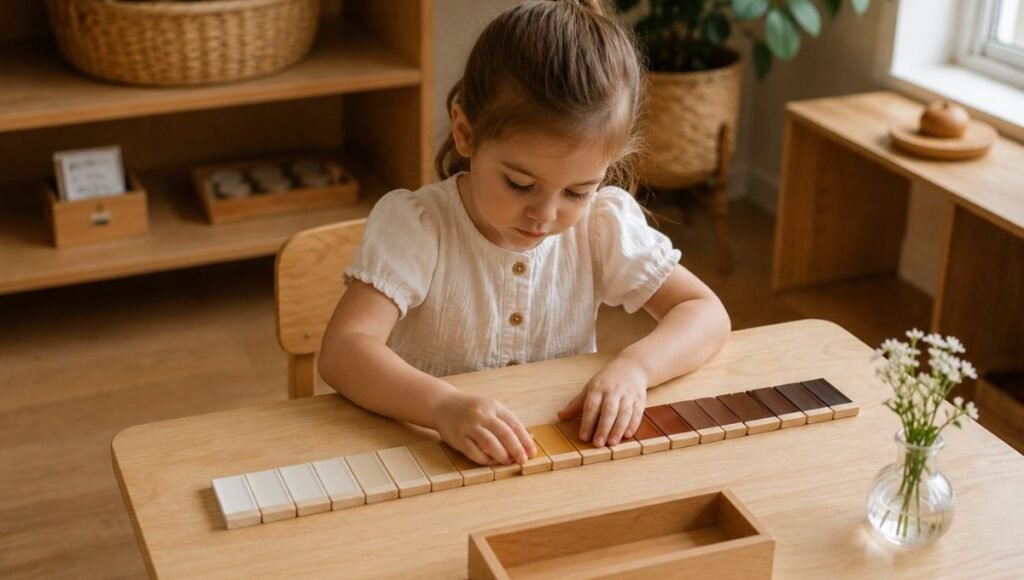
Sensorial Materials
The Montessori sensorial curriculum is built around materials that isolate single sensory qualities and refine the child’s ability to perceive and categorize them: light vs. heavy, rough vs. smooth, loud vs. quiet, many vs. few.
For home adaptation:
- Fabric matching pairs (swatch samples of different textures, found and matched by touch)
- Sound cylinders (small containers with different fill materials matched by sound)
- Color tablets (paint chip samples for grading colors from lightest to darkest)
- Smelling jars (small containers with distinctive scents to identify and match)
None of these require special Montessori equipment. They can be assembled from household materials in an afternoon.
Early Math Materials
Montessori’s math materials are among her most ingenious — concrete, physical representations of abstract mathematical concepts that let children literally touch and feel the difference between quantities.
Beginner materials (3–4 years):
- Number rods (10 rods of graduating length, representing 1–10)
- Sandpaper numbers (traced with fingers while spoken aloud — kinesthetic number learning)
- Counters and counting mat
More advanced (4–6 years):
- Bead chains (actual bead chains representing multiplication tables)
- Golden bead material (physical representation of units, tens, hundreds, thousands)
At home, simpler versions work beautifully: counting stones arranged in groups, loose objects sorted and counted, number tiles with corresponding quantities.
Montessori Learning Toys: Literacy Materials
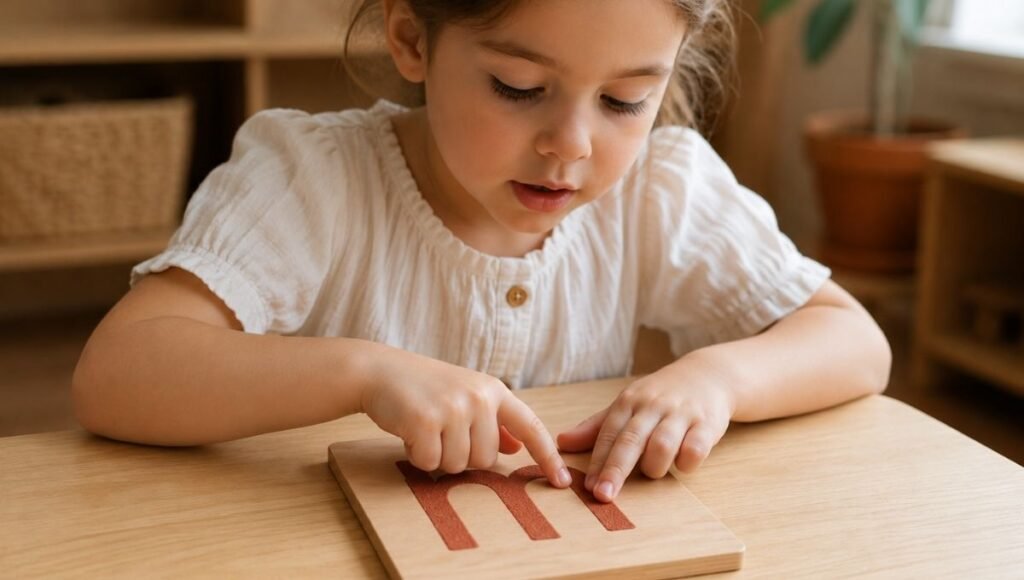
Sandpaper letters are among the most famous Montessori literacy materials — letters cut from fine sandpaper and mounted on wooden tiles. The child traces the letter with two fingers while saying the phonetic sound. This kinesthetic approach — feeling the shape while saying the sound — creates stronger memory encoding than visual-only approaches.
Movable alphabet — individual letter tiles that allow children to compose words before they have the fine motor control to write them — is the bridge between phonetic awareness and reading.
For home use: magnetic letters on a fridge, large-print letter tracing sheets, sandpaper letter approximations made with textured fabric glued to cardboard.
What Is NOT a Montessori Toy (Despite the Label)
This might be the most useful section in this guide, because the marketing has gotten genuinely confusing.
Toys that claim to be Montessori but aren’t:
Busy boards with random activity panels — These are popular, attractive, and often labeled Montessori. But a board that has 12 different latches, zippers, buttons, and activities on the same surface violates the “isolation of difficulty” principle. The child is exposed to many different challenges simultaneously, which fragments attention rather than deepening it. A genuine Montessori approach introduces one fastener skill at a time.
Electronic toys labeled “Montessori learning toys” — If a toy produces sounds, lights, or responses without the child’s direct physical action creating them, it’s not Montessori. The principle is “the child does the work.” An electronic toy that rewards random button-pressing is the opposite of this.
Decorative wooden toys — A wooden toy car or wooden animal figure is lovely. But if it doesn’t invite purposeful activity, provide sensory feedback, or develop a specific skill, the wood is just aesthetic. It’s not Montessori just because it’s natural.
Highly complex multi-step materials for very young children — Montessori is insistent about developmental matching. A material designed for a 5-year-old given to a 2-year-old isn’t Montessori — it’s just frustrating.
What Are Montessori Toys? The Quick Checklist
Before buying anything labeled Montessori, ask:
✅ Does this require the child to do something specific? ✅ Does it provide clear feedback when the child succeeds or fails? ✅ Is it matched to my child’s current developmental stage? ✅ Is it made from safe, natural materials with non-toxic finishes? ✅ Does it develop a real skill or understanding? ✅ Can my child use it independently after a brief introduction?
If the answer to most of these is yes — it’s a genuine Montessori material, whatever it’s made from.
If the answer is mostly no — it might still be a lovely toy, but calling it Montessori is marketing, not philosophy.
Safety in Montessori Materials
Montessori’s emphasis on natural materials isn’t just philosophical — it’s safety-aligned.
For all Montessori toys:
- Non-toxic, water-based finishes on all wooden materials
- ASTM F963 compliance (required for all U.S. toys)
- No small parts that pass the toilet paper roll test for children under 3
- No button batteries in any materials for toddler use
- Natural fiber fabrics (organic cotton, wool) for sensory materials
- BPA-free for any plastic components
Specific to Montessori sensorial materials:
- Smelling jars should contain only safe, food-grade scents (essential oils approved for children, herbs, spices)
- Water activities (pouring, transferring) require close supervision and appropriate waterproofing of the play area
- Small objects used in counting or sorting must be too large to be swallowed or carefully supervised
Frequently Asked Questions
What are Montessori toys? Montessori toys are materials designed around Maria Montessori’s educational principles: they invite purposeful activity, provide sensory feedback, are self-correcting, match the child’s developmental stage, and develop real skills and understanding. They don’t perform for the child — the child does the work. The material doesn’t need to be wooden or aesthetically neutral to be genuinely Montessori.
What age are Montessori toys for? Montessori materials exist for every stage from birth through adolescence. The most distinctive materials are designed for ages 3–6 (the classic Montessori preschool window), but the principles apply from infancy — high-contrast mobiles for newborns and treasure baskets for 6-month-olds are both authentically Montessori.
Are Montessori toys better than regular toys? Genuinely Montessori materials are better than passively entertaining toys at developing specific skills, building independence, and sustaining focused attention. They’re not better than all other toys — a quality building set or a well-chosen puzzle can be just as developmentally valuable. The Montessori label is only meaningful when the underlying principles are actually present.
Are wooden toys always Montessori? No. Wood is the preferred material in Montessori practice for good reasons (sensory quality, weight, durability, environmental sustainability), but a wooden toy isn’t automatically Montessori. The design principles matter more than the material. A wooden toy that doesn’t invite purposeful activity or develop a specific skill isn’t Montessori regardless of its material.
How do I set up a Montessori toy environment at home? Less is more. Present 3–5 materials at a time on low, accessible shelves. Rotate materials when mastery is achieved. Keep each material complete (all pieces present, in good condition). Introduce new materials with a brief, wordless demonstration before leaving the child to explore independently. Avoid hovering — step back and observe.
Are Montessori toys worth the money? The expensive branded Montessori materials (from specialist suppliers) are often very high quality but not necessary. Many genuine Montessori materials can be made from household items, purchased at mainstream retailers, or found in nature (stones for counting, sticks for sorting, shells for sensory exploration). The philosophy is more important than the price tag.
The Bottom Line
Montessori toys at their best are among the most developmentally powerful tools in early childhood — not because of how they look, but because of what they do. They put the child in the driver’s seat. They build real skills. They teach children that effort produces results and that they can figure things out on their own.
The aesthetic trappings — the wood, the neutral colors, the open shelving — are fine, even pleasant. But they’re not the point. The point is the child doing the work. The child feeling successful. The child moving, slowly and at their own pace, toward “I can do it myself.”
That’s what Maria Montessori was observing when she sat on the floor with children in Rome over a century ago. It’s still true.
Related guides:
- Best Educational Toys: The Complete Guide
- Fine Motor Skills Toys
- Best Toys for 1-Year-Olds
- Best Toys for 2-Year-Olds
- Best Toys for 3-Year-Olds
- Building Toys for Toddlers
- Sensory Toys for Babies
References
- American Academy of Pediatrics (AAP). (2024). The Power of Play. https://www.healthychildren.org
- Bower, C., et al. (2017). The effect of block play on mathematics achievement. Journal of Early Childhood Research.
- Piaget, J. (1952). The Origins of Intelligence in Children. International Universities Press.
- Montessori, M. (1912). The Montessori Method. Frederick A. Stokes Company.
- Lillard, A.S. (2005). Montessori: The Science Behind the Genius. Oxford University Press.
- Centers for Disease Control and Prevention (CDC). (2023). Developmental Milestones. https://www.cdc.gov/ncbddd/actearly/milestones/
- National Association for the Education of Young Children (NAEYC). (2024). Good Toys for Young Children by Age and Stage. https://www.naeyc.org
- U.S. Consumer Product Safety Commission (CPSC). Toy Safety. https://www.cpsc.gov