
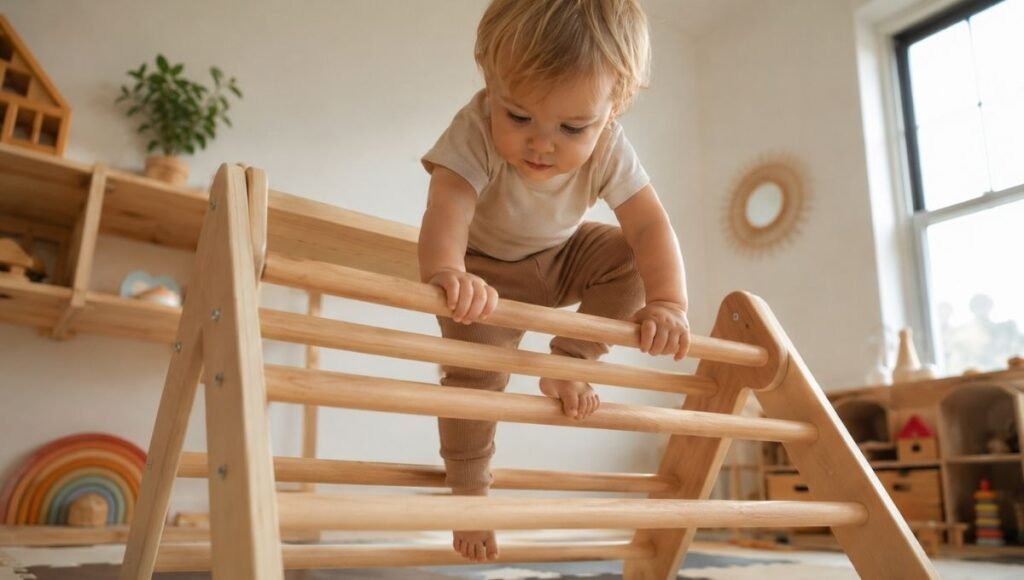
Every parent of a climbing toddler has had the moment.
You turn around for thirty seconds — literally thirty seconds, to answer a text or stir something on the stove — and your child is on top of the kitchen table. Or scaling the bookshelf. Or hanging off the arm of the sofa with the confidence of someone who has absolutely no concept of gravity.
You can’t stop it. Every parent who has tried to stop a climbing toddler has discovered, usually through exhausted repetition, that this approach does not work. Climbing is not a phase. It’s not a behavior problem. It’s a developmental imperative — and the child who can’t climb something will find something to climb, regardless of what you think about the situation.
This is where the Pikler triangle enters the conversation. If you’re in parenting groups, on Pinterest, or anywhere near Montessori-adjacent content, you’ve seen it. A simple wooden A-frame climbing structure that looks almost too plain to justify its price tag. And you’ve probably had the same question everyone else has: is it actually worth it, or is this one of those things the internet told me I needed?
This guide gives you the honest, complete answer — from someone who has watched children climb one for years.
Key Takeaways
- The Pikler triangle was designed by a Hungarian pediatrician over 100 years ago. Dr. Emmi Pikler (1902–1984) believed children should develop motor skills freely, at their own pace, without adult interference. The triangle embodies this philosophy: it offers a challenge and steps back.
- It’s appropriate from 6 months to approximately age 5–6. According to multiple child development sources including the RAD Pikler Triangle (the only U.S. product certified by the Pikler Organization), the most significant developmental benefits occur between 9 months and 30 months — but children use and love it well beyond that.
- It builds specific, measurable skills. Gross motor development, balance, coordination, core strength, spatial awareness, risk assessment, confidence, and problem-solving — all through what looks like simple climbing.
- It is safe — with appropriate supervision. The structure is intentionally low to the ground. Typical height ranges from 28–36 inches. Falls happen, but from a low height onto a mat, which is why a soft mat underneath is the standard recommendation.
- Not all Pikler triangles are equal. Rung spacing, wood quality, finish safety, and structural integrity vary enormously between brands. This guide tells you exactly what to look for.
What Is a Pikler Triangle, Actually?
Let’s start with the basics, because the name gets confusing. In the United States, a legal trademark on the word “Pikler” means many manufacturers call their products “climbing triangles,” “Montessori climbers,” or “climbing frames” — but they’re all describing the same basic structure developed by Dr. Emmi Pikler.
A Pikler triangle is a wooden A-frame climbing structure with horizontal rungs spaced at intervals that allow small children to climb up, over, and through. It’s typically made from birch, pine, or maple wood with a non-toxic finish. Most stand between 28 and 36 inches tall. Many are foldable for storage.
That’s it. That’s the whole thing. No batteries. No buttons. No screen. No app.
And yet it’s one of the most developmentally significant pieces of equipment you can put in a home with young children.
The philosophy behind it is as important as the structure itself. Dr. Pikler observed that when children are given freedom to move and explore at their own pace — without adults “helping” them climb higher or reach further than their body is ready for — they develop physical confidence, spatial awareness, and self-knowledge that children who are constantly assisted don’t develop as naturally. The triangle provides the structure. The child provides everything else.
Pikler Triangle Benefits: What It Actually Develops
Parents on Reddit often ask a version of the same question: “Is a Pikler triangle just a fancy toy, or does it actually do something?” The answer, with specificity:
Gross Motor Development
Climbing a Pikler triangle requires and develops: core strength, leg strength, arm strength, bilateral coordination (both sides of the body working together), grip strength, and balance. These aren’t abstract benefits — they’re the same physical capacities that support walking, running, jumping, and eventually sports and active play.
The American Academy of Pediatrics identifies gross motor development as one of the primary developmental milestones of the first two years of life. A Pikler triangle provides a dedicated, safe environment for exactly this development.
Risk Assessment and Physical Confidence
This is the benefit that surprises parents most. Children who climb regularly — and who are allowed to figure out their own limits without constant adult intervention — develop a genuine sense of what their body can and cannot do. They learn to assess height, angle, and grip quality through experience.
The child who has climbed a Pikler triangle hundreds of times has internalized spatial information about their body that the child who has been consistently lifted and carried hasn’t developed in the same way. This isn’t about being reckless — it’s about building the physical self-knowledge that makes children actually safer in the world, because they’ve learned their limits from the inside.
Problem-Solving Through Movement
Getting down is often harder than getting up. Most toddlers discover this on the Pikler triangle — and the experience of figuring out how to descend safely, after several uncertain moments, is genuine problem-solving. The thinking required to plan a physical route, assess a hold, and adjust when something doesn’t work is cognitively demanding in a way that most toys aren’t.
Imaginative Play
By 3–4 years, the Pikler triangle stops being primarily a climbing challenge and starts being a prop. It becomes a castle, a fort, a ship, a mountain. A blanket draped over it becomes a cave or a secret hideout. This imaginative dimension extends the toy’s useful life significantly — children who’ve “mastered” the climbing challenge at 2.5 often return to it daily at 4 as a storytelling prop.
Independence and Confidence
There’s something specific that happens when a toddler reaches the top of a Pikler triangle for the first time on their own — without being lifted, without being guided, entirely through their own effort. The expression is unmistakable. That’s not just pride. That’s the internalization of “I can do hard things,” which is exactly the confidence that developmental psychologists identify as a foundation for later learning and resilience.
Climbing Toys for Toddlers: Pikler Triangle vs. Other Options
If you’re comparing the Pikler triangle to other climbing toys for toddlers, here’s the honest assessment:
| Option | Best For | Limitations |
|---|---|---|
| Pikler Triangle | Ages 6 months–5 years, indoor, developmental focus | Price ($150–$350), requires floor space |
| Foam climbing sets (e.g., Nugget) | Very young babies, soft landing, versatile | Less physical challenge, doesn’t grow with child |
| Outdoor climbing dome | Ages 3+, larger backyards | Not suitable for indoor use, weather exposure |
| Plastic indoor slide/climber | Affordable, self-contained | Low durability, limited developmental range, less attractive |
| Pikler triangle + ramp set | Ages 6 months–6 years, most versatile | Higher cost, more floor space required |
The Pikler triangle wins on developmental longevity — no other single indoor climbing structure remains actively useful from 6 months through age 6. That’s the key advantage.
Indoor Climbing Toys for Toddlers: Setting Up Your Space
The most common parent mistake with Pikler triangles is placement. A few practical guidelines:
Always use a soft mat underneath. A yoga mat is the absolute minimum. A foam play mat (2–4 inches thick) is better. You’re not trying to cushion a fall from a significant height — the triangle is relatively low — but you’re preventing the hard floor contact that makes a small tumble more painful and more frightening. Frightening falls are what create fear of climbing; soft landing zones create confidence.
Place it in a common area, not a bedroom. This is consistent across every Pikler safety guide: the triangle should be where an adult can see it. Not for constant hovering — Dr. Pikler’s philosophy was explicitly against helicopter supervision — but for proximity. Being able to hear and occasionally see is enough.
Give it space to breathe. The triangle needs clear space on all sides. Children will approach it from unexpected angles, hang off the sides, and occasionally tumble backward. A minimum of 3 feet clear on all sides is the standard recommendation.
Don’t rush the introduction. Some babies take to it immediately at 6 months. Others show no interest until 14 months. Both are normal. Put it out, let them explore at their own pace, and resist the urge to demonstrate or encourage climbing before they’re ready.
Pikler Triangle Age Guide: What to Expect at Each Stage
6–9 Months: The Beginning
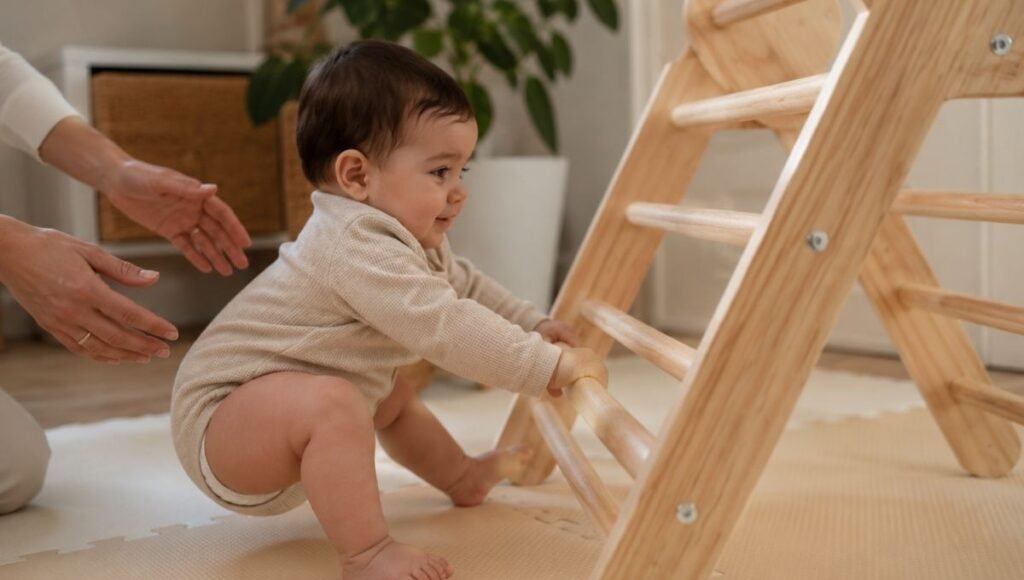
At this stage, the triangle is primarily a pulling-up structure. Babies who are learning to stand use the rungs to pull themselves up, hold, bounce, and practice weight-bearing. They’re not climbing yet — they’re using it as a support structure while their legs develop the strength standing requires.
What you’ll see: Baby pulls up to standing, holds the lower rungs, bounces and tests their legs, practices sitting back down.
What’s happening developmentally: Leg strengthening, early balance practice, weight-shifting that prepares for walking.
9–18 Months: First Climbing Attempts
This is when most children begin attempting the rungs. Early climbing is slow, deliberate, and often involves long pauses while the child calculates their next move. This deliberateness is not hesitation — it’s risk assessment in action. Don’t rush it.
What you’ll see: Climbing the first two or three rungs, possibly getting stuck and needing help getting down, increasing confidence over time.
What’s happening developmentally: Bilateral coordination, grip strength, core engagement, spatial planning.
18 Months–3 Years: Peak Physical Challenge
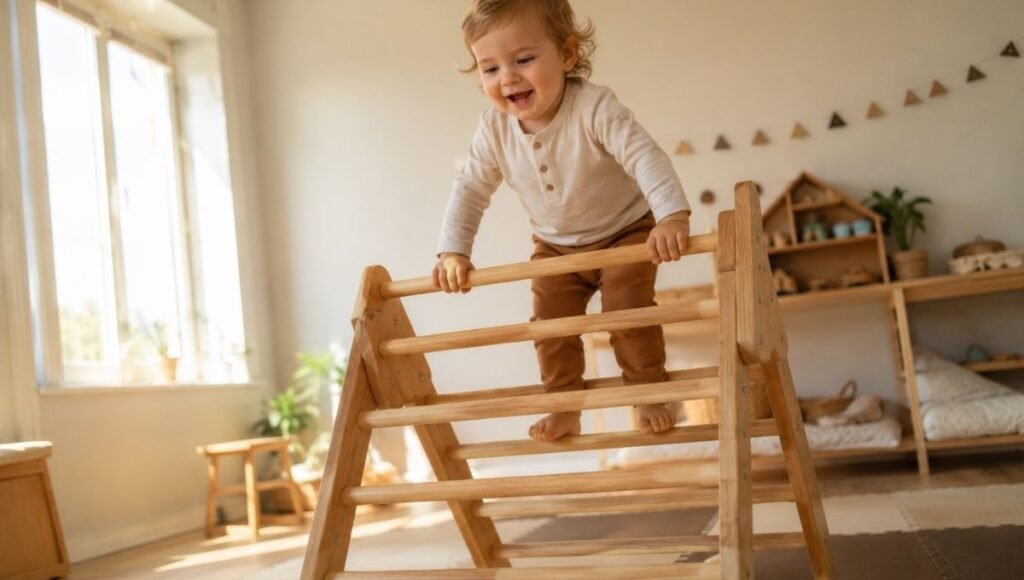
This is the Pikler triangle’s primary developmental window. Toddlers at this stage are climbing the full height of the structure, figuring out how to descend, and beginning to combine the triangle with accessories (ramps, slides) for more complex challenges.
What you’ll see: Confident climbing and descending, increased speed, beginning to use accessories, social climbing (doing it alongside other children).
What’s happening developmentally: Full gross motor integration, risk assessment refinement, physical confidence building, early cooperation.
3–5 Years: Imaginative Play Takes Over
By now, most children have physically “mastered” the triangle — it no longer represents a significant climbing challenge. But it enters a second life as an imaginative play prop. This phase is less physically demanding but equally valuable from a developmental perspective.
What you’ll see: Draping blankets to make forts, incorporating it into pretend play scenarios, using it as a base for storytelling.
What’s happening developmentally: Narrative play, creative problem-solving, social negotiation with other children.
Is the Pikler Triangle Safe? The Honest Answer
The honest answer is: yes, with appropriate supervision and setup — and no, there are no absolute guarantees, because no climbing equipment can eliminate all risk.

Here’s what the research and experience show:
The height is intentionally low. Standard Pikler triangles are 28–36 inches tall. A fall from the top — which is not uncommon, especially during learning phases — is a fall from roughly two to three feet. With a mat underneath on an otherwise soft surface, this produces bumps and sometimes tears, but serious injury is rare.
Children self-regulate. This is the most counterintuitive and most well-documented aspect of Pikler’s philosophy: when children are not pushed beyond their ability level by adult enthusiasm, they generally don’t climb higher than they can handle. The toddler who hesitates at the fourth rung is telling you something important about their readiness — and that hesitation is protective.
Supervision does not mean hovering. Dr. Pikler was explicit about this. Supervision means being in the room, able to respond if needed, while allowing the child to work through challenges independently. The instinct to “spot” a child on every rung actually removes the risk-assessment learning that makes children safer climbers overall.
What to check for safety:
- Rung spacing: 3–3.5 inches between rungs is the standard. Too wide and small heads or limbs could potentially get stuck
- Wood quality: Smooth, splinter-free sanding throughout. Run your hand over every surface before the first use
- Non-toxic finish: Water-based, clearly labeled non-toxic. Birch and pine with water-based finishes are the standard
- Structural integrity: The frame should feel completely solid with no wobble when you push it. Any movement in the joints is a concern
- Weight capacity: Most standard triangles support 100–150 lbs. Verify the limit before allowing multiple children to climb simultaneously
Best Pikler Triangle Options: What to Look For
The market ranges from under $100 to over $400, and the quality difference is significant. Here’s what actually matters when evaluating options:
Wood and finish: Birch or maple with water-based, non-toxic finish. Avoid products that don’t specify finish type or that list “paint” without non-toxic certification.
Rung diameter and spacing: Rungs should be around 1 inch in diameter — large enough for small hands to grip confidently, not so large that fingers can’t wrap around them. Spacing of 3–3.5 inches is the safety standard.
Foldability: A foldable triangle is significantly more practical for most homes. It stores flat against a wall when not in use and is easier to move between rooms. Non-foldable triangles are often sturdier but require dedicated space.
Base width: A wider base means better stability. The triangle should not wobble or tip when a child applies weight from an unusual angle — and they will.
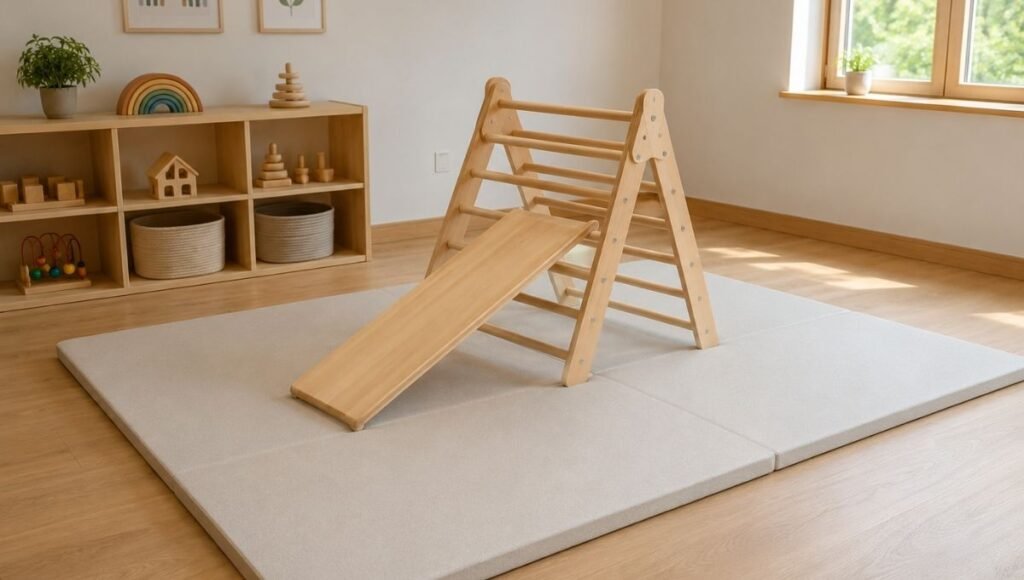
Accessories: A ramp with one smooth side (for sliding) and one textured side (for climbing) is the most valuable addition. It extends the triangle’s usefulness, adds a sliding element that toddlers love, and creates a more versatile climbing environment. Climbing arches, balance boards, and swings are available as additions for larger sets.
Brands worth researching:
- RAD Pikler Triangle: The only U.S. product certified by the Pikler Organization. Handmade in Los Angeles. Premium quality and price.
- Tiny Land: CPSC-certified, affordable entry point, widely reviewed positively by parents
- Cassarokids: Foldable, FSC-certified wood, available in multiple sizes
- Avenlur: Premium maple and walnut construction, investment-level quality
The “Worth It” Question: A Direct Answer
Reddit parents ask this constantly, and they deserve a direct answer.
Yes, a Pikler triangle is worth it — if your child is a climber.
The honest qualifier: if your child shows no interest in climbing (some don’t), a Pikler triangle is an expensive piece of furniture. But if your child is the one scaling the bookshelf, climbing out of the crib, or treating every piece of furniture as a climbing challenge, the triangle gives that impulse a safe, appropriate outlet that you can live with.
The math also works. A Pikler triangle is used from 6 months to 6+ years, making it one of the longest-lasting toys you can buy. At $80–$130 for a basic set, the cost per year of use is incredibly low — especially compared to single-function toys that get abandoned in three months.
The cases where it might not be worth it:
- Your child genuinely has no climbing instinct (rare, but real)
- You have no floor space — the triangle needs at minimum a 4×4 foot area
- You’re looking for something that requires no supervision — this isn’t that toy
Frequently Asked Questions
What age is a Pikler triangle for? Most Pikler triangles are appropriate from 6 months to approximately age 5–6, with the most intensive developmental use occurring between 9 months and 3 years. After 3, children typically use it more as an imaginative play prop than a climbing challenge. The developmental benefits at every stage are real.
Is a Pikler triangle safe for a 1-year-old? Yes, with adult supervision and a soft mat underneath. One-year-olds are typically in the early climbing phase — they’ll use the rungs to pull to standing and attempt the first few rungs. The falls that happen at this stage are from low heights and, on a mat, generally result in surprise rather than injury. Never leave a child under 3 unsupervised on any climbing equipment.
Do I need accessories like a ramp or climbing arch? A basic triangle is completely functional on its own for children up to about 18 months. From 18 months onward, a ramp (with smooth and textured sides) significantly extends the play value and developmental range. It’s the single most useful addition. Climbing arches and full climbing sets are excellent if space and budget allow, but not necessary to start.
What’s the difference between a Pikler triangle and a Montessori climber? In practice, these terms are used interchangeably by most manufacturers and parents. The Pikler triangle is a specific design (A-frame with rungs) named after Dr. Emmi Pikler. “Montessori climber” is a broader marketing term applied to various wooden climbing structures aligned with Montessori principles of independent, child-led exploration. All Pikler triangles could be called Montessori climbers; not all Montessori climbers are Pikler triangles.
My toddler climbs everything and I’m exhausted. Will a Pikler triangle actually help? Genuinely, yes. The Pikler triangle works because it gives the climbing impulse somewhere to go. Most parents report that their most enthusiastic climbers spend significant daily time on the triangle — and that the constant furniture-climbing reduces when the triangle is available. It doesn’t eliminate the urge; it redirects it productively.
Should I get a foldable or non-foldable Pikler triangle? For most homes, foldable is more practical. It stores flat when not in use and can be moved between rooms. Non-foldable triangles are generally sturdier and better for dedicated playroom spaces. If you’re apartment-living or have limited dedicated play space, foldable is the clear choice.
The Bottom Line
The Pikler triangle is one of those rare toys that earns every bit of the enthusiasm it generates in parenting communities — not because it’s trendy, but because it genuinely delivers on its developmental promise across a wider age range than almost any other single piece of equipment.
It’s a climbing challenge, a problem-solving exercise, a confidence builder, a physical fitness tool, and eventually a storytelling prop. It’s also, for parents of climbers, a gift to yourself: somewhere safe and sanctioned for the child who was going to climb something regardless.
Dr. Pikler’s insight — that children given freedom to move and challenge themselves develop more fully than those who are constantly guided and protected from difficulty — is over 100 years old. It holds up.
Related guides:
- Best Outdoor Toys for Toddlers
- Best Toddler Toys: The Complete Guide
- Best Toys for 2-Year-Olds
- Best Toys for 3-Year-Olds
- Rainy Day Activities for Kids
- Fine Motor Skills Toys
References
- American Academy of Pediatrics (AAP). (2024). Gross Motor Development Milestones. https://www.healthychildren.org
- Centers for Disease Control and Prevention (CDC). (2023). Developmental Milestones: 1–3 Years. https://www.cdc.gov/ncbddd/actearly/milestones/
- RAD Children’s Furniture. RAD Pikler Triangle — The Only Pikler-Certified Triangle in the United States. https://radchildrensfurniture.com
- Knight, L.L. (Parenting Educator). Expert commentary on climbing and gross motor development. Cited in The Bump, 2025.
- National Institute for Play. (2023). Physical Play and Gross Motor Development. https://www.nifplay.org
- Pikler Institute. Dr. Emmi Pikler’s Philosophy of Child Development. https://pikler.hu/en