
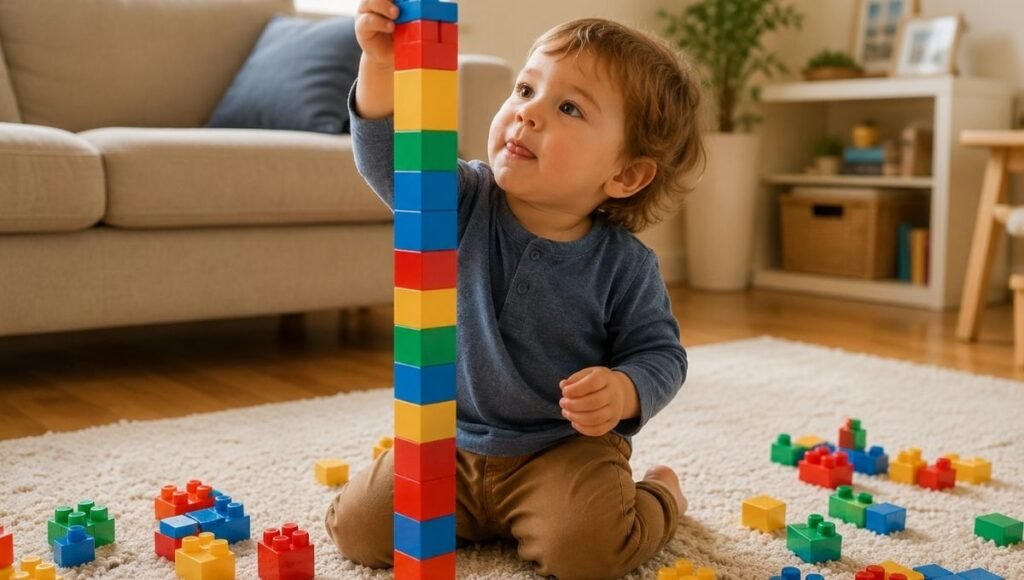
My son built his first real tower at 14 months. Not “stacked two blocks and knocked them over” — an actual, deliberate tower, seven blocks high, with the careful concentration of someone defusing a bomb. And when it fell, he didn’t cry. He looked at the pile of blocks on the floor, looked at me, and started again.
I remember thinking: he’s learning something right now that I can’t teach him. He’s learning that things fall, that you can rebuild them, that trying again is just what you do.
Building toys for toddlers and kids are one of those rare toy categories where the developmental research and the lived parent experience are in complete agreement: they work. Not in a vague “educational” way, but in specific, measurable, transferable ways that matter for everything from spatial reasoning to mathematical thinking to emotional persistence.
The challenge is that the category is enormous — wooden blocks, magnetic tiles, DUPLO, stacking rings, construction sets, marble runs — and not all of them are equally appropriate at every age. This guide cuts through the options with one goal: helping you find the right building toy for your specific child, right now, without buying something they’ll either ignore or outgrow in two weeks.
Key Takeaways
- Block play has the strongest research support of any toy category. A 2017 study in the Journal of Early Childhood Research found that complex block play in preschool directly improves mathematical achievement — not correlated, directly linked. A 2014 review in Trends in Neuroscience and Education confirmed that spatial play in early childhood builds the spatial reasoning that underlies later STEM performance.
- Open-ended building toys outlast structured sets. A set of wooden unit blocks or magnetic tiles stays developmentally relevant from age 1 through age 8+ because the play evolves with the child. A kit that builds one specific thing is done when the thing is built.
- The right building toy is just beyond current mastery. Too easy and there’s no learning. Too hard and there’s only frustration. The productive zone is achievable with effort — which is exactly where persistence, problem-solving, and genuine cognitive development happen.
- Magnetic tiles are not the same as wooden blocks — they develop different skills, suit different ages, and belong in different stages of a building toy collection. This guide explains when each type is most valuable.
- Safety matters in this category. Small parts, powerful magnets, and cheap construction are all genuine hazards. We cover exactly what to check before buying.
Why Building Toys Are Worth the Investment
Let me make the case specifically, because it changes how you evaluate what you’re buying.
When your toddler stacks blocks and watches them fall, they’re running a physics experiment: testing gravity, balance, and the relationship between cause and effect. When your preschooler builds an enclosure for their toy animals, they’re doing spatial planning — imagining a 3D structure and then executing it. When your 5-year-old figures out why their tower keeps falling on one side, they’re doing engineering: identifying a problem, forming a hypothesis, testing a solution.
The research on all of this is unusually clear. Dr. Susan Levine’s work at the University of Chicago has consistently shown that children who engage in more puzzle and block play show significantly stronger spatial reasoning — and spatial reasoning is one of the strongest predictors of performance in mathematics and science throughout school.
What this means practically: the DUPLO set or the wooden blocks you buy your 2-year-old aren’t just toys. They’re building specific cognitive architecture that will matter for the next twenty years.
Building Toys for Toddlers: By Developmental Stage
Stacking and Nesting Toys (12–18 Months): The Foundation
At 12–18 months, “building” means stacking, nesting, and knocking down — and this is exactly right. The developmental work happening at this stage is foundational: understanding that objects can be ordered by size, that balance is a real physical property, and that you can control what happens in the world with your hands.
Stacking cups and rings Still the gold standard for this age. Stacking rings develop size ordering (seriation) — the understanding that objects have a consistent size relationship to each other, which is a mathematical concept. Nesting cups build spatial understanding (smaller fits inside larger) and object permanence.
At 12 months, your toddler will mostly remove the rings and replace them randomly. By 15 months, they’ll begin attempting to order by size. By 18 months, many can do it successfully. One toy, six months of developmental progression.
Simple wooden blocks (large) Large, smooth wooden blocks — the kind that come in sets of 20–30 large pieces — are appropriate from about 12 months. At this age, your toddler is stacking 2–3 blocks deliberately, exploring the physical properties of weight and balance, and discovering cause-and-effect (I knock it, it falls). Choose blocks with smooth, splinter-free finishes and non-toxic, water-based paint or stain.
What to look for at this age:
- Large enough to be safe for mouthing (no piece smaller than 1.75 inches)
- Smooth, rounded edges
- Non-toxic finishes — ASTM F963 compliance
- Pieces that stack predictably (uniform size and shape for first blocks)
Stacking Toys for Toddlers (18 Months–2.5 Years): First Real Structures
Between 18 months and 2.5 years, building becomes intentional. Your child isn’t just stacking — they’re trying to build something specific. A house. A garage. A tower taller than themselves. The attempts don’t always succeed, but the intention is there, and that intention is cognitively significant.
LEGO DUPLO DUPLO — the large-brick version of LEGO, eight times bigger than standard bricks — is the building toy most widely recommended by child development professionals for this age range. The pieces connect with a satisfying click that gives children the physical feedback of success. They’re large enough to be completely safe. And they’re open-ended in a way that structured kits aren’t — a box of DUPLO bricks becomes whatever the story demands.
A DUPLO starter brick box (100+ pieces) is one of the best toy investments available for toddlers. It stays useful through age 5 or 6, grows in complexity as skills develop, and has a resale value that most toys don’t.
Wooden unit blocks For parents who prefer natural materials, a set of wooden unit blocks is the building toy recommendation from virtually every occupational therapist, preschool educator, and child development researcher. The “unit” refers to the consistent proportional relationship between pieces — the long blocks are exactly twice the length of the short ones, which means children are doing mathematical reasoning (proportion, symmetry, equivalence) every time they build.
A quality wooden unit block set (60–80 pieces) stays relevant from 18 months through age 8, with increasingly sophisticated play at every stage. This is one of the highest-evidence toy investments available.
Editor’s opinion: If I could only buy one building toy for the entire toddler-through-kindergarten age range, it would be a quality set of wooden unit blocks. The research is unambiguous, the play value is extraordinary, and the toy never becomes “too easy” because there’s always a more complex structure to attempt.
Magnetic Tiles for Toddlers and Preschoolers (2–6 Years): The Game-Changer
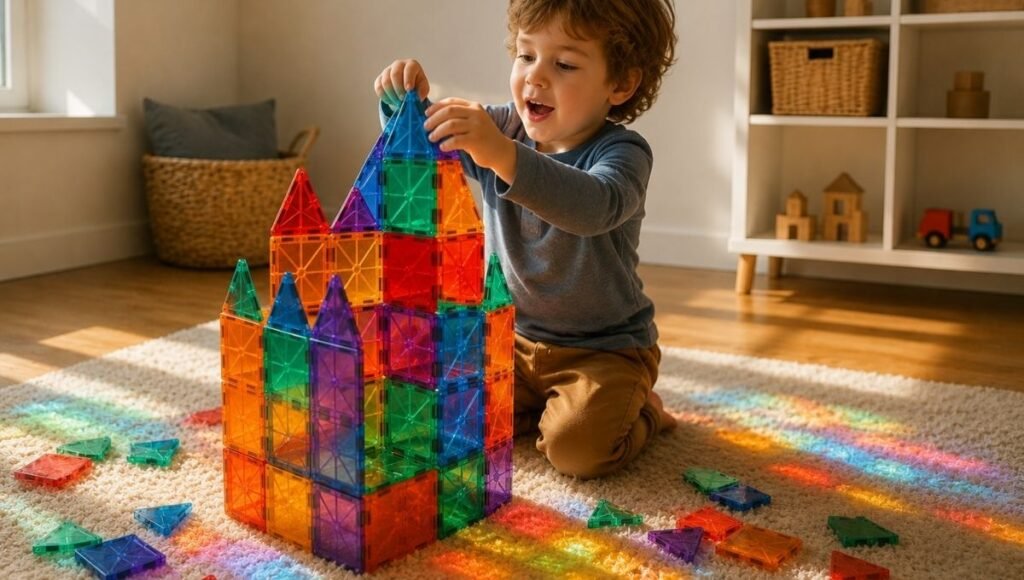
Somewhere around age 2 to 2.5, magnetic building tiles become developmentally accessible — and for many children, they become the building toy that gets used most consistently from preschool through early elementary school.
Why magnetic tiles work so well: The magnetic connection means children get the satisfaction of a stable structure without the precise stacking required for block towers. At 2, they’re making flat shapes and simple enclosures. At 3, they’re building 3D houses and castles. At 5, they’re creating multi-story structures with ramps, windows, and roofs. At 7, they’re building complex architectural projects that incorporate other toys as inhabitants.
That developmental arc — from flat shapes to architectural complexity — across five or six years of a single toy is genuinely unusual. Most toys have a useful window of one to two years.
Magnetic tiles for kids: what to look for:
- Fully enclosed magnets — this is non-negotiable. Cheap alternatives sometimes have inadequate sealing; if magnets can come loose, they’re a serious medical hazard if swallowed
- Transparent colored panels — allows light to pass through, adding a visual discovery element
- Compatible with major brand systems (many brands are cross-compatible)
- Smooth, rounded edges on all panels
The best magnetic tile brands: Magna-Tiles is the original and still the most consistently recommended for build quality and magnet strength. Picasso Tiles offer a more budget-friendly option with good compatibility. For younger toddlers, look for starter sets of 32 pieces; for preschoolers, 60+ pieces opens up more structural complexity.
Safety note: Always buy magnetic tiles from reputable brands with verified enclosed magnets. Cheap alternatives with inadequate sealing can allow small, powerful magnets to come loose. These are not a choking hazard — they’re a surgical emergency. Two separate magnets swallowed can attract through intestinal walls and cause life-threatening internal injuries.
Building Toys for Kids Ages 4–8: Real Complexity, Real Engineering
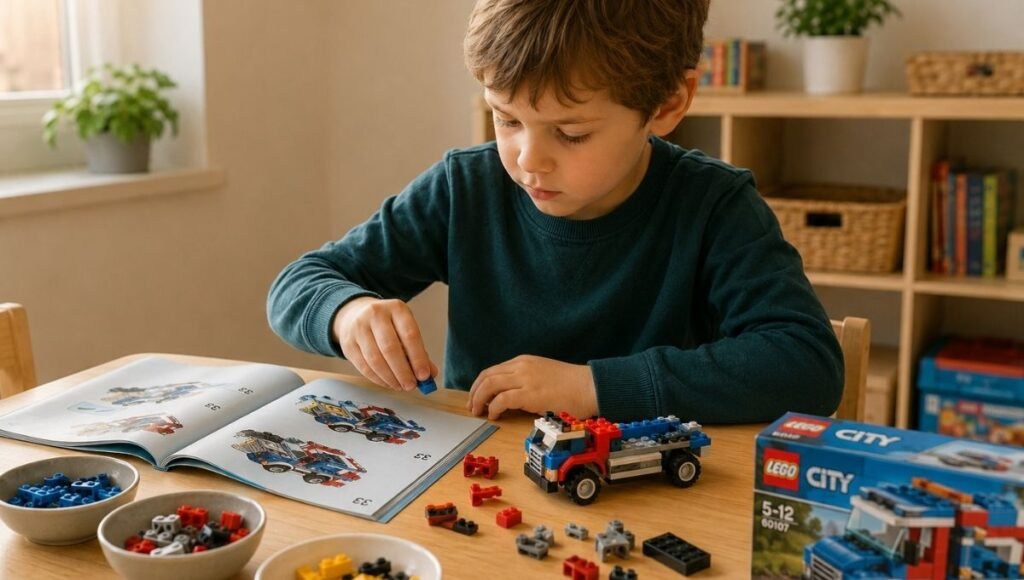
By 4–5, building play becomes genuinely architectural and increasingly ambitious. Children at this age are planning structures before they build them, troubleshooting when things don’t work, and often building with a specific purpose in mind — a castle for their knights, a city for their vehicles, a house for their dolls.
Standard LEGO (4+) Four to five is typically when children are ready to transition from DUPLO to standard LEGO bricks. The 4+ labeled sets are specifically designed for this transition — slightly more complex than DUPLO but with larger pieces than standard LEGO. The skills developed (fine motor precision, instruction-following, spatial planning) are significant.
The open-ended use of LEGO — building something entirely original rather than following instructions — is generally more developmentally valuable than kit-building alone. Encourage post-kit free building by making extra pieces available.
Marble runs From about age 4, children have the attention span and fine motor skill for moderate-complexity marble runs. The engineering challenge — building the track, predicting the marble’s path, troubleshooting when it doesn’t reach the end — is one of the most direct STEM learning experiences available in toy form.
Look for runs with clearly connecting pieces that hold firmly. The most frustrating marble runs are the ones where pieces pop apart during the run — this creates negative associations with the engineering challenge itself.
Magnetic tiles expansion For children who already have magnetic tiles, age 4–6 is the perfect time to add expansion packs: windows, doors, ramps, and car bases that enable increasingly complex structures. The play value of magnetic tiles genuinely doubles with these additions.
Building Blocks for Kids: Wooden vs. Plastic vs. Magnetic — What’s the Difference?
Parents often ask which type of building toy is “best” — and the honest answer is that they develop different skills and work best at different ages.
| Type | Best Age | What It Develops | Key Advantage |
|---|---|---|---|
| Stacking cups/rings | 12–24 months | Size ordering, spatial awareness | Safe for mouthing, develops foundational math concepts |
| Large wooden blocks | 12 months–3 years | Balance, cause-effect, early architecture | Natural material, no small parts, long developmental arc |
| LEGO DUPLO | 18 months–5 years | Intentional construction, fine motor, creativity | Click feedback, highly open-ended, grows with child |
| Wooden unit blocks | 18 months–8 years | Mathematical reasoning, spatial planning | Longest developmental arc of any building toy |
| Magnetic tiles | 2–8+ years | 3D geometry, architecture, STEM thinking | Extraordinary longevity, grows significantly in complexity |
| Standard LEGO | 4–12+ years | Fine motor, instruction-following, engineering | Unlimited complexity ceiling |
| Marble runs | 4–8 years | Engineering thinking, cause-effect, spatial prediction | Unique STEM learning experience |
The building toy collection that serves children best across the full age range looks something like: stacking cups → wooden unit blocks → DUPLO → magnetic tiles → standard LEGO. Each stage builds on the spatial reasoning and construction skills developed in the previous one.
Wooden Blocks for Kids: Why Material Quality Matters
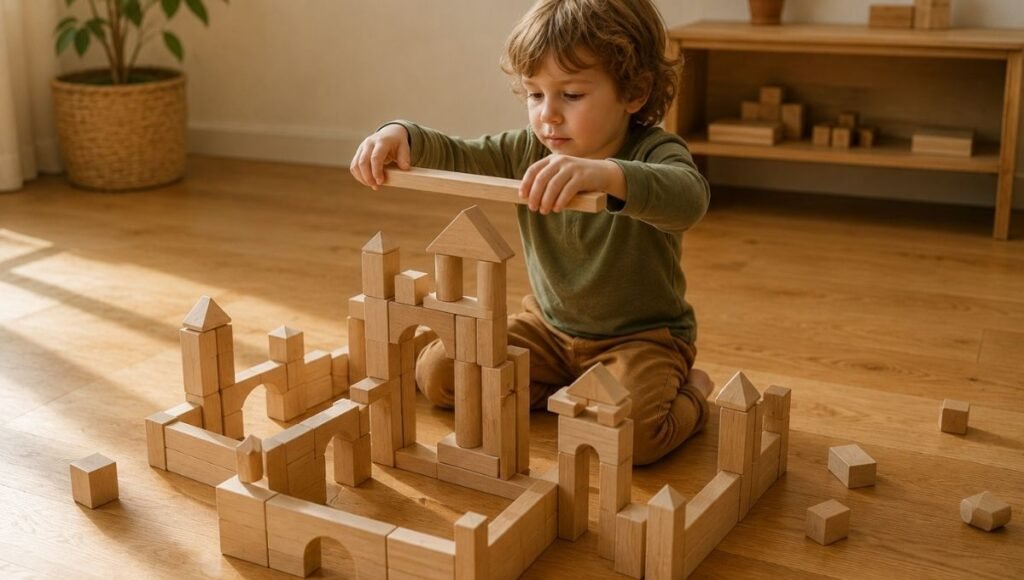
For wooden building toys specifically, material quality deserves careful attention — both for safety and for play longevity.
What to check:
- Non-toxic finishes — water-based stain or paint, clearly labeled non-toxic. Cheap imported wooden toys sometimes use finishes that aren’t appropriate for children who still mouth objects
- Splinter-free sanding — run your hand over every surface. Any roughness that feels like it could catch skin will get worse with use
- Consistent dimensions — for unit blocks especially, consistency in size is critical. Blocks that aren’t truly proportional don’t build reliably, which removes the mathematical reasoning element
- Hardwood vs. softwood — hardwood blocks (maple, beech) are more durable and produce a more satisfying building experience than softwood alternatives
- ASTM F963 compliance — required for all toys sold in the U.S., but worth verifying
Best brands for wooden building toys: Melissa & Doug and Hape are both consistently recommended for quality and non-toxic finishes. For unit blocks specifically, Community Playthings and Hardwood Heritage are the professional/school standards — more expensive but extraordinary quality.
Building Toys Safety Checklist
For all building toys:
- ASTM F963 compliance (required for U.S. market)
- CPSC certification
- Age rating checked and appropriate for your specific child
For wooden blocks:
- Non-toxic finishes (water-based, clearly labeled)
- No splinters or rough edges
- Large enough pieces for the child’s age (toilet paper roll test for anything questionable)
For magnetic tiles:
- Verified enclosed magnets from reputable brands
- No visible gaps in tile edges where magnets could be accessed
- Inspect regularly for any cracking in tile edges
For LEGO and small building pieces:
- Age 4+ for standard LEGO bricks — check your specific child’s mouthing habits
- Inspect regularly for broken pieces with sharp edges
- Store separately from younger siblings’ toys
What NOT to Buy: The Building Toy Honest Skip List
Cheap magnetic tile sets with uncertain magnet enclosure This is the one category where I’d strongly recommend buying from established brands rather than saving money. The difference between safe and unsafe magnetic tiles is not visible — it’s in the quality of the edge sealing. Unknown brands with inadequate sealing present a genuine medical hazard.
Single-purpose construction kits for very young children A kit that builds one specific thing — assembled once, displayed, done — provides a fraction of the developmental value of open-ended building toys. Save construction kits for age 5+, when the process of following complex instructions is itself a valuable developmental exercise.
Flimsy marble run sets Marble runs where pieces pop apart during the run are genuinely frustrating in a way that damages children’s relationship with the engineering challenge. Spend slightly more on a set with pieces that hold — the Ravensburger GraviTrax series is widely recommended for piece quality.
Building toys significantly above developmental stage A building toy that’s too complex for your child doesn’t provide a productive challenge — it produces frustration and rejection of the category. Always match the toy to where your child actually is, not where you hope they’ll be in three months.
Frequently Asked Questions
What are the best building toys for toddlers? The most developmentally valuable building toys for toddlers are: LEGO DUPLO (18 months–5 years), wooden unit blocks (18 months through school age), and magnetic tiles (from about age 2). Stacking cups and rings are excellent from 12 months. All of these have strong research support and unusually long developmental arcs.
Are magnetic tiles safe for toddlers? Yes — when purchased from reputable brands with verified enclosed magnets. The key safety requirement is that magnets must be fully sealed within the tile edges with no possibility of coming loose. Buy from established brands (Magna-Tiles, Picasso Tiles) and inspect regularly for any cracking in tile edges. Never allow loose small magnets near children.
What’s the difference between DUPLO and regular LEGO? DUPLO bricks are exactly 8 times larger than standard LEGO bricks and are specifically designed for children ages 18 months to 5 years. They connect with the same system but are completely safe for children who still mouth objects. Standard LEGO bricks are appropriate from about age 4, when children no longer regularly mouth small objects.
Do wooden blocks actually help with math? Yes, with research support. Multiple studies, including Dr. Susan Levine’s work at the University of Chicago, have found direct links between block play in early childhood and spatial reasoning — which directly predicts mathematical ability. The proportional relationships in unit blocks in particular engage early mathematical thinking every time children build.
How many building toys does a child need? Less than you might think. One quality set of DUPLO, one set of wooden unit blocks, and one set of magnetic tiles covers the full range of building toy development from 18 months through age 8. More variety doesn’t produce better development — depth of engagement with a few well-chosen toys is more valuable than a large collection of different building systems.
My toddler only knocks down blocks instead of building. Is this normal? Completely normal — and developmentally appropriate. Knocking things down is cause-and-effect learning. It’s physics. It’s also satisfying in a way that 14-month-old brains find genuinely compelling. Building will come. For now, the knocking-down is the point.
The Bottom Line
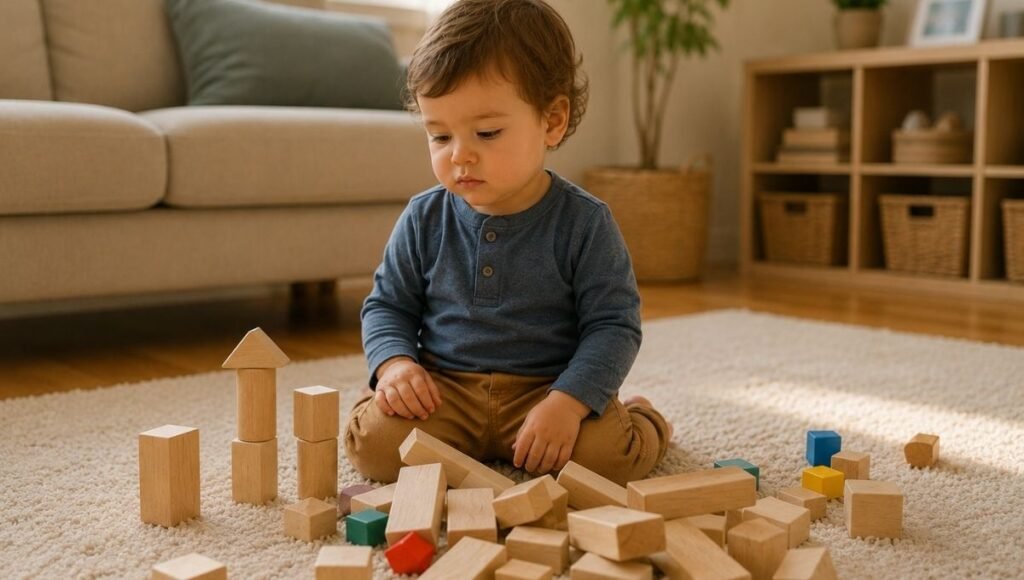
The best building toys for toddlers and kids are ones that invite your child to construct, problem-solve, and persist — in ways that evolve naturally as their skills develop.
Start with wooden blocks or DUPLO. Add magnetic tiles around age 2. Let standard LEGO come when the fine motor skills are ready. Build gradually rather than all at once.
And on the inevitable afternoon when the tower collapses for the fifth time and small eyes fill with tears — resist the urge to fix it. Let them look at the pile. Let them decide what comes next.
That moment — the deciding what comes next — is the whole point.
Related guides:
- Best STEM Toys for Kids
- Best Puzzles for Kids
- Best Toys for 2-Year-Olds
- Best Toys for 3-Year-Olds
- Best Toys for 4-Year-Olds
- Educational Toys: The Complete Guide
References
- Bower, C., et al. (2017). The effect of block play on mathematics achievement. Journal of Early Childhood Research.
- Uttal, D.H., et al. (2014). The malleability of spatial skills: A meta-analysis of training studies. Trends in Neuroscience and Education.
- Levine, S.C., et al. (University of Chicago). Research on spatial reasoning and block play. Cited in multiple publications including Developmental Psychology.
- American Academy of Pediatrics (AAP). (2024). The Power of Play. https://www.healthychildren.org
- National Association for the Education of Young Children (NAEYC). (2024). Good Toys for Young Children by Age and Stage. https://www.naeyc.org
- Centers for Disease Control and Prevention (CDC). (2023). Developmental Milestones. https://www.cdc.gov/ncbddd/actearly/milestones/
- U.S. Consumer Product Safety Commission (CPSC). Toy Safety. https://www.cpsc.gov