
At some point in the last week, your child has probably held a banana to their ear and had a full conversation. Or put their stuffed rabbit to bed with a detailed bedtime routine that included three books and a glass of water. Or declared the living room a bakery and taken your order with the seriousness of a Michelin-starred chef.
If you’ve witnessed any version of this, you already know something important: pretend play is not time-wasting. It’s not a break from learning. It is the learning.
The best pretend play toys are the ones that give this already-happening imaginative impulse something to work with — props, settings, and tools that expand what’s possible without scripting the story. The challenge for parents is knowing which toys genuinely earn their floor space and which ones are expensive props that get used twice and forgotten.
This guide gives you the honest, developmental-first answer. We’ll cover why pretend play matters more than most parents realize, which toy categories deliver the most lasting imaginative value, what to look for at each age, and — as always — what to skip.
Key Takeaways
- Pretend play peaks between ages 2 and 6. According to the American Academy of Pediatrics, imaginative play during this window directly builds language development, emotional regulation, empathy, and executive function — the skills that predict school success better than early academics.
- Play kitchens are the single most-recommended pretend play toy by child development professionals across multiple age ranges — from 18 months through age 6 and beyond, in different ways.
- Open-ended props beat themed sets. A bin of open-ended dress-up pieces will be used daily for years. A single-character costume will be exciting for a week and then live in the closet.
- Safety at this age means non-toxic materials and no small parts. Any pretend play set with food, accessories, or small props needs to meet ASTM F963 standards and be age-appropriate for mouthing — because toddlers still do.
- The adult role matters. Research from Harvard’s Center on the Developing Child confirms that children who engage in pretend play with a responsive adult show significantly stronger language and cognitive development than those who play alone with the same toys.
Why Pretend Play Is One of the Most Important Things Your Child Does
Let me make the developmental case clearly, because it changes how you shop.
When your 3-year-old feeds their baby doll and puts her to bed, they’re not just playing. They’re practicing sequencing (first this, then that), emotional attunement (the doll needs comfort), and narrative structure (there’s a beginning, middle, and end to this story). When your 4-year-old runs a restaurant and takes your order, they’re practicing role perspective-taking, social scripts, and the kind of collaborative storytelling that underpins later reading comprehension.
Researchers at the University of Virginia found that children who engage in rich sociodramatic play — pretend play with characters, roles, and narratives — show stronger executive function, including impulse control, cognitive flexibility, and working memory. These aren’t soft skills. They’re the skills that determine academic success, social competence, and emotional resilience.
Dr. Stuart Brown, founder of the National Institute for Play, has written extensively about how imaginative play is not a luxury of childhood but a developmental necessity — one that shapes neural architecture in ways that persist throughout life.
The toys that support pretend play aren’t accessories to development. In the 2–6 year window especially, they’re central to it.
Best Pretend Play Toys by Category
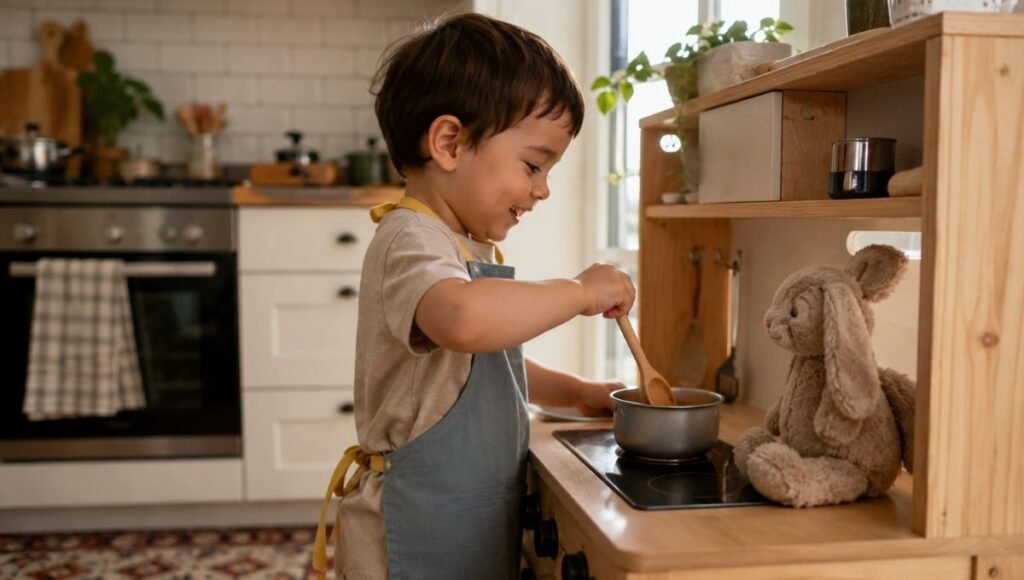
Play Kitchen for Toddlers and Kids: The Cornerstone of Pretend Play
If there’s one pretend play toy that earns universal recommendation from child development professionals, occupational therapists, and parents who’ve tried everything, it’s the play kitchen. Not because it’s trendy, but because it’s developmentally perfect for a remarkably wide age range.
Here’s what makes a play kitchen worth the investment:
At 18–24 months: Your toddler is in the peak imitation phase — they want to do exactly what you do, immediately. A play kitchen placed near the real kitchen becomes a daily parallel play ritual. They “cook” while you cook. The language that flows naturally — “What are you making? Is it hot? Can I have some?” — is pure vocabulary development.
At 2–3 years: Kitchen play becomes more elaborate. There are recipes, guests, catastrophes (the soup is too salty), and resolutions. Your child assigns roles, negotiates who gets to be the chef, and maintains narrative continuity across multiple play sessions.
At 4–5 years: The kitchen becomes a restaurant, a café, a food truck. There are menus (sometimes written), prices (sometimes negotiated), and reviews (sometimes extremely critical). The social complexity of this play is genuinely impressive.
What to look for in a play kitchen:
- Durable construction — this toy gets used hard, daily, for years. Solid wood or heavy-gauge plastic both work; cheap thin plastic won’t survive the enthusiasm
- Realistic details that satisfy the imitation drive: a knob that clicks, a door that opens, a faucet that turns
- Appropriate scale — your child should be able to reach all elements comfortably while standing
- Neutral color palette — this extends play life significantly; play kitchens that work in any scenario don’t limit the story
Editor’s opinion: The play kitchen is the one toy I’d tell every parent of a toddler to buy without hesitation. The play-per-dollar ratio over the years it gets used is extraordinary. It’s also the toy that most parents report their child gravitating to at other people’s houses — which tells you everything.
Pretend Play Toys for Toddlers: Doctor and Vet Kits
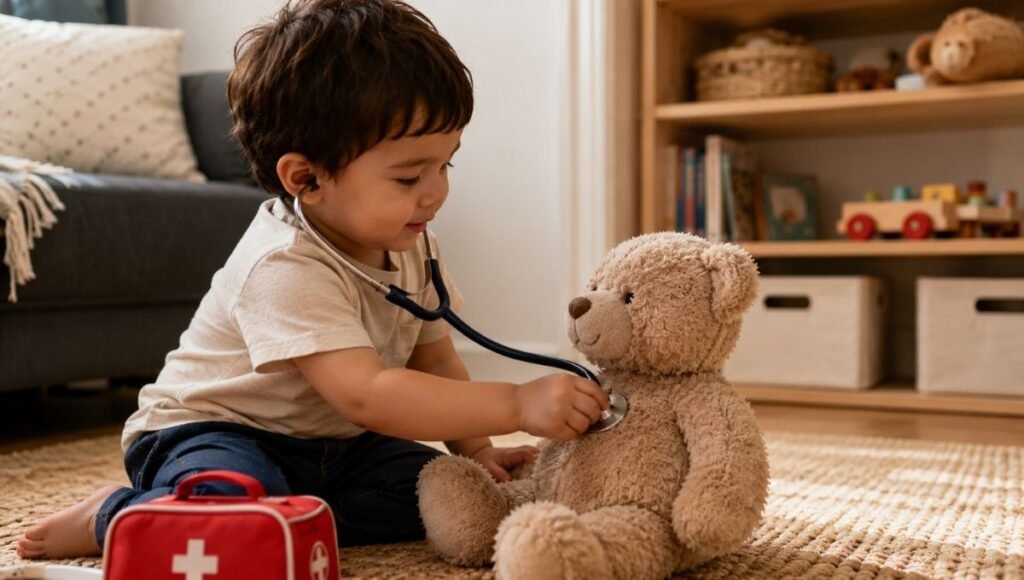
By age 2–3, children are processing significant emotional content around medical experiences — doctor visits, getting hurt, feeling sick, seeing others in distress. A wooden doctor kit gives them the one thing they need most in this processing: control.
When your child “examines” their stuffed rabbit, listens to its heart, and administers pretend medicine, they’re working through anxiety, practicing empathy, and developing the narrative sophistication that comes from taking on a role with its own responsibilities and knowledge.
Real parent moment: I watched my daughter who was terrified of blood tests spend three weeks giving her dolls elaborate blood tests with her toy syringe. By the time her actual appointment came around, she walked in calmly and explained the procedure to the nurse. Pretend play is therapy in the most literal developmental sense.
What to look for in a doctor or vet kit:
- Wooden construction — more durable and often better quality than plastic sets
- No small detachable pieces for children under 3
- A variety of tools that allow different “procedures” (stethoscope, otoscope, bandages, thermometer)
- Soft-bodied patient (a stuffed animal or doll) makes the play more emotionally resonant
Play Kitchen for Kids: Food Sets and Cooking Accessories
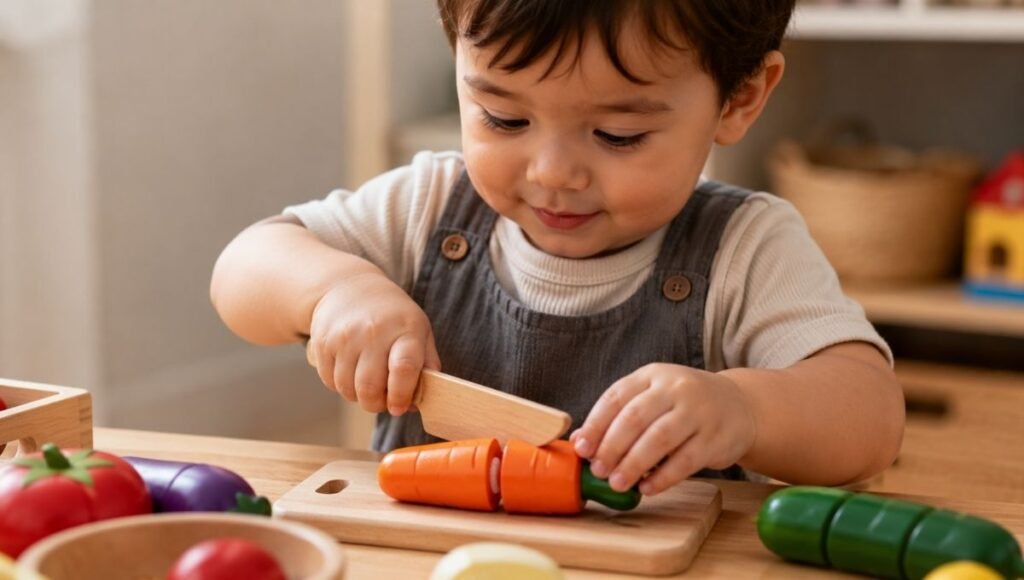
The best play food sets are the ones that extend the play kitchen experience into dedicated cooking scenarios — meal planning, ingredient sorting, food preparation, and serving.
At this age, the most developmental play food options are:
Cut-and-velcro food sets: The cutting action is genuinely fine motor work — your child grips the wooden knife, lines it up, and presses down to separate the pieces. By ages 2.5–3, this is a satisfying and achievable precision challenge. The resulting “meal” can be sorted, arranged, and served repeatedly.
Magnetic or velcro food storage: A toy refrigerator or pantry with sorted food items introduces categorization (fruit here, vegetables there), pretend meal planning, and the organizational thinking that underpins later executive function.
Baking sets: A small pretend mixer, rolling pin, baking sheet, and play dough (or pretend dough) create elaborate baking scenarios. Particularly effective at ages 3–5 when children are interested in real baking but can’t yet manage it safely.
Safety note: All play food should be clearly labeled non-toxic and BPA-free. For children under 3, ensure all food pieces are large enough not to be swallowed — apply the toilet paper roll test to any piece that concerns you.
Dollhouses: Social Laboratories in Miniature
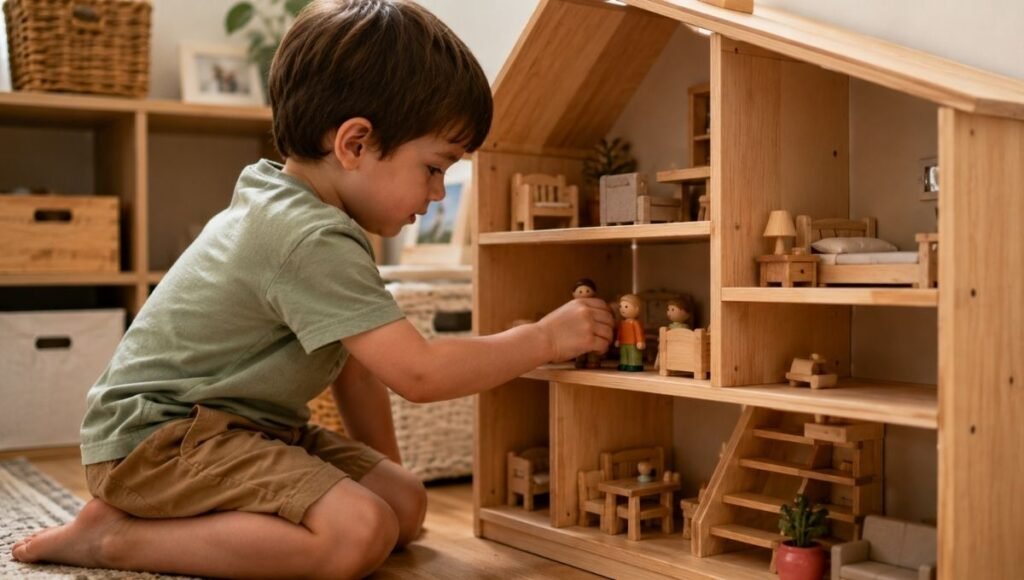
At ages 3–6, a dollhouse becomes a social laboratory where your child works out everything they’re observing and processing about human relationships — family dynamics, friendship conflicts, power and care, daily routines, and emotional experiences they haven’t yet found words for.
The play that happens around a well-made dollhouse is often the most revealing and developmentally rich of any toy category. Children who struggle to articulate their feelings will often act them out through dollhouse figures. Children navigating complex family situations process them through dollhouse scenarios. Children practicing new social situations — starting school, meeting new friends — rehearse them through the figures.
What makes a good dollhouse at this age:
- Flexible layout — rooms that allow multiple configurations of furniture and figures
- Sturdy construction that withstands daily enthusiastic rearrangement
- Figures with neutral enough features to represent “any family” — not locked into one specific demographic
- Scale that allows comfortable manipulation by 3-year-old hands
- Open back or front for easy access
What doesn’t work: Dollhouses with fixed walls and tiny, fiddly furniture that’s hard for small hands to move. The play value drops dramatically when the physical manipulation is too frustrating.
Dress-Up Clothes: Where Identity Play Begins

Between ages 3 and 6, children are working out who they are — trying on identities, testing roles, exploring what it feels like to be someone else for an afternoon. Dress-up clothes are the most direct tool for this important developmental work.
The distinction that matters most here: open-ended pieces vs. specific costumes.
A specific princess costume lets your child be that princess. A cape, a crown, and a flowing skirt let them be a queen, a wizard, a superhero, an explorer, or anyone else the current story demands. The open-ended version serves the developmental purpose better, lasts longer (the story changes; the costume doesn’t need to), and tends to get used far more frequently.
Best open-ended dress-up elements:
- Capes in various colors (no specific character attached)
- Crowns and headpieces in neutral designs
- Simple hats: chef’s hat, firefighter hat, doctor’s cap
- Scarves and fabric pieces that can become anything
- Simple accessory props: a doctor’s bag, a chef’s spoon, a magic wand
What to look for: Soft, washable fabrics with easy fastening (velcro or elastic — not buttons or complicated ties). If a 4-year-old can’t put it on themselves in 30 seconds, it will get abandoned before the play begins.
Puppet Theaters and Storytelling Sets
From around age 3, puppets unlock something specific: the safety of speaking through a character. Many children who are shy, anxious, or working through something difficult find it much easier to say things through a puppet than directly. This isn’t just cute — it’s therapeutic in a genuine developmental sense.
A simple doorway puppet theater paired with 4–6 animal or character hand puppets creates a storytelling space that children return to surprisingly often. Having an “audience” (parents, siblings, stuffed animals) adds the social dimension that makes this particularly valuable.
What makes a good puppet set:
- Puppets soft enough to be comfortable to wear on a small hand
- Expressive enough faces to represent different emotions
- A range of characters that can play different roles in different stories
- A theater structure that’s easy to set up and take down (or stays up)
Pretend Play Toys by Age: Quick Reference
Pretend Play Toys for 2 Year Old Children
The priority at 2 is imitation — they want to do what they see. Simple kitchen sets, basic doctor kits, and soft baby dolls with simple accessories are perfect. Keep props large (no small pieces) and focused on familiar everyday scenarios.
Best picks: Basic play kitchen, soft baby doll, simple wooden doctor kit, cut-and-velcro play food
Pretend Play Toys for 3 Year Old Children
At 3, imaginative play becomes genuinely narrative. Your child assigns roles, creates storylines, and maintains them across multiple play sessions. Slightly more complex sets are appropriate now — dollhouses, larger play kitchen accessories, a dress-up bin.
Best picks: Wooden dollhouse with figures, expanded kitchen accessories, open-ended dress-up bin, puppet set
Pretend Play for 4–5 Year Olds
By 4–5, pretend play scenarios have plot arcs, character development, and continuity. Children at this age love elaborate setups — a restaurant, a veterinary hospital, a bakery — and they’ll return to the same scenario across multiple days.
Best picks: Play kitchen with restaurant accessories, veterinarian or doctor play set, puppet theater, expanded dress-up collection, small world play sets
Safety: What to Check in Every Pretend Play Set
Pretend play toys are handled constantly, enthusiastically, and often by children who still put things in their mouths. Safety standards matter more here than almost anywhere else.
For all pretend play toys:
- ASTM F963 compliance (required for U.S. toys)
- CPSC certification
- BPA-free and phthalate-free for any plastic components
- Non-toxic finishes on all wooden toys
Specifically for play food and kitchen sets:
- No pieces small enough to be swallowed (toilet paper roll test for anything that concerns you)
- No sharp cut points on velcro food
- Materials that can be cleaned — play food gets handled constantly
Specifically for dress-up clothes:
- No cords or strings longer than 12 inches (strangulation hazard)
- Flame-retardant-free where possible (some flame retardants are not appropriate for children’s clothing)
- Soft fabrics that won’t irritate sensitive skin
Specifically for puppets:
- Firm attachment of all elements (eyes, nose, hair)
- No loose strings or small decorative pieces
- Washable construction — puppets get used intensively
What NOT to Buy: The Pretend Play Honest Skip List
Overly scripted play sets Sets that come with a predetermined story, assigned characters, and a specific sequence of play are limiting the very thing pretend play is supposed to develop — imagination. If the toy tells your child what to do, they’re not imagining; they’re following instructions.
Single-character costumes for very young children A 2-year-old doesn’t need to be a specific princess — they need to be whoever they currently are in their imagination. Single-character costumes expire with the enthusiasm for that character, which is usually a matter of weeks.
Very cheap play kitchens A play kitchen is an investment that should last 3–5 years of daily use. A cheaply constructed kitchen that wobbles, has stickers instead of printed detail, and breaks within the first six months isn’t a savings — it’s a waste. This is one category where quality genuinely pays off.
Electronic pretend play toys that script the interaction Toys that tell your child what to do next, provide automated responses, or perform for them rather than with them are reducing the imaginative demand. The best pretend play toys are silent — they respond to what your child brings, not the other way around.
Frequently Asked Questions
What are the best pretend play toys for toddlers? The most developmentally valuable pretend play toys for toddlers are simple play kitchens, soft baby dolls, basic doctor kits, and cut-and-velcro play food sets. At this age, the priority is imitation of familiar adult activities — toys that let them “do what you do” have the highest engagement and developmental value.
What age is best for a play kitchen? Play kitchens are appropriate and valuable from around 18 months through age 6 — which is an unusually wide developmental arc for any single toy. At 18 months, children use them for simple imitation. By 5–6, they’re running elaborate restaurant scenarios. The play kitchen earns its investment through longevity.
Is pretend play really educational? Extensively documented, yes. Multiple research studies — including work from the University of Virginia, Harvard’s Center on the Developing Child, and the National Institute for Play — confirm that rich pretend play directly builds executive function, language development, empathy, and emotional regulation. These are foundational skills for school success and beyond.
What’s the difference between a good play kitchen and a cheap one? Construction quality and realistic detail. A good play kitchen has sturdy materials that won’t tip or break under enthusiastic use, realistic elements (working knobs, a real-feeling faucet) that satisfy the imitation drive, and durable finish that doesn’t peel or fade with daily handling. Cheap kitchens have stickers that peel, thin plastic that cracks, and details that look good in photos but disappoint in person.
Are dress-up clothes good for boys too? Absolutely, and the developmental research supports this clearly. Children of all genders benefit from the identity exploration and role-taking that dress-up enables. Offering open-ended pieces (capes, hats, aprons, scarves) rather than gender-coded costumes serves all children equally well.
When should pretend play become more complex? Pretend play naturally becomes more complex as children develop — there’s no “should” about it. At 2, scenarios are simple and short. By 4, they’re elaborate and sustained. By 6, they involve rules, multiple characters, and continuity across days. This progression happens naturally with appropriate toys and time. If a child shows no interest in pretend play by age 3, mention it to your pediatrician.
The Bottom Line
The best pretend play toys are the ones that give your child’s already-active imagination something to work with — a setting, a role, a prop — without scripting the story.
A good play kitchen. A wooden doctor kit. An open-ended dress-up bin. A dollhouse with figures they can move anywhere. These aren’t complicated or expensive. They’re the toys that get used daily for years, that anchor the most developmental play happening in your home, and that your child will remember long after the batteries on everything else have died.
The banana-as-phone doesn’t need to be replaced. But the right props make it a whole lot more interesting.
Related guides:
- Best Toys for 2-Year-Olds
- Best Toys for 3-Year-Olds
- Best Toys for 4-Year-Olds
- Best Educational Toys: The Complete Guide
- Rainy Day Activities for Kids
- Best Gifts for 3-Year-Olds
References
- American Academy of Pediatrics (AAP). (2024). The Power of Play: A Pediatric Role in Enhancing Development in Young Children. https://www.healthychildren.org
- Harvard Center on the Developing Child. (2023). Serve and Return Interaction and Executive Function. https://developingchild.harvard.edu
- Brown, S. (National Institute for Play). (2023). Play Science — The Patterns of Play. https://www.nifplay.org/science/
- Berk, L.E., Mann, T.D., & Ogan, A.T. (University of Virginia). (2006). Make-believe play: Wellspring for development of self-regulation. In D.G. Singer, R.M. Golinkoff, & K. Hirsh-Pasek (Eds.), Play = Learning.
- Centers for Disease Control and Prevention (CDC). (2023). Developmental Milestones. https://www.cdc.gov/ncbddd/actearly/milestones/
- U.S. Consumer Product Safety Commission (CPSC). Toy Safety. https://www.cpsc.gov