
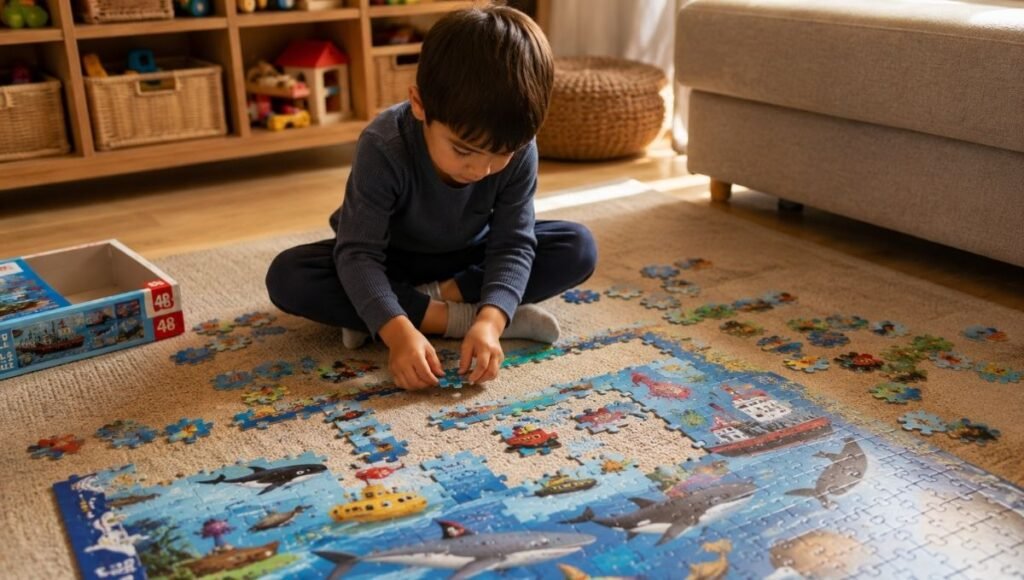
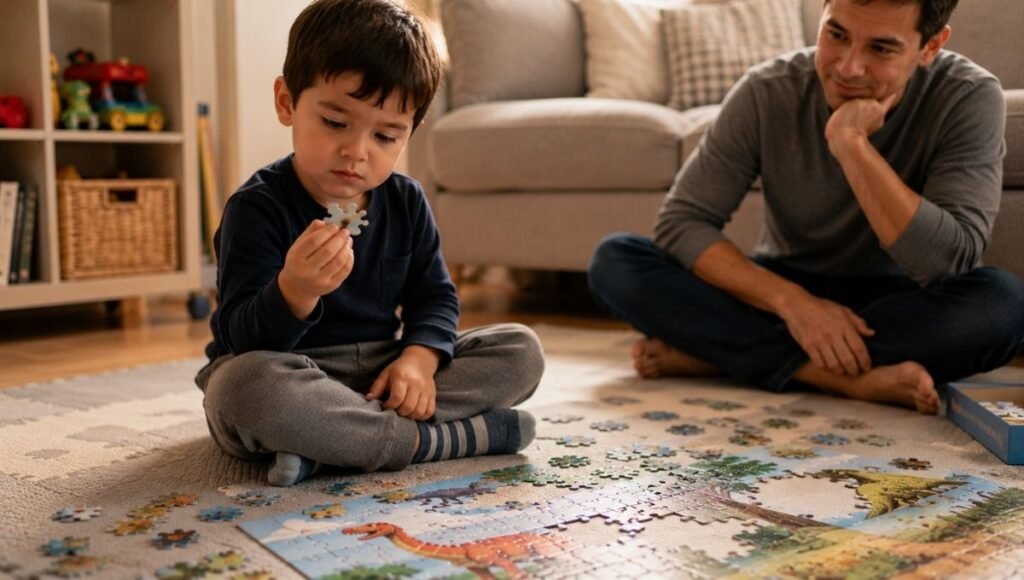
There’s a particular parenting satisfaction that comes from watching your child complete a puzzle. Not just because it’s quiet — though that’s genuinely meaningful at 4 PM on a Thursday — but because you can almost see the thinking happening. The picking up, the rotating, the trying, the frustration, the adjustment, the trying again. And then the moment the piece clicks into place and their face changes.
That sequence — try, fail, adjust, succeed — is one of the most valuable things a child can practice. And puzzles for kids are one of the few toys that naturally structure exactly that experience, at every age from 12 months through middle childhood, in a format that requires no batteries, no screens, and no adult hovering.
The problem isn’t knowing that puzzles are good. The problem is knowing which puzzle is right for your specific child’s age and skill level. Too easy and they’re bored in ninety seconds. Too hard and they’re frustrated in ninety seconds — which often looks identical to bored but involves significantly more crying.
This guide gives you the complete picture: what puzzles actually develop at each stage, the right piece count and type for every age, specific picks worth buying, and the common purchasing mistakes parents make that turn a potentially great toy into an ignored one.
Key Takeaways
- Puzzle piece count is developmental, not arbitrary. The age ranges on puzzle boxes are genuine developmental guidelines, not just safety marketing. A puzzle with too many pieces doesn’t challenge your child — it overwhelms them and creates negative associations with puzzles that can persist.
- Puzzles build skills that transfer directly to academics. A 2019 study published in the Journal of Experimental Child Psychology found that toddlers who played with puzzles at ages 2–4 showed significantly better spatial reasoning skills at age 4.5 — skills that directly predict mathematical ability.
- Wooden puzzles outperform cardboard at this age. For children under 5, wooden puzzles with knobs or thick pieces are significantly more developmentally appropriate than thin cardboard jigsaw pieces. The piece quality matters as much as the piece count.
- The right puzzle is one they can almost do. The productive challenge zone for puzzle play is just beyond current mastery — achievable with effort, not immediate, and not impossible. This is where the real learning happens.
- Floor puzzles change the experience. Large-format floor puzzles spread out on the carpet engage children differently than tray puzzles on a table — more physically, more collaboratively, and often for longer stretches.
What Puzzles Actually Build: The Developmental Case
Before we get to specific picks, let’s talk about why puzzles appear on virtually every child development expert’s recommended toy list — because the reasons are more specific than “they’re educational.”
Spatial reasoning: When a child rotates a puzzle piece to find the correct orientation, they’re doing genuine spatial reasoning — understanding how objects relate to each other in space. This skill, research from the University of Chicago consistently shows, is one of the strongest predictors of later mathematical achievement. A wooden puzzle at age 2 is genuinely connected to algebra comprehension at age 12.
Fine motor development: Picking up, gripping, and precisely placing puzzle pieces builds the pinch strength and hand-eye coordination that underpin writing. Knob puzzles in particular develop the exact two-finger pinch grip that pencil holding requires.
Executive function: Completing a puzzle requires planning (looking at the whole image), problem-solving (trying different pieces), inhibitory control (not forcing a piece that doesn’t fit), and persistence (continuing when it’s hard). These executive function skills are among the strongest predictors of school success.
Frustration tolerance: This one is underrated but important. A puzzle that’s appropriately challenging will frustrate your child — and that’s the point. Learning to stay with a difficult task, to try a different approach rather than giving up, is a skill that requires practice. Puzzles provide this practice in a low-stakes context.
Puzzles for Toddlers: By Age and Developmental Stage
Puzzles for 1 Year Old Babies: The First Puzzle Experience
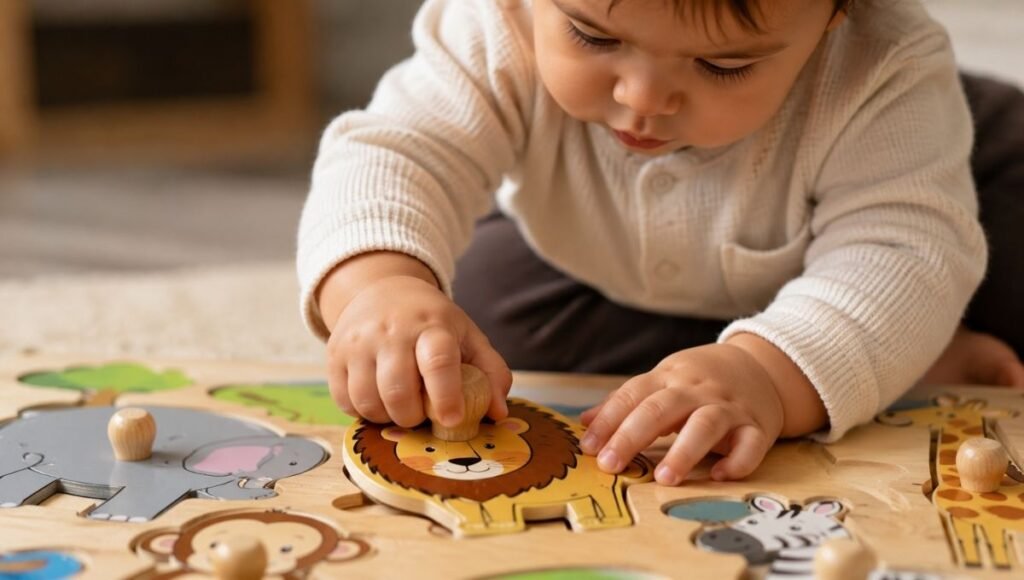
At 12–18 months, the goal isn’t puzzle-solving in any conventional sense. Your baby is working on the foundational skills that puzzle-solving will eventually require: picking up objects with a pincer grip, placing objects intentionally, and understanding that pieces fit into specific spots.
What works at this age:
Knob puzzles (2–4 pieces) — The classic first puzzle. A single piece with a large wooden knob that fits into one specific space. At 12 months, babies will mostly remove the pieces and put them back randomly. By 15–18 months, they’ll begin attempting to match pieces to their outlines.
Look for:
- Knobs large enough to grip without a precise pincer grasp
- Simple, clear images (one animal or object per piece)
- Smooth, finished wood with no splinters
- Pieces that fit snugly but release easily — too tight and it’s frustrating; too loose and it doesn’t teach fitting
Shape sorters and peg puzzles — At this age, the line between puzzle and shape sorter is blurry, and that’s fine. Both are building the same foundational spatial skills.
What to avoid at this age: Any puzzle with thin pieces that require precise edge-matching. Standard jigsaw pieces, even large ones, are developmentally premature before about age 3.
Wooden Puzzles for Toddlers: Ages 18 Months to 3 Years
This is the golden window for wooden puzzle development. Between 18 months and 3 years, children move from basic knob puzzles to 6–12 piece puzzles with increasingly precise fitting. The developmental arc within this window is rapid.
18–24 months: 4–6 piece knob puzzles with clear, simple images. Themes that connect to familiar objects (animals, vehicles, fruit) maintain engagement better than abstract shapes.
24–30 months: 6–8 piece puzzles, beginning to transition from knob handles to puzzles without handles (chunky pieces that lift directly from the tray). This transition is a genuine fine motor milestone.
30–36 months: 8–12 piece puzzles without knobs. Your child is now picking up pieces by pinching the flat surface — a more demanding grip that directly develops pencil-holding muscles.
The Ravensburger and Melissa & Doug question: Both brands are consistently recommended by occupational therapists for piece quality. Ravensburger’s die-cut precision means pieces fit together exactly — not too tight, not too loose. Melissa & Doug’s wooden puzzles are similarly well-crafted for this age range. Both are worth the modest price premium over discount alternatives.
Editor’s opinion: The quality of the cut matters more than people realize. A cheaply-made wooden puzzle where pieces fit too loosely teaches children nothing about spatial precision — because any orientation works. A well-made puzzle with a snug fit is genuinely more educational.
Puzzles for Kids Ages 3–5: The Preschool Puzzle Years
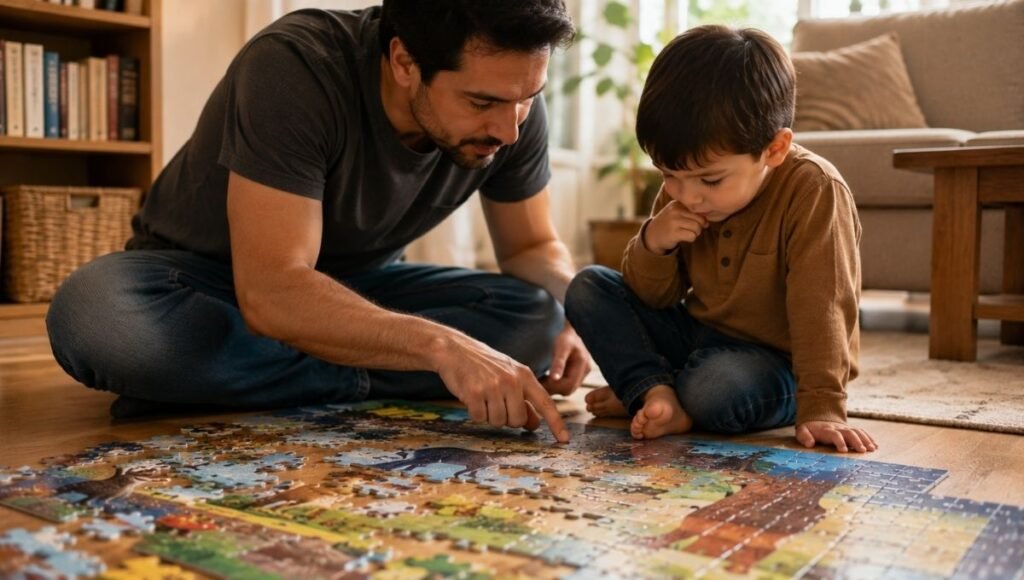
Three to five is when puzzle play becomes recognizably “puzzle play” — multi-piece jigsaws, floor puzzles spread across the living room, the beginning of independent puzzle-solving without adult guidance.
Ages 3–3.5: 12–24 piece puzzles. At this age, children are beginning to use the image (the picture on the box or the completed puzzle) as a guide, rather than just trying every piece in every position. This strategic approach is a cognitive milestone.
Ages 3.5–4.5: 24–48 piece puzzles. Floor puzzles are particularly valuable at this stage — the large format, spread out on the floor, engages the whole body and often invites collaborative play with a parent or sibling.
Ages 4.5–5: 48–100 piece puzzles. By 5, many children can work on puzzles independently for 15–20 minute stretches — which is developmentally significant, and also practically very useful at 5:30 PM.
The floor puzzle advantage: Floor puzzles aren’t just bigger — they change the experience. Children who work on floor puzzles tend to:
- Stay engaged longer (the physical scale is more immersive)
- Work more collaboratively with siblings and parents
- Use edge-finding strategies more naturally (the boundary of the puzzle is visible at a glance)
Best floor puzzle brands: Melissa & Doug and Ravensburger both make reliably well-cut floor puzzles. Look for formats around 18″×24″ for ages 3–4, and larger formats as skills develop.
Puzzles for Kids Ages 5–8: Real Challenge, Real Satisfaction
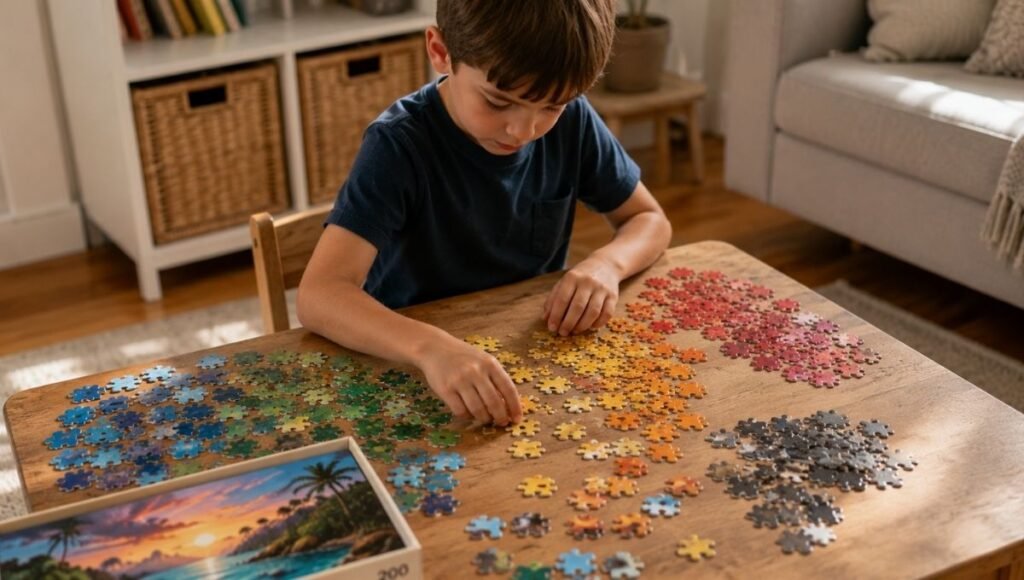
By 5, most children are ready for puzzles that represent genuine cognitive challenges — ones that require planning, strategy, and sustained attention across multiple sessions.
Ages 5–6: 100–200 piece puzzles. A 200-piece puzzle spread on the dining table becomes a multi-day project — started one afternoon, returned to the next morning, completed with genuine triumph. The delayed gratification involved is developmentally valuable in a way that instant-completion puzzles aren’t.
Ages 6–8: 200–500 piece puzzles. At this range, children are developing real puzzle strategies: sorting by color, finding edge pieces first, working section by section. These strategic approaches are planning and executive function development in action.
3D puzzles and specialty puzzles: From about age 6, children who enjoy 2D puzzles often find new engagement in 3D puzzle formats — foam or wooden structures that assemble into three-dimensional objects. These add a spatial reasoning dimension that standard flat puzzles don’t provide.
Best Puzzles for Kids: What to Actually Buy
Best Overall: Ravensburger Floor Puzzles
Ravensburger’s die-cut precision produces pieces that fit together exactly — satisfyingly snug without being frustrating to separate. For ages 3–6, their floor puzzle range (24–100 pieces) is consistently the highest-quality option available.
What makes Ravensburger worth the price:
- Precision-cut pieces that fit together and stay together
- Anti-glare surface that makes the image easier to read
- Sturdy cardboard that survives repeated assembly and disassembly
- Wide range of themes and piece counts across all ages
Best Wooden Puzzles for Toddlers: Melissa & Doug
For the 12-month to 3-year range, Melissa & Doug’s wooden puzzle line is the most widely recommended by occupational therapists and child development professionals. Their knob puzzles, chunky tray puzzles, and first jigsaw puzzles are all well-constructed, well-finished, and developmentally appropriate.
Best specific picks:
- Melissa & Doug Farm Animals Knob Puzzle (4 pieces, ages 12+ months)
- Melissa & Doug Wooden Chunky Puzzle — Vehicles (6 pieces, ages 2+)
- Melissa & Doug 24-piece Floor Puzzle (multiple themes, ages 3+)
Best for First Jigsaw Experience: Orchard Toys
UK-based Orchard Toys makes exceptionally well-designed first jigsaw puzzles for the 2–4 age range. Their pieces are thicker and larger than standard children’s jigsaws, the images are clear and engaging, and the difficulty progression across their range is thoughtfully calibrated.
Best for Spatial Challenge: Tangram Puzzles
From around age 4, tangram sets — geometric shape puzzles where pieces are rearranged to form different silhouettes — provide a different kind of spatial challenge than standard jigsaw puzzles. They build flexible spatial thinking (moving the same pieces into different configurations) rather than the pattern-matching of jigsaws.
Best for Building Puzzle Confidence: 2-in-1 Puzzles
Several brands make puzzles where the completed puzzle image can then be used as a building prompt — placing pieces to recreate a scene on a background board. These reduce the visual complexity of pure jigsaws (because the placement guide is always visible) while still building spatial skills. They’re particularly useful for children who have found standard jigsaws frustrating.
The Puzzle Mistakes Parents Make (And How to Avoid Them)
Buying too many pieces too soon This is the most common puzzle mistake — and the one with the most lasting consequences. A child who repeatedly fails at a puzzle because it’s too hard doesn’t develop persistence; they develop a dislike of puzzles. Always buy at or slightly below your child’s current level for their first puzzle in a new format, then move up.
Not storing puzzles properly A puzzle with missing pieces is not a puzzle — it’s a source of frustration for everyone. Puzzle storage bags (flat ziplock bags work perfectly) preserve complete sets and make it much easier to introduce “old” puzzles as fresh challenges after a few weeks away.
Hovering during puzzle play The instinct to help when your child is struggling is natural — and usually counterproductive. The frustration of a puzzle that’s slightly too hard is where the executive function development happens. Narrate and encourage; avoid pointing to the correct piece. “That one looks like it has a straight edge — where do the straight edges go?” is helpful. Pointing to the correct spot is not.
Abandoning puzzles after a frustrating session Puzzle engagement is variable. A child who refuses a puzzle one afternoon may return to it the next morning with fresh eyes and complete it in minutes. Don’t retire a puzzle based on one session’s reaction.
Buying based on piece count alone Two 24-piece puzzles can be dramatically different in difficulty depending on image complexity, piece shape variability, and cut precision. A 24-piece puzzle with a busy, visually similar image (a scene with lots of grass) is significantly harder than a 24-piece puzzle with distinct, high-contrast elements. Match the image to your child’s current ability, not just the number.
Frequently Asked Questions
What are the best puzzles for kids overall? The most consistently recommended puzzles for children are Ravensburger floor puzzles (for ages 3–8), Melissa & Doug wooden knob and chunky puzzles (for ages 12 months to 3 years), and Orchard Toys first jigsaws (for ages 2–4). All three brands prioritize piece quality and age-appropriate difficulty in ways that cheaper alternatives don’t.
What puzzles are best for toddlers? For toddler puzzles, wooden knob puzzles (2–6 pieces) for ages 12–24 months, chunky wooden tray puzzles (6–12 pieces) for ages 2–3, and simple 12–24 piece floor puzzles for ages 3+ are the most developmentally appropriate choices. The key is smooth wooden construction, clear simple images, and snug-but-not-frustrating piece fitting.
How do I know if a puzzle is too hard for my child? If your child attempts the puzzle and abandons it in frustration within 2–3 minutes consistently across multiple sessions, the puzzle is too hard. If they complete it in under 30 seconds without visible thought, it’s too easy. The right puzzle produces 5–15 minutes of engaged effort before completion.
Are wooden puzzles better than cardboard for young children? Yes, significantly so for children under 4. Wooden puzzle pieces are thicker, more graspable, more durable, and better suited to the developing pincer grip of toddlers. Thin cardboard jigsaw pieces require a level of fine motor precision that most children don’t develop until around age 3.5–4.
How many puzzles should a child have? Quality over quantity. Two or three puzzles at the right difficulty level that your child returns to repeatedly are more valuable than a large collection of puzzles they’ve completed once. Rotate puzzles in and out of access — a puzzle that’s been “away” for three weeks feels new again and produces fresh engagement.
My child gets very frustrated with puzzles and refuses to continue. What should I do? First, check that the puzzle is at the right difficulty level — a child who consistently refuses puzzles may be encountering ones that are too hard. Second, try puzzles alongside them rather than observing. Children who puzzle alongside a parent tend to persist longer. Third, frame incomplete puzzles positively: “We got five pieces done today — let’s see how many we get tomorrow.”
Can puzzles help with school readiness? Yes — with strong research support. Spatial reasoning developed through puzzle play has been directly linked to mathematical achievement in multiple longitudinal studies. Fine motor skills developed through puzzle piece manipulation support writing readiness. And the executive function skills practiced during puzzle play (persistence, planning, problem-solving) are among the strongest predictors of school success.
The Bottom Line
The best puzzles for kids are genuinely one of the highest-value toy investments available across the entire childhood age range. They’re inexpensive, durable, screen-free, developmentally rich, and capable of providing genuinely independent quiet play as children develop the skills to tackle them alone.
The formula is simple: match the piece count to the developmental stage, prioritize wooden construction for children under 4, choose Ravensburger or Melissa & Doug for piece quality, and resist the urge to help when your child is struggling.
The clicking piece sounds quiet. What it’s actually doing is remarkably loud.
Related guides:
- Best Fine Motor Skills Toys
- Best STEM Toys for Kids
- Best Toys for 3-Year-Olds
- Best Toys for 4-Year-Olds
- Best Educational Toys: The Complete Guide
- Rainy Day Activities for Kids
References
- Levine, S.C., et al. (2019). Puzzle play: A neglected activity that promotes spatial thinking in young children. Journal of Experimental Child Psychology.
- Uttal, D.H., et al. (2014). The malleability of spatial skills: A meta-analysis of training studies. Trends in Neuroscience and Education.
- American Academy of Pediatrics (AAP). (2024). The Power of Play. https://www.healthychildren.org
- National Association for the Education of Young Children (NAEYC). (2024). Good Toys for Young Children by Age and Stage. https://www.naeyc.org
- Centers for Disease Control and Prevention (CDC). (2023). Developmental Milestones. https://www.cdc.gov/ncbddd/actearly/milestones/
- U.S. Consumer Product Safety Commission (CPSC). Toy Safety. https://www.cpsc.gov