
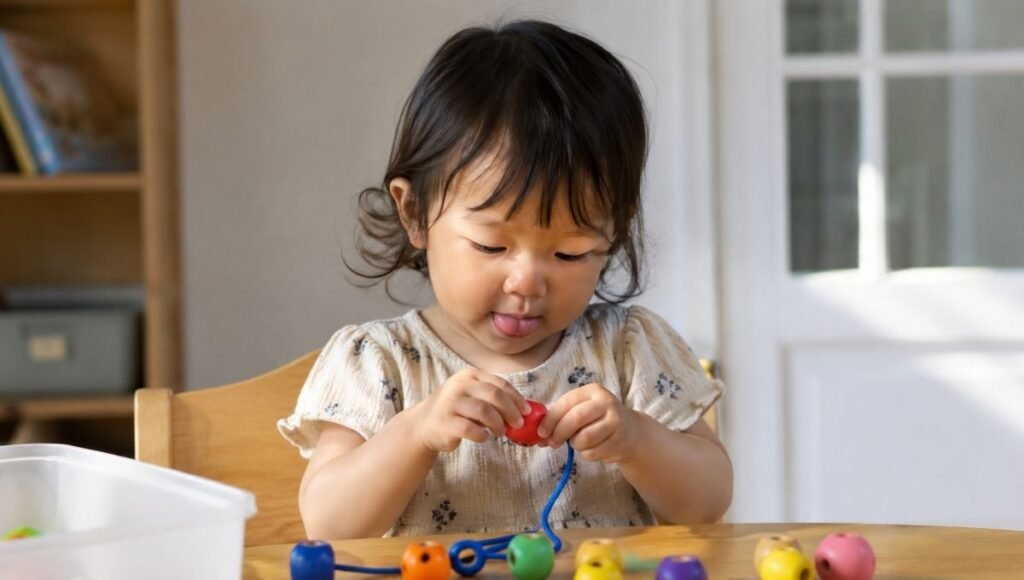
There’s a particular kind of parenting worry that doesn’t announce itself loudly. It just sits there quietly in the back of your mind while you’re watching your toddler struggle to pick up a small piece of food, or grip a crayon, or button a coat. And eventually you find yourself typing something into Reddit at 10 PM: “Is it normal that my 3-year-old can’t…”
The answers in those threads are genuinely helpful — parents sharing what worked, OTs occasionally dropping in with professional perspective, the reassuring chorus of “same here, you’re not alone.” But what they rarely give you is the complete picture: which specific toys actually build fine motor skills, why they work, how to know if your child is genuinely behind, and what to do when your toddler wants absolutely nothing to do with the activity you’ve carefully set up.
That’s what this guide is for.
Fine motor skills toys aren’t a niche parenting concern — they’re one of the highest-leverage investments you can make in early childhood, because the hand strength, coordination, and dexterity that develop in the first five years directly underpin writing, self-care, and virtually every academic task your child will do in school. The good news: building these skills through play is completely achievable at home, with toys that don’t require a therapy clinic or a significant budget.
Key Takeaways
- Fine motor skills are declining. Multiple pediatric occupational therapists have reported seeing significant fine motor skill deficits in children entering kindergarten over the past decade — a trend attributed to decreased hands-on play and increased screen time. The toys you choose at home genuinely matter.
- The pincer grasp is the developmental milestone to understand. This two-finger picking motion — thumb and index finger — is the foundation of everything from picking up a blueberry to holding a pencil. Most children develop it between 9–12 months, but it needs practice and refinement through toddlerhood.
- You need less equipment than you think. Play dough, tweezers, beads, lacing cards, and a few well-chosen toys cover the full spectrum of fine motor development. The activities matter more than the price tag.
- Non-toxic materials are non-negotiable at this age. For any toy that involves mouthing, repeated hand contact, or art materials, BPA-free, phthalate-free, and ASTM F963-compliant certification is the baseline.
- If you’re genuinely concerned, get an OT evaluation. This guide is for typical development support — not for replacing professional assessment. The “When to See a Specialist” section at the end gives you the specific signs to watch for.
What Fine Motor Skills Actually Are (And Why They Matter More Than You Think)
Fine motor skills are the small, precise movements of the hands, fingers, wrists, and sometimes feet. The term sounds clinical, but the practical reality is more immediate: fine motor skills are what allow your child to zip their own jacket, use a fork without spilling everything, hold a crayon without it looking like they’re gripping a steering wheel, and eventually write legibly.
The developmental window for building these skills is early childhood — and it’s genuinely time-sensitive in the sense that the skills developed (or not developed) during ages 1–5 create the foundation that school will build on. A 6-year-old with weak fine motor development will struggle with writing, cutting, and managing classroom materials in ways that affect confidence and academic performance.
According to a 2023 report from the American Journal of Occupational Therapy, occupational therapists in school settings are documenting significant increases in fine motor skill referrals among kindergarten-age children. The contributing factors are consistent: less time spent in hands-on play, more time with touchscreens (which don’t require the grip strength or pinch development of physical manipulation), and reduced craft and building activities.
This isn’t a reason to panic. It’s a reason to choose toys thoughtfully.
Fine Motor Skills Toys by Age: What to Look For at Each Stage
Fine Motor Toys for Babies (6–12 Months)
At this age, fine motor development is mostly about the transition from whole-hand grasping to the beginnings of pincer grip. Your baby’s hands are figuring out that different objects require different approaches — and toys that encourage this exploration are doing genuine developmental work.
What works:
- Soft stacking rings and cups in varied sizes
- Textured rattles with different surfaces to explore
- Simple cause-and-effect toys that respond to finger pressure
- Board books with thick pages they can practice turning
- Soft squeeze toys that respond to grip strength
The key at this stage is variety of texture and size — not complexity of toy. A collection of objects that feel different in the hand is more developmentally valuable than a single sophisticated toy.
Fine Motor Toys for Toddlers (12–24 Months): The Pincer Grasp Years
Between 12 and 24 months, most children are consolidating their pincer grasp and beginning to develop the intentional, controlled hand movements that underpin everything else. This is the age of deliberate placing, deliberate dropping, and the deep satisfaction of putting a small object exactly where you wanted it.
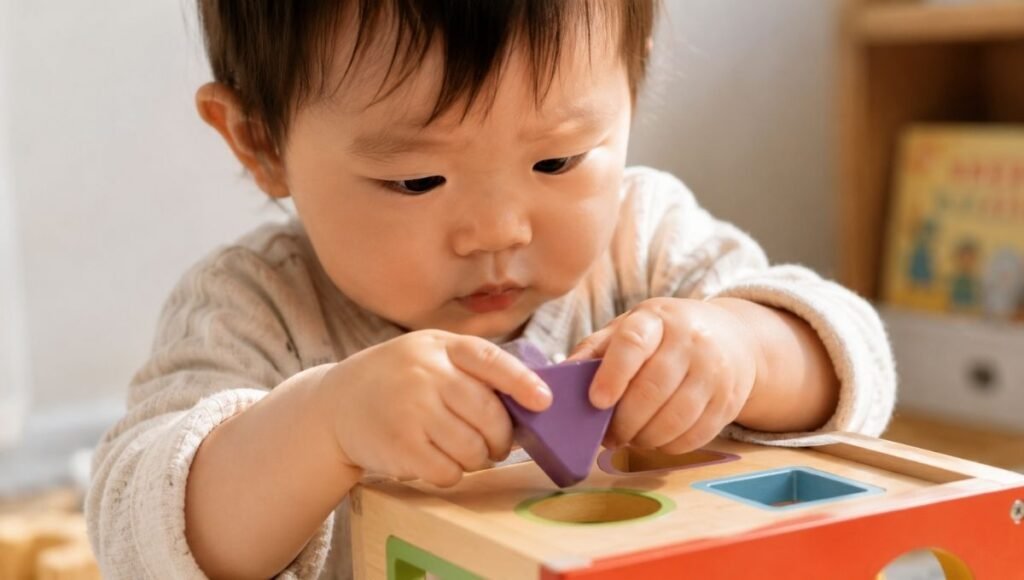
Shape sorters Still the workhorse of toddler fine motor development. At 12–18 months, your child is learning to align objects to openings — rotating, adjusting, problem-solving. Choose a shape sorter with 3–5 shapes and smooth, large pieces. The moment a shape finally drops through is a motor and cognitive victory simultaneously.
Stacking rings and cups Removing rings from a post and replacing them requires precision and intentionality that’s genuinely challenging at 14 months. The proprioceptive feedback (the physical sense of getting it right) is part of what makes this so satisfying and developmentally effective.
Simple puzzles with knob handles Large-piece puzzles with chunky handles introduce the pincer grasp in a more demanding context — your child must pick up, orient, and place a piece with increasing precision. At 15–18 months, 4–6 piece puzzles with large knobs are appropriate. By 24 months, puzzles without knobs become achievable.
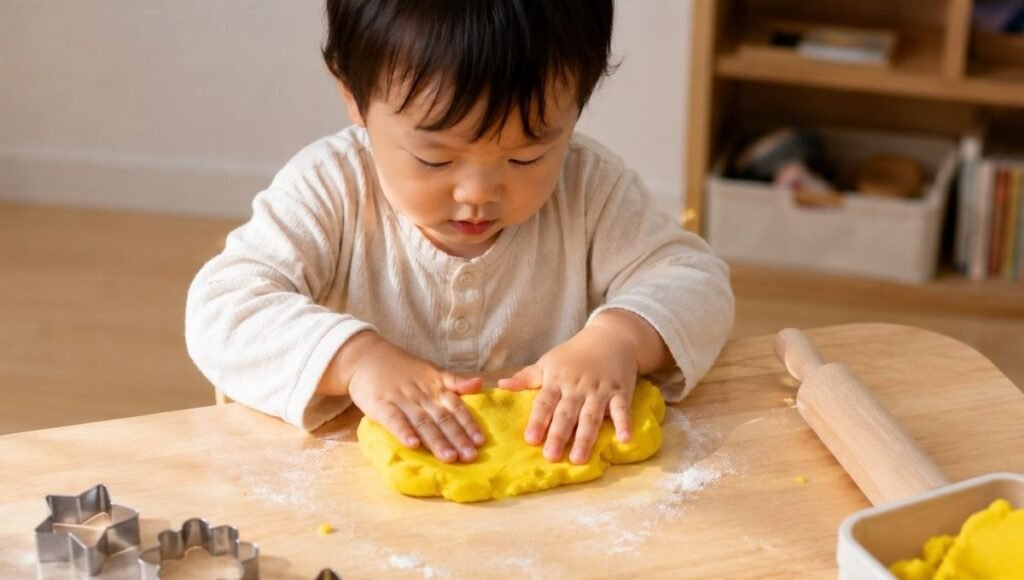
Play dough I’ll say it again here because it keeps being true: Play-Doh is one of the most effective fine motor development tools available for under $15. Squeezing, rolling, pinching, pressing, and pulling clay directly builds the intrinsic hand muscles — the small muscles inside the palm that control precise finger movement and that are notoriously difficult to strengthen through any other activity.
Safety note: Choose clearly labeled non-toxic play dough for children who still mouth materials. Homemade play dough with food coloring is a safe alternative.
Fine Motor Development at Ages 2–3: Getting Precise
Two to three years is when fine motor development becomes genuinely visible in daily life. Your child is attempting to dress themselves (with varying success and spectacular frustration), using utensils more purposefully, and beginning to make intentional marks with crayons and pencils. This is also when occupational therapists start looking more specifically at hand dominance, grasp patterns, and grip strength.
Threading and lacing toys Lacing cards — wooden shapes with holes around the perimeter and a lace to thread through — require the bimanual coordination (both hands working together) that’s a key developmental marker at this age. Threading beads onto a lace is a more demanding version of the same skill. Both build the precise finger control that directly transfers to pencil use.
Choose lacing supplies with a stiff lace end (so the child can direct it without adult help) and holes large enough that success is achievable but not immediate.
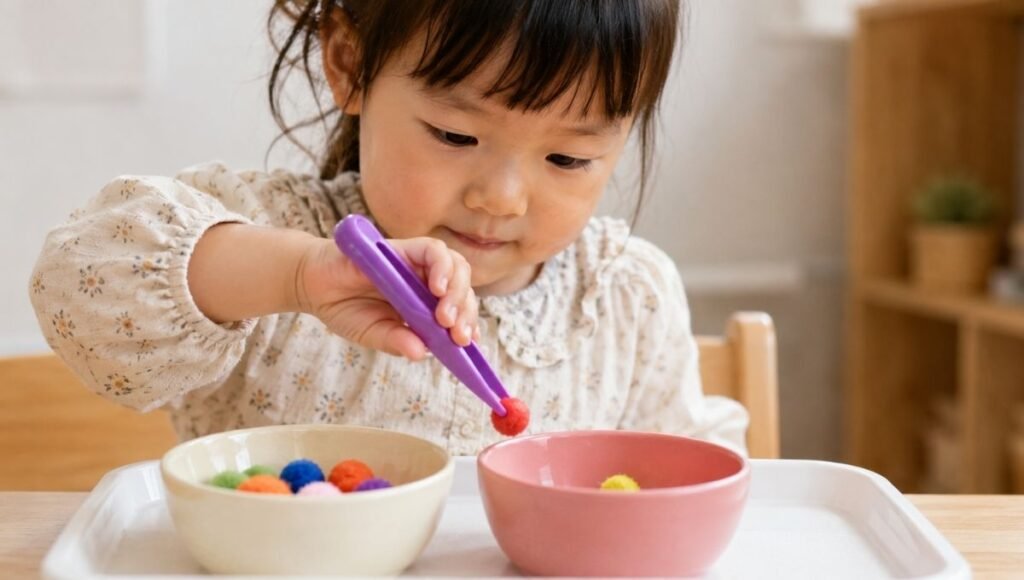
Tweezers and tong activities Child-sized tweezers or tongs, used to transfer small objects between containers, build grip strength and precision in a way that’s genuinely engaging. The Learning Resources Squeezy Tweezers are a consistent occupational therapist recommendation for this age — the squeeze-to-open mechanism builds exactly the muscle groups needed for scissor use.
Set up a simple “transfer station”: a tray with two small containers and a collection of objects to move between them (pom poms, small blocks, large beads). This activity looks simple and delivers serious developmental work.
Pegboards A classic pegboard — the kind where pegs are placed in holes in a board — develops grasp, release, and the precision placing that underpins writing. At 2 years, children are working on basic placement. By 3, they can begin creating patterns. Look for pegs large enough to be safe but small enough to require a proper grip rather than a whole-hand grasp.
Finger painting and early mark-making At 2–3, drawing and painting aren’t about the result — they’re about the process of controlling a tool. Finger painting builds tactile awareness and proprioception. Thick crayons (triangular grip crayons are ideal) build the grip pattern that will eventually become pencil hold.
Editor’s opinion: Triangular crayons are genuinely one of the most underrated parenting purchases. They naturally guide small hands into a proper tripod grip. The round ones are harder to hold correctly — and correct habits formed now save significant retraining later.
Best Fine Motor Toys for Ages 3–5: School-Prep Skills
At 3–5 years, fine motor development shifts toward school readiness. The specific skills being developed — proper pencil grip, cutting with scissors, managing clothing fasteners — are the ones that teachers will look for in kindergarten. This is the developmental window where intentional practice through play matters most.
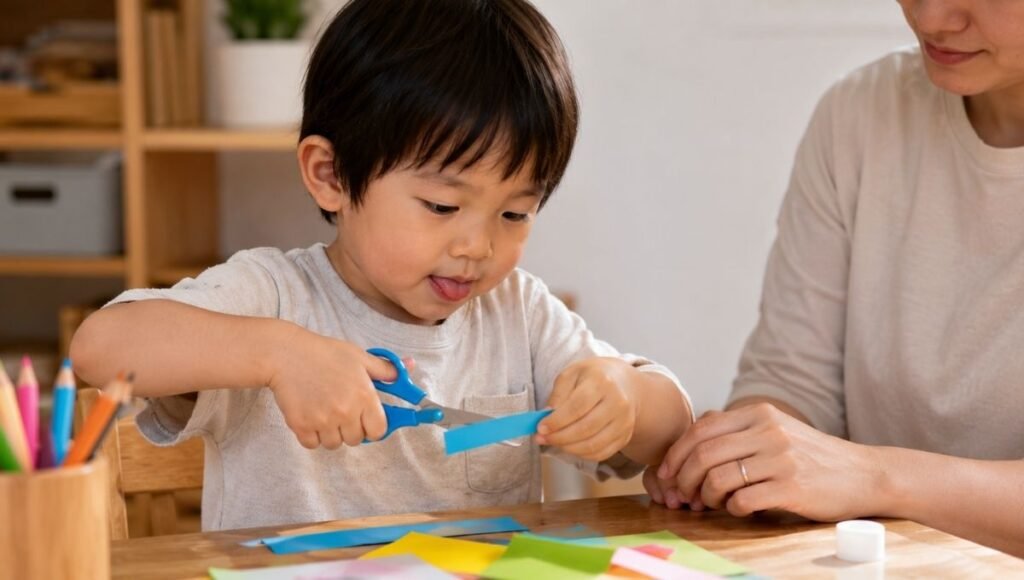
Child-safe scissors + cutting activities The ability to use scissors is a specific fine motor milestone that typically emerges around age 3–4. It requires bilateral coordination (one hand holds the paper, the other operates the scissors), grip strength, and the ability to make the snipping motion deliberately.
Start with simple straight cuts (strips of paper), then move to curves and shapes. Child-safe scissors with a spring-return mechanism (they open automatically after each cut) are recommended by OTs for children who struggle with the opening motion.
Beading with smaller beads At 3+, the bead size can decrease as pincer grasp becomes more refined. Small bead sets (with beads around 1 cm in diameter — always check these are safe for your specific child) build extraordinary finger precision. The lace threading requires the kind of fine motor control that directly predicts successful pencil grip.
Safety reminder: Any bead small enough to be swallowed should be kept away from children who still mouth objects or have younger siblings.
Building sets with small connectors Standard LEGO bricks (not DUPLO — the small kind) are one of the most OT-recommended fine motor toys for ages 4+. Pressing bricks together requires significant pinch strength. Separating them is equally demanding. Building complex structures requires sustained bimanual coordination. The fine motor workout happening during a LEGO session is substantial.
Spirograph and drawing tools By 4–5, children are ready for drawing tools that require controlled, precise movement: simple Spirograph sets, dot-to-dot books, maze workbooks, and tracing activities. These build the controlled pencil movement that writing requires, in a context that feels like play rather than practice.
The Toys OTs Keep Recommending (And Why)
After reviewing multiple occupational therapist resource lists and the recurring recommendations in parent communities, these specific toys appear consistently:
Learning Resources Spike the Fine Motor Hedgehog A plastic hedgehog with holes in its back designed for colored “quill” pegs. The action of pinching and inserting each quill builds exactly the muscles needed for pencil grip. OTs recommend it specifically because the resistance level is appropriate — it requires effort without being frustrating. Works well from 18 months through age 4 in different ways.
Melissa & Doug Bead Sequencing Set Large wooden beads in shapes and colors, with laces for threading. The beads are large enough to be safe for children 3+ and small enough to require a proper pincer grip. The pattern cards add a cognitive element that sustains engagement beyond pure motor practice.
Kinetic Sand Genuinely underrated for fine motor development. The resistance of kinetic sand when squeezed and shaped requires more muscle activation than play dough. Pressing, pinching, rolling, and shaping all work the intrinsic hand muscles. The satisfying way it holds shapes produces the kind of engagement that sustains long sessions.
Lacing Cards (wood or foam) Any set of well-made lacing cards. The OT recommendation is consistent: lacing requires alternating hand movements, spatial planning, and precise finger manipulation simultaneously. It’s one of the most efficient fine motor exercises available in toy form.
Melissa & Doug Lock Box A wooden box with multiple types of latches, padlocks, and fasteners to open. This directly practices the hand skills needed for clothing and daily living (buttons, buckles, zippers) in a low-stakes, engaging format.
Non-Toxic Toys for Babies and Toddlers: Why Material Safety Matters
For fine motor development toys specifically, material safety deserves extra attention — because these are toys that spend significant time in hands (and mouths) at an age when chemical exposure is most impactful.
What to look for:
- BPA-free and phthalate-free for all plastics — essential for any toy that will be mouthed
- Non-toxic, water-based finishes on wooden toys — not just “natural” wood (which can still be treated with chemicals)
- ASTM F963 compliance — the U.S. toy safety standard, required by law for toys sold in America
- CPSC certification — Consumer Product Safety Commission oversight
- Food-grade silicone for any teether or mouthing toy used alongside fine motor play
For art materials specifically:
- ACMI AP (non-toxic) seal on all crayons, paints, and modeling materials
- Water-based, washable formulations for paints and markers
- Clearly labeled non-toxic for any modeling compound
A practical note: “Non-toxic” labeling on toys is regulated in the U.S. — it’s not just a marketing claim. But “natural” is not a regulated term and tells you nothing about safety. Look for the certifications, not the adjectives.
What to Do When Your Child Won’t Engage With Fine Motor Activities
This comes up constantly in parent communities, and it deserves a direct answer.
First: check the difficulty level. The most common reason children disengage from fine motor activities is that the activity is either too easy (boring) or too hard (frustrating). Fine motor toys that are just slightly above current ability — challenging enough to require effort, achievable enough to produce success — hold attention. Toys that are too easy get dismissed. Toys that produce repeated failure get rejected.
Second: follow their interest, not the activity. A child who loves vehicles will tolerate threading if the result is “putting wheels on a car.” A child who loves animals will engage with tweezers if they’re “feeding” animal figures. The fine motor exercise is the same; the motivation is completely different. Use their interests as the container for the skill practice.
Third: do it alongside them. Children at this age are profoundly motivated by doing what adults do. If you sit at the table and work on a lacing card yourself while narrating what you’re doing, your toddler will almost certainly want to participate within two minutes. Start the activity yourself, without inviting them. The “I want to do that” instinct will arrive on its own.
Fourth: keep sessions short. Fine motor work is genuinely tiring for small hands. 5–10 minutes of focused fine motor play is appropriate for a 2-year-old; 10–15 minutes for a 3-year-old; 15–20 minutes for a 4-year-old. Stop while they’re still engaged — not after they’ve lost interest.
When to Talk to a Specialist
This guide supports typical fine motor development. But some children benefit significantly from professional OT assessment, and earlier referral always produces better outcomes than waiting.
Talk to your pediatrician or request an OT evaluation if your child:
- At 12 months: is not reaching for or picking up small objects
- At 18 months: is not attempting to stack 2–3 blocks or use a spoon with any control
- At 24 months: cannot scribble with a crayon or pick up small objects with a pincer grasp
- At 3 years: cannot manage buttons or zippers, struggles significantly with self-feeding, or doesn’t attempt to draw
- At 4 years: cannot cut paper with scissors, has an unusual pencil grip that doesn’t self-correct, or shows significant frustration with hand tasks that peers manage comfortably
- At any age: has lost fine motor skills they previously had
Occupational therapy for fine motor concerns is widely available, often covered by insurance, and genuinely effective. There’s no developmental downside to getting an evaluation — and early support makes a meaningful difference.
Frequently Asked Questions
What are the best fine motor skills toys for toddlers? The most consistently recommended fine motor toys for toddlers are: play dough, shape sorters, lacing cards, pegboards, threading beads, simple puzzles, and child-safe tweezers for transfer activities. These cover the full spectrum of fine motor development from pincer grasp through bimanual coordination. They’re also among the least expensive options in the toy category — which is a bonus.
At what age should I start fine motor toys? Fine motor development begins in infancy — by 6 months, babies are already developing the hand skills that will eventually become a pincer grasp. Age-appropriate fine motor toys can begin from 6 months (textured rattles, soft squeeze toys) and increase in complexity through toddlerhood and preschool.
Are non-toxic toys actually safer? What should I look for? “Non-toxic” labeling on toys sold in the U.S. is regulated — it refers to specific chemical standards, not just a marketing claim. For fine motor toys specifically, look for BPA-free and phthalate-free plastics, non-toxic water-based finishes on wooden toys, ASTM F963 compliance, and ACMI AP certification on art materials. These aren’t optional extras — they’re the baseline for any toy that will be handled repeatedly by young children.
My toddler just throws or destroys every fine motor toy. Is something wrong? Almost certainly not. Throwing, dismantling, and using toys in ways other than “intended” is developmentally normal through about age 2.5 — and it’s actually fine motor practice (grip, release, aim). If it continues past age 3 with every toy, mention it to your pediatrician. But for toddlers, it’s usually just toddler-ness.
Can screen time affect fine motor development? Yes, to some extent. Touchscreens don’t develop grip strength, pinch force, or the three-dimensional manipulation that physical toys do. The American Academy of Pediatrics recommends limiting screen time to 1 hour per day for children 2–5, partly for this reason. Screen-free, hands-on play remains the most effective context for fine motor development.
How long should fine motor activities last for toddlers? Keep sessions short and stop while they’re still engaged. 5–10 minutes for 2-year-olds, 10–15 for 3-year-olds, 15–20 for 4-year-olds. Fatigue leads to frustration, which leads to rejection of the activity entirely. Brief, frequent sessions are significantly more effective than longer, forced ones.
The Bottom Line
Fine motor skills toys are some of the highest-value developmental investments you can make in early childhood — not because they’re expensive or complex, but because the skills they build underpin every academic and self-care task your child will do for the rest of their life.
The toys that work best are usually the simplest: play dough, lacing cards, shape sorters, simple puzzles, and a set of child-sized tweezers. Materials that are safe to handle, activities that are just the right level of challenge, sessions that end before frustration sets in.
You don’t need a therapy office. You need a kitchen table, twenty minutes, and the willingness to sit alongside them and try.
Related guides:
- Best Sensory Toys for Babies
- Best STEM Toys for Kids
- Best Toys for 2-Year-Olds
- Best Toys for 3-Year-Olds
References
- American Journal of Occupational Therapy. (2023). Fine Motor Skill Development in Early Childhood: Current Trends and Intervention Approaches. https://ajot.aota.org
- Centers for Disease Control and Prevention (CDC). (2023). Developmental Milestones: Fine Motor Skills. https://www.cdc.gov/ncbddd/actearly/milestones/
- American Academy of Pediatrics (AAP). (2024). Media and Young Minds. https://www.healthychildren.org
- National Institute for Play. (2023). The Science of Play and Child Development. https://www.nifplay.org
- U.S. Consumer Product Safety Commission (CPSC). Toy Safety Standards. https://www.cpsc.gov
- Art and Creative Materials Institute (ACMI). Non-Toxic Certification Standards. https://acmiart.org
- NHS Grampian Occupational Therapy Service. (2023). How to Help Your Child With Hand Skills. https://www.aberdeenshire.gov.uk