
Here’s a travel scenario every parent knows intimately: you’re at 30,000 feet, somewhere over the middle of nowhere, and your toddler has officially exhausted every single toy in your carry-on. All of them. In forty-five minutes. You still have three hours to go.
If you’ve lived this moment, this guide is for you.
Travel toys for toddlers are one of those categories where the difference between a good choice and a bad one is felt immediately and viscerally. A toy that requires constant parent involvement at home is a toy that chains you to your seat for an entire flight. A toy with tiny pieces is a toy you’ll spend twenty minutes searching for between seat cushions at 35,000 feet. A toy that makes noise is a toy that will earn you looks from every passenger in a five-row radius.
But the right travel toys? They’re genuinely magical. They buy you the twenty quiet minutes you need to eat your meal, answer one email, or simply sit still for a moment. That’s not a small thing.
After traveling with two kids across multiple continents and too many road trips to count, I’ve developed a very clear sense of what works and what doesn’t. This is the guide I wish I’d had before my first flight with a lap baby.
Key Takeaways
- Quiet is non-negotiable on planes. Any toy that makes sound — electronic or otherwise — needs a volume switch. A toy that plays music on an airplane without a mute option is not a travel toy. It’s a social experiment in how quickly strangers lose patience.
- Independent play is the goal. The best travel toys for toddlers are ones your child can operate entirely themselves — no constant parent involvement, no setup required every five minutes.
- Pack for rotation, not abundance. Research from Zero to Three confirms that toddlers engage more deeply with fewer toys presented one at a time. Don’t pack 15 toys. Pack 5 good ones and introduce them one at a time throughout the journey.
- Mess-free matters more in transit. Anything involving loose pieces, liquids, or staining potential should stay home. The travel version of a toy should always be the contained, clean version.
- Age-matched is critical. A toy too simple bores them instantly. A toy too complex frustrates them. Both outcomes involve crying at altitude.
What Makes a Good Travel Toy for Toddlers?
Before we get to specific recommendations, let’s establish the standard. Not every toy that works at home works on a plane or in a car. The best travel toys for toddlers meet all of these criteria:
1. Compact and lightweight. It has to fit in a carry-on, a diaper bag, or a car seat pocket without taking up the space of a small country.
2. Mess-free or contained mess. Loose crayons roll under seats. Stickers end up on the seat-back screen. Paint is absolutely not happening. Choose toys designed to contain their own chaos.
3. Quiet operation. On a plane especially, this is not optional. If it beeps, plays music, or makes repetitive sounds without a volume switch, leave it at home.
4. Independent play. If your toddler needs you every two minutes to reset, fix, or participate in the toy, you haven’t actually created a break — you’ve just changed the format of your work.
5. Age-appropriate engagement. Match the toy to where your specific child is developmentally. A shape sorter that’s mastered at home will be boring on the plane. A puzzle that’s too hard will cause frustration. Find the sweet spot of familiar-but-still-engaging.
6. Durable under toddler travel conditions. Toddlers drop things, bite things, throw things, and occasionally disassemble things. Travel toys need to survive all of the above.
Best Travel Toys for Toddlers on Airplanes
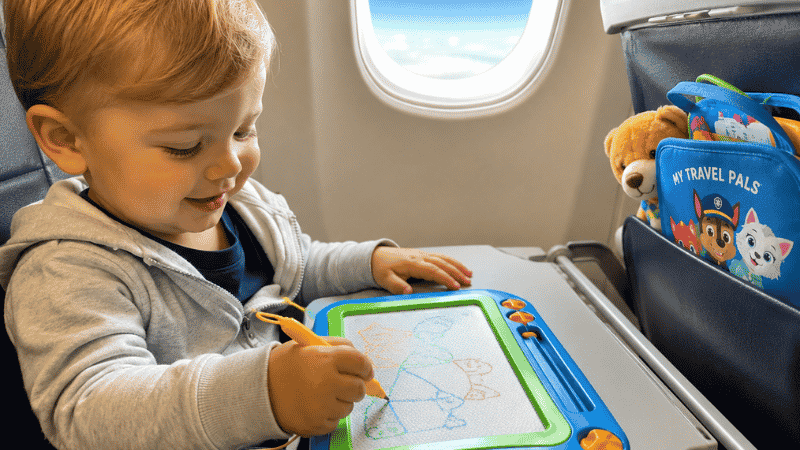
Magnetic Drawing Boards
The magnetic drawing board is arguably the single best airplane toy for toddlers, and I will stand behind that opinion firmly.
Here’s why: it’s completely self-contained (no loose pieces, no mess), it requires no setup or parental assistance after the first thirty seconds, it can be used on the tray table or in the lap, it resets instantly with a slider, and it gives toddlers something purposeful to do with their hands for extended periods.
At 18 months to 2 years, children use magnetic drawing boards to make lines, dots, and simple shapes. By 2.5 to 3 years, they’re drawing specific things — a sun, a face, a dog — and the pride in showing you their creation is genuinely lovely at altitude. By 4, they’re writing letters and numbers.
One toy that grows through the entire toddler age range. Weighs almost nothing. Fits in a large purse. No batteries required.
What to look for: A board with a smooth drawing surface, a sturdy magnetic pen attached by a cord (so it doesn’t get dropped and roll away), and a simple slider eraser. Some models also have magnetic stamps — these add play value but also add small-part risk for younger toddlers, so check the age rating carefully.
Water Wow! Mess-Free Activity Books
Melissa & Doug’s Water Wow! books are the airplane secret weapon that parents who travel regularly all seem to discover eventually. The “paint” is just water applied with a small brush — when it touches the special pages, colors appear. When the page dries, it resets to plain white, ready to use again.
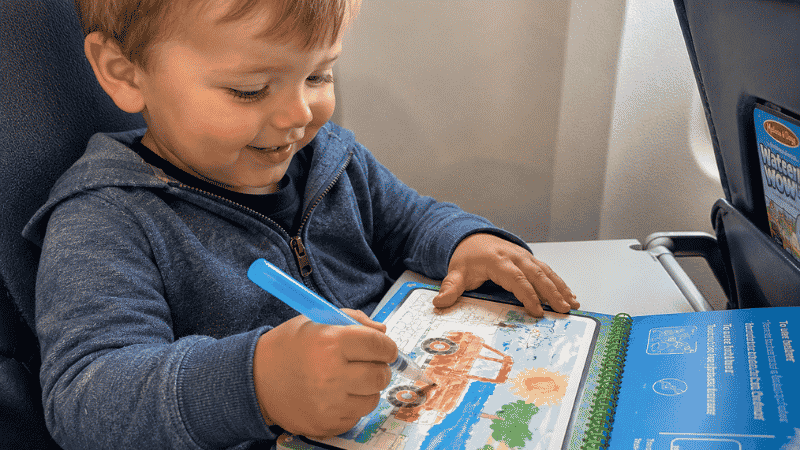
The benefits for air travel are remarkable: no ink, no mess, no staining, no loose parts. Just a small book and a water-filled brush pen. Parents who’ve used these describe them as sanity-saving for exactly the reasons you’d expect — they keep a toddler occupied quietly and independently for stretches of time that feel genuinely surprising.
Best for: Ages 2–5. The brush pen requires some fine motor control to use intentionally, so under 2 may need some adult guidance initially.
Travel tip: Fill the brush pen before boarding at home or in the airport bathroom. Airport security may flag it if filled with liquid at the checkpoint.
Airplane Toys for Toddlers: Suction Cup Toys
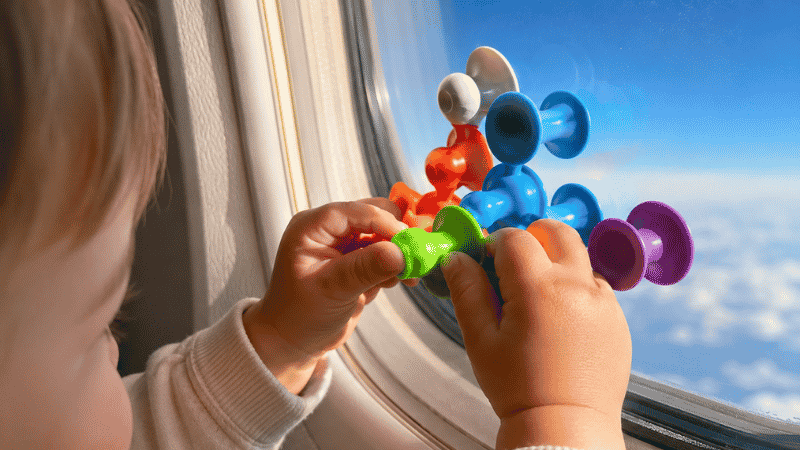
Suction cup toys that stick to airplane windows, tray tables, or smooth seat surfaces are specifically designed for exactly this use case — and they’re remarkably effective.
Spinning tops with suction bases, small activity panels that stick to the tray table, and simple cause-and-effect toys that mount to a smooth surface all give toddlers a fixed point of engagement without the toy rolling away, falling under the seat, or becoming a projectile.
For airplane toys for toddlers in the 12–24 month range especially, suction toys on the tray table are ideal because they stay put, they engage the cause-and-effect fascination that’s at its peak at this age, and they require zero parental setup after initial attachment.
Safety note: Check that suction cups are large enough not to be a choking hazard if they detach. For children who still mouth everything, silicone suction cups are the safest option.
Busy Boards (Compact, Travel-Sized)
A travel-sized busy board — with buckles, zippers, velcro, buttons, and laces — is particularly effective for the 12–24 month range, which is the hardest age to travel with and the age when airport security seems most determined to slow you down.
At this age, toddlers are intensely interested in real-world mechanisms — fasteners, closures, things that click and zip and snap. A busy board gives them a safe, contained version of this exploration that requires zero parent involvement after the initial “here, look at this” moment.
Travel tip: Introduce the busy board at home two or three times before the trip so it’s already familiar and interesting. A completely new toy presented on a plane can be either immediately loved or immediately rejected — pre-trip familiarity tips the odds toward the former.
Reusable Sticker Books
Melissa & Doug reusable sticker books — with sticker scenes that can be arranged, removed, and rearranged repeatedly — are consistently mentioned by traveling parents as one of their most reliable airplane toys.
The key word is reusable: the stickers are designed to be repositioned many times, which means one book provides multiple sessions of engagement across a long flight rather than being “done” after fifteen minutes.
Best for: Ages 2–4. At 2, children will mostly peel and place stickers randomly. By 3, they’re creating specific scenes and stories with the characters. By 4, there’s a narrative.
Travel tip: Keep the book in a ziplock bag for the return journey so no stickers get lost in transit.
Best Travel Toys for Toddlers on Road Trips
Road trips offer slightly more flexibility than airplane travel — you can pull over, there’s more space, noise is less of an issue, and you have the advantage of the car itself as entertainment (for a while). But the fundamental challenge is the same: keeping a toddler engaged long enough to make meaningful progress toward your destination.
Wikki Stix
Wikki Stix are waxy, bendable sticks that stick to smooth surfaces and to each other — they can be shaped into letters, animals, frames, and abstract shapes, then peeled off and reshaped endlessly.
They’re particularly beloved by traveling parents for a combination of reasons: they weigh almost nothing, they don’t dry out or make a mess, they stick to car windows and seat-back screens without leaving residue, and they engage fine motor skills in a way that holds toddler attention better than their unassuming appearance would suggest.
Best for: Ages 2.5–5. Younger toddlers may not have the fine motor control to get the most out of Wikki Stix, but from around 2.5 they become genuinely compelling.
Tip: Get a few different colors and challenge older toddlers to make specific shapes or letters — “Can you make a circle? Can you make the letter A?” This turns passive play into a game.
Simple Wooden Puzzles (Travel-Sized)
A small wooden puzzle — 6–12 pieces with large knobs, stored in a fabric pouch — is excellent for toddler airplane activities and road trips alike for children in the 18 months to 3-year range.
The key is choosing a puzzle that’s at the right difficulty level: challenging enough to require some thought, achievable enough to produce the satisfaction of completion. A puzzle your toddler has mastered completely at home will bore them. A puzzle entirely beyond their ability will frustrate them. Aim for something they can do with a bit of effort.
Travel modification: Store puzzles in a shallow tray or ziplock bag so pieces don’t scatter. A puzzle mat with a frame is ideal for road trips (it has a built-in boundary) but may be too large for airplane tray tables.
Finger Puppets and Small Soft Toys
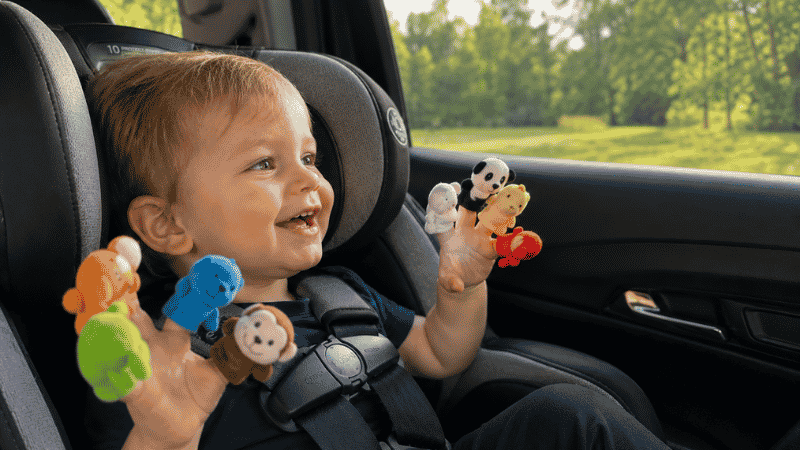
A set of 4–5 finger puppets takes up essentially no space, weighs nothing, and unlocks imaginative play that can sustain a toddler for surprisingly long stretches on a road trip.
From around 18 months, toddlers begin assigning roles to small figures and acting out simple scenarios. By 2.5, those scenarios have plots. By 3, they’re elaborate narratives. A set of animal or family finger puppets gives your toddler a cast of characters to work with — and gives you the option of joining the story when you want to, or letting them play independently when you don’t.
Tip for car travel: Keep puppets within arm’s reach of the car seat, not in the trunk. The ability to hand them back when dropped without stopping the car is a significant quality-of-life improvement.
Travel Toys for 1 Year Old: What Actually Works
One-year-olds are the most challenging travel age — they’re mobile, curious, have limited attention spans, and can’t yet engage with the more sophisticated travel toys that work for older toddlers.
For travel toys for 1 year old children, focus on:
- Soft textured balls (can be squeezed, mouthed, and explored without mess or noise)
- Small fabric books with flaps (safe for mouthing, engaging for little hands)
- Simple silicone teethers with varied textures (teething is usually still happening, and something safe to mouth is essential)
- Suction cup toys attached to the tray table or car seat tray
- A soft finger puppet (simple, lightweight, versatile)
Key principle for 1-year-olds: Have more toys than you think you need (5–7 small items) and rotate them every 10–15 minutes before interest wanes, rather than waiting until your toddler has fully lost interest and started crying.
Travel Toys for 2 Year Old and Travel Toys for 3 Year Old: What Changes
By two and three, toddlers can sustain independent engagement for longer — but they also have much stronger preferences and opinions, including about when they’re done with a toy.
For 2-year-olds, prioritize:
- Magnetic drawing boards
- Water Wow! books
- Reusable sticker scenes
- Simple finger puppets
- Busy boards with buckles and zippers
For 3-year-olds, you can add:
- Wikki Stix (they have the fine motor control now)
- Simple card games (Go Fish, basic matching games)
- Small activity workbooks (mazes, dot-to-dot, simple drawing prompts)
- Audiobooks or podcasts for kids (screen-free, but engaging for longer stretches)
Toddler Airplane Activities: The Rotation Strategy
The single most effective travel strategy I’ve found for toddlers isn’t about having the perfect toy — it’s about how you present what you have.
The rotation strategy: Pack 5 toys. Don’t give them all at once. Start with one toy about 20 minutes after takeoff (when the novelty of the plane itself starts to wear off). When interest genuinely wanes — not at the first sign of boredom, but when they’ve truly exhausted a toy — introduce the next one. Save the best or newest toy for the hardest stretch (usually the final hour of a long flight).
This approach works because the novelty of each toy does as much work as the toy itself. A toy that’s been sitting in your bag for an hour and a half feels new again when it appears. A toy presented immediately on boarding will be “done” well before you need it most.
The Travel Toy Bag: How to Pack It
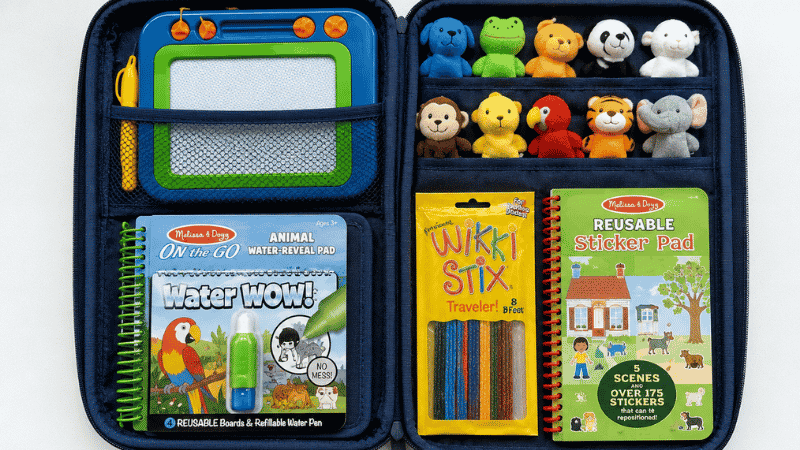
Carry-on essentials (packed in a dedicated small bag or pouch, accessible without opening main luggage):
- 1 magnetic drawing board
- 1 Water Wow! book + pre-filled brush pen (in a small ziplock)
- 2–3 finger puppets
- 1 reusable sticker book (in a ziplock)
- 1 small pouch of Wikki Stix (for 2.5+)
- 1 small puzzle or busy board (age-appropriate)
- A few favorite books (board books for under 2, soft books for babies)
- Snacks (separate from toys, but just as important)
What to leave home:
- Anything with more than 20 pieces
- Anything requiring adult assembly or reset every 5 minutes
- Anything electronic without a volume switch
- Anything with staining potential (regular markers, paints)
- Anything your toddler has already completely mastered and finds boring
Safety Checklist for Travel Toys
Travel introduces different safety considerations than home play — specifically, the reality that you’re in a confined space with other people and limited ability to respond quickly if something goes wrong.
For air travel specifically:
- No small parts that could be swallowed and require medical intervention at altitude
- No toys with button batteries that could be accessed (already non-negotiable at home, but critical in travel context)
- No latex balloons (obvious, but worth saying)
- Nothing sharp or with hard edges that could cause injury during turbulence
For car travel:
- Soft toys only in the car seat area — nothing hard that could become a projectile during sudden braking
- No toys with cords, strings, or loops near the car seat
- Keep toys within reach of the car seat so you don’t have to stop to retrieve dropped items
For all travel:
- All plastic: BPA-free and phthalate-free
- All art materials: non-toxic, clearly labeled
- ASTM F963 compliance for any purchased toys
Frequently Asked Questions
What are the best travel toys for toddlers on airplanes? The most consistently reliable airplane toys for toddlers are magnetic drawing boards, Water Wow! mess-free activity books, suction cup toys that attach to the tray table, reusable sticker books, and finger puppets. All of these are quiet, mess-free, compact, and can be used independently without constant parent involvement.
How do I keep a toddler entertained on a long flight? The rotation strategy is your best tool: pack 4–6 good toys and introduce them one at a time, waiting until interest genuinely wanes before presenting the next one. This preserves the novelty of each toy across a longer journey. Snacks as a separate “entertainment” layer also help significantly — eating takes time and focus.
What travel toys work for a 1-year-old on a plane? For travel toys for 1 year old children, prioritize sensory and cause-and-effect toys: suction cup toys on the tray table, small fabric books, soft textured balls, silicone teethers, and simple finger puppets. Have more options than you think you need and rotate every 10–15 minutes.
Are electronic toys okay for airplane travel with toddlers? Only if they have a functioning volume switch — and you should test it before boarding. A toy with a broken or inadequate volume switch should stay in the bag on a plane. Many traveling parents avoid electronic toys entirely on flights and find that quiet, manual toys actually hold toddler attention better in the novel environment of an airplane.
How many toys should I pack for a toddler on a flight? For a flight under 3 hours: 3–4 toys plus snacks. For a flight of 3–6 hours: 5–6 toys. For a flight over 6 hours: 6–8 toys, introduced very slowly. Quality and variety matter more than quantity — one magnetic drawing board and one Water Wow! book will serve you better than ten cheap toys.
What should I NOT pack as a travel toy for a toddler? Anything with loose small pieces, any toy requiring adult reset or involvement every few minutes, electronic toys without a volume switch, anything with staining potential, anything your toddler has completely mastered at home and finds boring, and anything too fragile to survive being dropped, thrown, or chewed.
The Bottom Line
The best travel toys for toddlers aren’t the ones with the most features or the biggest box. They’re the ones that buy you genuine quiet time — tools your toddler can use independently, that don’t make noise, don’t create mess, and don’t run out of batteries somewhere over the Atlantic.
A magnetic drawing board, a Water Wow! book, a few finger puppets, and the rotation strategy will get you further than any single “perfect” toy.
Pack light. Rotate slowly. And remember: the snacks are also doing important work.
Looking for more toy guides by situation? Browse our related guides:
- Best Toys for Toddlers: The Complete Guide
- Best Toys for 1-Year-Olds
- Best Toys for 2-Year-Olds
- Best Toys for 3-Year-Olds
- Sensory Toys for Babies
References
- Zero to Three. (2025). Play and Learning. https://www.zerotothree.org/resource/play-and-learning/
- American Academy of Pediatrics (AAP). (2024). Choosing Safe Toys. https://www.healthychildren.org
- U.S. Consumer Product Safety Commission (CPSC). Toy Safety. https://www.cpsc.gov/Safety-Education/Safety-Guides/Toys
- Centers for Disease Control and Prevention (CDC). (2023). Developmental Milestones. https://www.cdc.gov/ncbddd/actearly/milestones/
- Federal Aviation Administration (FAA). Traveling with Children. https://www.faa.gov/travelers/fly_children