
Four is one of those ages that sneaks up on you. One day you have a toddler who needs help putting on their shoes. Then somehow, seemingly overnight, you have a small person with strong opinions, elaborate storylines, a best friend named Maya from preschool, and an unsettling ability to negotiate.
If you’re shopping for the best toys for 4 year olds, you’ve probably noticed that the options suddenly feel more overwhelming than ever. The baby toys are clearly too simple. The big-kid toys feel too complicated. And every box claims to be “educational” — a word that’s lost almost all meaning at this point.
Here’s what I’ve learned after navigating this age twice: four-year-olds are at a genuine developmental crossroads. They’re leaving toddlerhood behind and getting ready for kindergarten. Their attention spans have grown. Their creativity has exploded. And for the first time, they genuinely want to play with other kids, not just near them.
The right toy at this age doesn’t just entertain — it builds the skills your child will actually need when they walk into a classroom. This guide will show you exactly what those toys look like, why they work, and which ones to skip entirely.
Key Takeaways
- Four is the kindergarten preparation year. According to the CDC, 4-year-olds are developing the ability to follow multi-step instructions, count to 10, draw recognizable shapes, and cooperate with peers — all skills that toys can directly support.
- Cooperative play begins now. Unlike 2 and 3-year-olds who play alongside others, most 4-year-olds genuinely play with other children — making simple board games and group building projects newly valuable.
- Attention spans have grown significantly. A focused 4-year-old can sustain independent play for 15–20 minutes with the right toy — nearly double the capacity of a 2-year-old.
- Pre-literacy and pre-math matter. The best educational toys for 4 year olds are ones that build letter recognition, early counting, and pattern recognition — not through drills, but through play.
- Open-ended still wins. Research from NAEYC consistently confirms that open-ended toys (blocks, art supplies, pretend play props) produce more complex thinking and language than single-function electronic toys, even at this age.
What’s Happening in Your 4-Year-Old’s Brain Right Now
Before we get to the list, it helps to understand what four actually looks like developmentally — because this age is more complex than most people realize.
According to CDC developmental milestones, most 4-year-olds can now tell you what they think is going to happen next in a book or a game. They can name some letters, count at least to four, and draw a person with two to four body parts. They’re using sentences with four or more words. They can cooperate with other children and take turns — imperfectly, but genuinely.
What this means for toys is significant. A 4-year-old isn’t just playing anymore. They’re narrating. They’re planning. They’re arguing about the rules of an imaginary game they invented five minutes ago. The toys that serve them best are ones that have enough depth to support all of that.
The best toys for 4 year olds tend to do at least one of these things:
- Support cooperative play and simple rule-following
- Build pre-literacy or early math skills through play
- Allow for increasingly complex pretend scenarios
- Offer genuine physical challenge (balance, coordination, strength)
- Invite open-ended building and creative problem-solving
The Builders: Construction Toys That Develop Engineering Minds
At four, building has become genuinely architectural. Your child isn’t just stacking anymore — they’re planning structures, troubleshooting when things collapse, and recreating things they’ve seen in the real world. This is engineering thinking in its earliest, most joyful form.
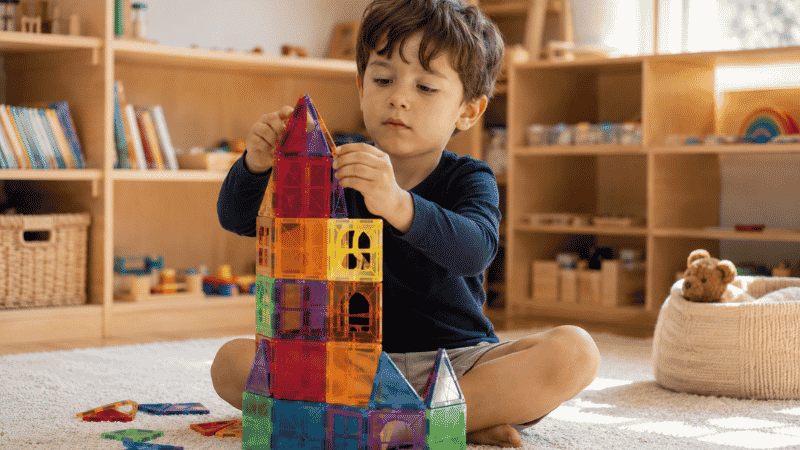
Magna-Tiles and Magnetic Building Sets
If there’s one toy that appears on every legitimate “best toys for 4-year-olds” list — from pediatric occupational therapists to preschool teachers — it’s magnetic building tiles. Magna-Tiles are the gold standard, and for good reason.
At four, children use these to build houses, castles, rocket ships, and enclosures for their small animal figures. The magnetic connection means they get the satisfaction of a successful build without the frustration of pieces that won’t stay. And unlike many toys, magnetic tiles genuinely grow with the child — an 8-year-old still finds new challenges in the same set.
A starter set of 32 pieces is plenty to begin. If you already have a set, consider adding specialized expansion pieces — ramps, doors, windows — that open up new building possibilities at this age.
Safety note: Always buy from reputable brands with fully enclosed magnets. Cheaper imitation sets sometimes have weaker enclosures that can allow magnets to come loose — a serious hazard if swallowed.
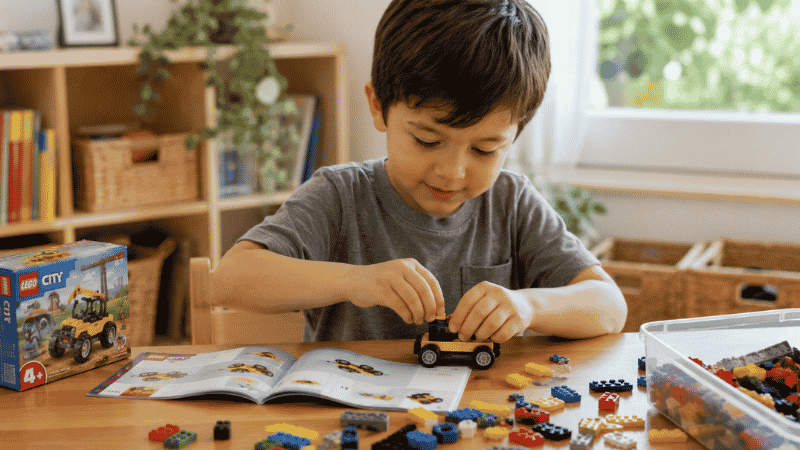
LEGO Classic Sets (the transition from DUPLO)
Four is often the age when children are ready to move from DUPLO to standard LEGO bricks — though this varies by child. The “4+” labeled LEGO Classic sets are designed specifically for this transition: simple enough to build successfully, complex enough to feel like a real achievement.
The key sign your child is ready: they can sit with a focused task for at least 10–12 minutes and handle small objects without constant mouthing. If they still put things in their mouths when tired or distracted, stay with DUPLO a bit longer — and that’s completely fine.
Building Toys for 4-Year-Olds: What to Look For
When shopping for building toys for 4 year olds, look for:
- Sets with a clear “first build” that can be completed in one sitting
- Enough pieces to create variations beyond the instructions
- Compatible with toys they already own (expands play value)
- Durable enough to survive being knocked off a table enthusiastically
The Imaginators: Pretend Play That Builds Real Skills
Four-year-olds are at peak imaginative play. Their stories are more elaborate than ever — complete with characters, plot twists, and detailed rules about who is allowed to do what. This isn’t just fun. According to the American Academy of Pediatrics, rich pretend play at this age directly develops executive function, empathy, and language skills that predict school success.
Dollhouses and Small World Play
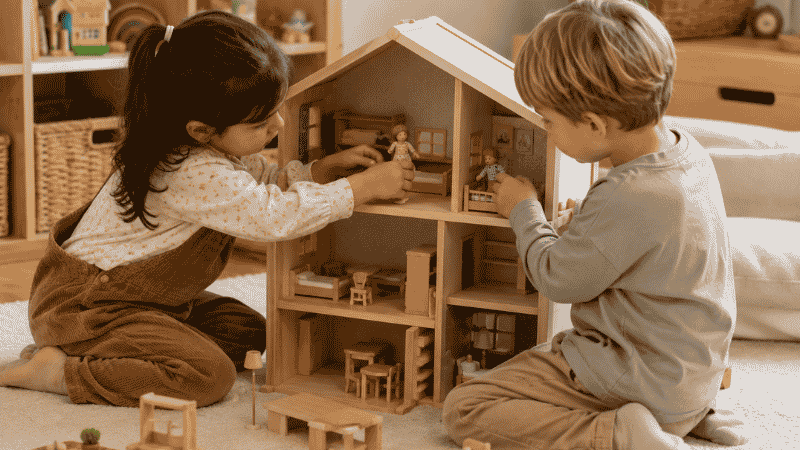
A simple dollhouse with a family of figures becomes an entire social laboratory at this age. Your child assigns roles, acts out scenarios (some of which will give you deep insight into what they think family life looks like), negotiates conflicts between characters, and practices the social scripts they’re encountering in preschool.
Look for a dollhouse with:
- Durable construction — it will be played with hard
- A simple layout (one or two floors, clear rooms) that doesn’t overwhelm
- Flexible enough that the figures can come out and go on adventures elsewhere
Puppet Theaters and Storytelling Sets
A simple puppet theater — even a cardboard box with a window cut out — unlocks storytelling in a way that most toys can’t. At four, children love having an “audience,” and performing with puppets gives them a way to practice narrative structure, character voices, and sequencing without it feeling like work.
Budget tip: A set of simple hand puppets (animal characters work best) plus a doorway puppet theater is genuinely one of the highest play-value investments at this age.
Dress-Up Clothes and Open-Ended Costume Pieces
By four, dress-up has moved beyond simple costumes into elaborate multi-character scenarios. A bin of open-ended pieces — capes, hats, scarves, simple props — serves them better than specific costumes, because they can become whoever the current story demands.
Look for soft, washable fabrics. Avoid costumes with complicated fasteners or stiff synthetic materials — if your 4-year-old can’t put it on themselves in under 30 seconds, they’ll lose interest before the game starts.
The Thinkers: Games and Puzzles That Build School-Ready Skills
Four is the perfect age to introduce simple board games and increasingly complex puzzles — not because they need to “learn” from them, but because the process of playing them builds skills that directly transfer to the classroom.
First Board Games (Cooperative and Simple Competitive)
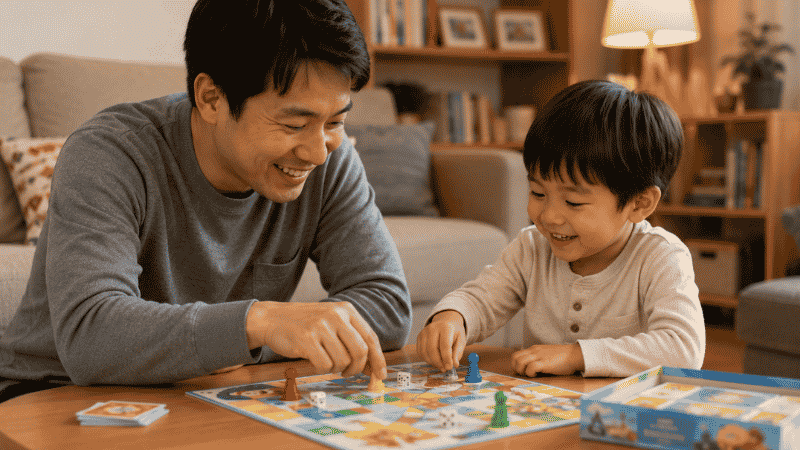
Simple board games are one of the most underrated toy categories for this age. They build turn-taking, patience, rule-following, counting, and the ability to handle not winning — all of which are genuine kindergarten readiness skills.
Best options for 4-year-olds:
- Hoot Owl Hoot — cooperative, no losers, counting and color matching
- Zingo — gentle competitive bingo with sight words
- Candy Land — color recognition, turn-taking, winning and losing gracefully
- My First Orchard — cooperative, simple rules, good for younger 4s
Avoid games with more than 6 rules, long wait times between turns, or outcomes that feel arbitrary. A 4-year-old can handle losing if it feels fair — they cannot handle losing if it feels random.
Puzzles (48–100 Pieces)
At four, most children are ready for puzzles in the 48–100 piece range. The key is finding puzzles with clear, bold images (not abstract or overly busy) and pieces that fit together satisfyingly without being so loose they fall apart during assembly.
Floor puzzles work well because they don’t need a dedicated table and the larger format is easier to manage. Ravensburger and Melissa & Doug both make reliably well-cut puzzles at this age range.
Parenting tip: If your child gets frustrated and wants to quit, try working on it yourself nearby without inviting them back in. The “I can do that” instinct usually kicks in within a few minutes.
Early Literacy and Math Games
Four is the ideal age to introduce play-based literacy tools — magnetic alphabet letters on the fridge, letter matching games, simple rhyming card games. These aren’t flashcards and they’re not drilling. They’re play-based exposure to the building blocks of reading.
Leapfrog magnetic letters remain a perennial recommendation because they let children physically manipulate letters while hearing their sounds — combining tactile, auditory, and visual learning in one simple toy.
Four-year-olds have extraordinary energy — but now that energy is more directed. They’re not just running wildly; they’re learning to pump their legs on a swing, to balance on a beam, to catch a ball that’s thrown specifically to them. The right active toys support this growing physical confidence.
Pedal Bikes (With or Without Training Wheels)
If your child has been on a balance bike, four is often the age when they’re ready for a pedal bike — and many balance bike alumni skip training wheels entirely, moving directly to two-wheel riding with remarkable ease.
If they haven’t done a balance bike, now is a great time to start — or go straight to a pedal bike with removable training wheels and plan to remove them within a few months once balance develops.
Always pair with a properly fitted helmet. Make it a non-negotiable from the very first ride, before any habits form.
Outdoor Toys for 4-Year-Olds: What Actually Gets Used
The outdoor toys that genuinely get used at this age are simpler than you’d expect:
- A good set of sidewalk chalk (large, easy-grip sticks)
- A kick ball or playground ball in an easy-to-catch size
- A sand and water table if you have outdoor space
- A jump rope (they’re learning to jump in rhythm, which takes practice)
- A scooter with two wheels — most 4-year-olds have the balance for this now
Skip elaborate outdoor play structures unless you have the space and the budget. A ball, some chalk, and a scooter will get more use than a plastic playhouse that costs three times as much.
Indoor Active Play for Rainy Days
A small indoor trampoline with a handlebar provides the proprioceptive input (deep joint and muscle pressure) that some children — especially those who seem to crash into everything — genuinely need for regulation. It’s also just extremely fun.
Alternatively, a simple obstacle course made from couch cushions, a low balance beam, and some painter’s tape on the floor costs almost nothing and can keep a 4-year-old busy for a surprising amount of time.
The Best LEGO Sets for 4-Year-Olds: A Quick Guide
LEGO deserves its own section here because it’s such a common question for parents navigating this transition year.
LEGO 4+ Sets (the official transition range): These sets have slightly larger pieces than standard LEGO, simpler build steps, and are specifically designed for children who are ready to move beyond DUPLO. Look for sets labeled “LEGO Classic 4+” or “LEGO 4+” — these have been tested for the developmental stage.
What makes a good first LEGO set for a 4-year-old:
- Under 100 pieces for the first attempt
- A subject they’re already interested in (vehicles, animals, their favorite characters)
- Clear, image-based instructions (not just line drawings)
- An adult who’s willing to sit alongside them for the first build
What to avoid:
- Sets with tiny specialty pieces that frustrate small hands
- Themes designed for older children with complex mechanisms
- Any set rated 6+ — the difficulty jump is real
Safety at 4: What Changes and What Doesn’t
Four-year-olds are significantly more capable than they were at two — but “more capable” comes with its own set of risks. They’re faster, stronger, more daring, and more likely to try things without fully understanding the consequences.
Getting safer at 4:
- Standard small toy pieces are generally appropriate (though know your specific child)
- More complex games and puzzles with smaller components
- Simple craft materials including scissors (child-safe, blunt-tipped)
Still requires adult attention:
- Power magnets (neodymium/rare earth): Still a life-threatening hazard if swallowed. Any toy with small, powerful magnets should be kept away from children under 6 and older children who still mouth objects.
- Trampolines: Even small indoor versions require supervision and clear rules (one person at a time, no flips).
- Bikes and scooters: Helmet every single time. No exceptions, no negotiations.
- Art supplies: Check that all paints, glues, and modeling materials are clearly labeled non-toxic. Some craft sets marketed to children contain materials that aren’t appropriate for this age.
Safety certifications to look for:
- ASTM F963 (required U.S. toy safety standard)
- CPSC compliance
- CE mark for European-manufactured toys
- “Non-toxic” labeling from ACMI (Art and Creative Materials Institute) for art supplies
What NOT to Buy: The 4-Year-Old Avoid List
Tablets and learning devices marketed as “educational” The American Academy of Pediatrics recommends that children ages 2–5 have no more than one hour of screen time per day from high-quality sources. A dedicated learning tablet is still a screen — and it’s competing with the open-ended, imaginative, physically active play that genuinely builds school readiness.
Toys with a single “solution” A toy that can only be done one way — assembled once, completed, done — provides a fraction of the play value of an open-ended toy. A 100-piece puzzle is great. A kit that results in one fixed object and then has nothing left to offer is not.
Anything requiring sustained solo focus for more than 20 minutes Even the most focused 4-year-old has limits. Toys that assume longer uninterrupted engagement create frustration rather than satisfaction.
Character-licensed toys that aren’t backed by good design The character on the box will get your child excited. The flimsy construction will disappoint both of you within a week. Always look beyond the branding to the actual toy underneath — durability, play value, and safety matter more than whatever show is currently popular.
If You Only Have 10 Minutes: The Quick-Pick Summary
Birthday party in an hour? Here’s the shortlist:
- Best overall: Magna-Tiles 32-Piece Classic Set
- Best first LEGO: LEGO Classic 4+ Starter Set
- Best for imaginative play: Wooden dollhouse with family figures
- Best board game: Hoot Owl Hoot (cooperative) or Zingo (gentle competitive)
- Best outdoor toy: Balance bike or two-wheel scooter + helmet
- Best gifts for 4 year old girl: Puppet theater set + simple hand puppets
- Best gifts for 4 year old boy: LEGO Classic 4+ set + magnetic tiles expansion
- Best budget gift: 48-piece floor puzzle (Ravensburger or Melissa & Doug)
- Best art gift: Washable watercolor set + large paper pad

Frequently Asked Questions
What are the best gifts for a 4-year-old girl? The most genuinely useful gifts for 4-year-old girls match her current developmental stage and interests — not just what’s pink or princess-themed. Building sets, art supplies, a dollhouse, a puppet theater, or an outdoor bike are all excellent choices. At four, what matters most is whether the toy supports her growing imagination and independence.
What are the best gifts for a 4-year-old boy? Same principle applies. The best gifts for 4-year-old boys are ones that match his current interests and developmental level — whether that’s construction, vehicles, animals, art, or pretend play. LEGO Classic sets, magnetic tiles, active outdoor toys, and simple board games are consistently popular choices that also deliver genuine developmental value.
Is my 4-year-old ready for regular LEGO (not DUPLO)? Possibly, but it depends on your specific child. Signs of readiness: can sit with a focused task for 10+ minutes, has good fine motor control, doesn’t regularly mouth small objects. If you’re not sure, start with a LEGO 4+ set — these bridge the gap between DUPLO and standard LEGO with slightly larger pieces.
What educational toys for 4-year-olds actually work? The ones that don’t feel like work. Magnetic alphabet letters, simple counting games, pattern puzzles, and cooperative board games all build school-readiness skills — but through play, not drills. The best educational toy for a 4-year-old is one they’ll actually choose to play with.
How do I choose toys that will last more than a week? Look for open-ended toys with multiple possible “uses.” A single-function toy (one thing to do, one way to do it) loses interest fast. A set of magnetic tiles, a bin of dress-up clothes, or a tub of play dough offers something different every day. Longevity = open-endedness.
My 4-year-old keeps asking for screen time instead of toys. What should I do? This is extremely common and doesn’t mean they’re “addicted” or that you’ve done anything wrong. Screens are highly stimulating and instantly gratifying — they’re designed to be. The best counter is having genuinely engaging toys accessible and playing with your child yourself for the first 5–10 minutes to get them started. Once they’re engaged, they usually continue independently.
When should I be concerned about my 4-year-old’s play development? Speak with your pediatrician if your 4-year-old shows no interest in pretend play, can’t follow simple two-step instructions, avoids playing with other children entirely, or has lost skills they previously had. Early support for developmental differences makes a significant difference — don’t wait to bring up concerns.
The Bottom Line
Finding the best toys for 4 year olds comes down to understanding this specific, remarkable developmental moment. Your child is smarter, more curious, and more socially aware than they’ve ever been. They’re getting ready for the biggest transition of their young life — starting school.
The toys that serve them best aren’t the most expensive, the most “educational”-looking, or the most popular. They’re the ones that invite them to build something, pretend something, figure something out, or do something physical — preferably with you beside them, at least for the first few minutes.
That’s it. That’s the whole secret.
Ready to keep planning? Read our guide to Best Toys for 3-Year-Olds for the year before, or jump ahead to Best Toys for 5-Year-Olds as your child approaches kindergarten. And if a birthday is coming up, our Gift Guides have age-specific picks by budget.
References
- Centers for Disease Control and Prevention (CDC). (2023). Developmental Milestones: 4 Years. https://www.cdc.gov/ncbddd/actearly/milestones/milestones-4yr.html
- American Academy of Pediatrics (AAP). (2024). The Power of Play: A Pediatric Role in Enhancing Development in Young Children. https://www.healthychildren.org
- National Association for the Education of Young Children (NAEYC). (2024). Good Toys for Young Children by Age and Stage. https://www.naeyc.org/resources/topics/play/toys
- Zero to Three. (2025). Best Toys for Babies and Toddlers. https://www.zerotothree.org/resource/best-toys-for-babies-toddlers/
- U.S. Consumer Product Safety Commission (CPSC). Toy Safety. https://www.cpsc.gov/Safety-Education/Safety-Guides/Toys
- Harvard Center on the Developing Child. (2023). Executive Function and Self-Regulation. https://developingchild.harvard.edu