
If you’ve ever stood in the middle of a toy aisle—or scrolled through endless pages of colorful plastic online—feeling completely overwhelmed, you are not alone. As parents in 2026, we are bombarded with “educational” labels and flashing lights promising to turn our infants into mini-geniuses. But here’s the truth: the best baby development toys don’t need a battery or a Wi-Fi connection. They just need to spark a “lightbulb moment” in your little one’s brain.
According to a landmark study by the Center on the Developing Child at Harvard University, a baby’s brain forms over 1 million new neural connections every second during the first few years of life. This means that playtime isn’t just about keeping them busy while you finish a cup of coffee; it’s the most important “educational investment” you’ll make this year. In this guide, we’ll cut through the marketing noise to find toys that actually support growing brains, with a special focus on the high-growth window of toys for babies 6-12 months development.
Decoding “Positive Categorization”: How Toys Drive Brain Power
At Toizora, we practice what we call Positive Categorization. We don’t just look at what a toy is; we look at what it does for the developing mind. When you pick up baby development toys, you are essentially selecting the “curriculum” for your baby’s daily learning.
Every time your baby reaches for a textured ball or drops a block into a bucket, their brain is firing off thousands of synapses. They are learning about spatial awareness, cause and effect, and fine motor control. By categorizing toys by their “logic dimension”—such as sensory exploration or problem-solving—you ensure your baby gets a balanced “mental diet” that stimulates both the left and right hemispheres of the brain.
The Golden Window: Best Toys for Babies 6-12 Months Development
Between 6 and 12 months, your baby undergoes a massive transformation. They go from being relatively stationary “observers” to active, mobile “explorers” with vision that reaches near-adult levels of clarity (20/40 to 20/20 acuity). This is the peak time to introduce specific toys for babies 6-12 months development that challenge their hand-eye coordination.
1. Mastering the Pincer Grasp
Around 9 to 10 months, babies transition from the “Palmar Grasp” (using the whole hand) to the “Pincer Grasp” (thumb and forefinger).
- The Operation: Use a “Object Permanence Box” with a single wooden tray. Place a ball ($4cm$ diameter to prevent choking) in the hole.
- Real-Life Case: “Our son, Leo, struggled with his pincer grasp until we introduced a vertical peg stacker,” says Maya, a pediatric occupational therapist and mom. “At first, he just knocked it over. By week three, he was using his two fingers to precisely lift each ring. It was like watching a tiny engineer at work.”
2. From Sitting to Crawling
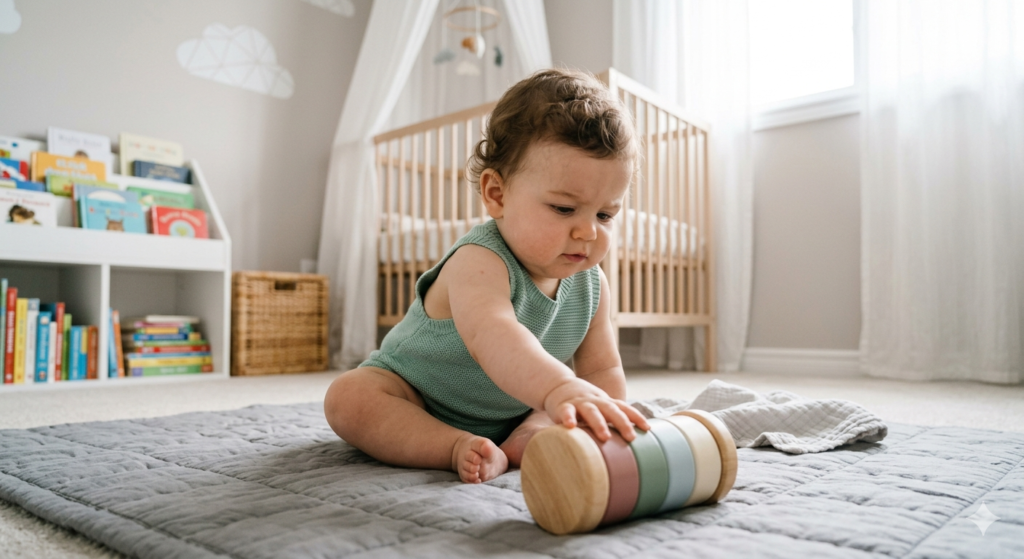
Mobility changes everything. Toys for babies 6-12 months development should encourage the “reach and lunge” motion. Weighted “Wobble Toys” that tilt but don’t fall are excellent motivators. As the toy rocks just out of reach, it strengthens the core muscles (Obliques and Erector Spinae) necessary for independent crawling.
Deciphering Quality: What Are the Best Baby Toys for Development?
When parents ask, “What are the best baby toys for development?” they are often looking for the perfect balance of safety, longevity, and educational value.
1. The “90/10 Rule” of Play
A truly effective toy should be 90% child and 10% toy. If the toy does all the singing, moving, and lighting up, your baby becomes a passive spectator. The best baby toys for development are those that require the child to push, pull, stack, or imagine to make the “fun” happen.
2. Material Safety & Maintenance
In 2026, we prioritize “mouth-safe” materials. Since everything goes into the mouth at this stage, your baby development toys must meet these standards:
- Platinum-Grade Silicone: Passes the “pinch test” (no white fillers appear when twisted).
- FSC-Certified Wood: Beech or Maple treated with food-grade linseed oil.
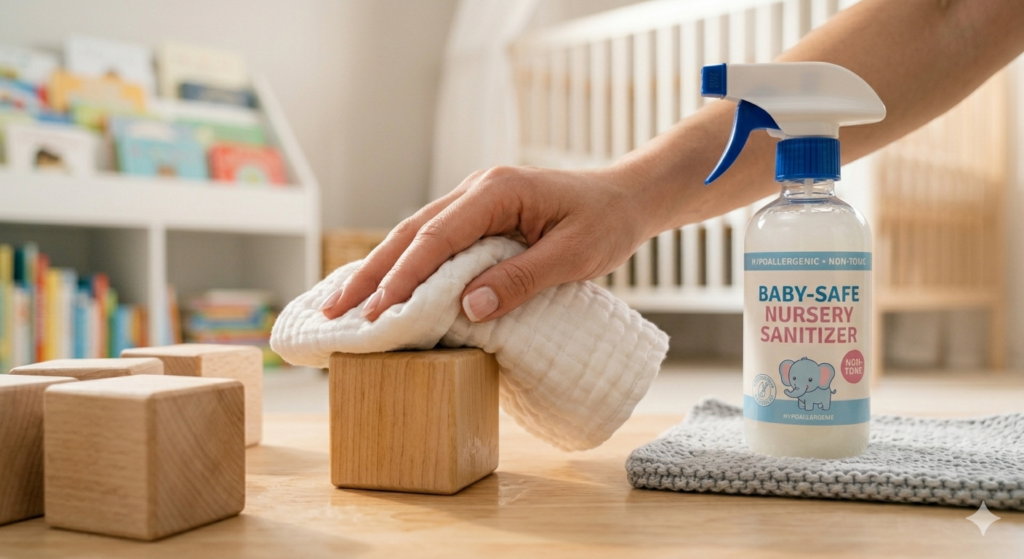
- The Cleaning Protocol: Sanitize hard toys in a dishwasher at 140°F (60°C) once a week. For soft crinkle books, a machine wash at 104°F (40°C) with fragrance-free detergent is ideal.
Comparison: Flashy Electronics vs. Open-Ended Classics
To help you decide where to spend your budget, consider this comparison based on developmental ROI (Return on Investment).
| Feature | Battery-Powered “Learning” Tablet | Open-Ended Stacking Cups |
| Active Engagement | Low (Pressing buttons) | High (Building & Pouring) |
| Skill Mastery | Rote Memory | Spatial Logic & Sequencing |
| Longevity | ~3 Months | 6 Months to 3 Years |
| Sensory Load | High (Potential Overstimulation) | Balanced (Natural Feedback) |
| Best Used For | Distraction during travel | Focused Floor Play |
5 Pro-Tips: The Smart Parent’s Strategy
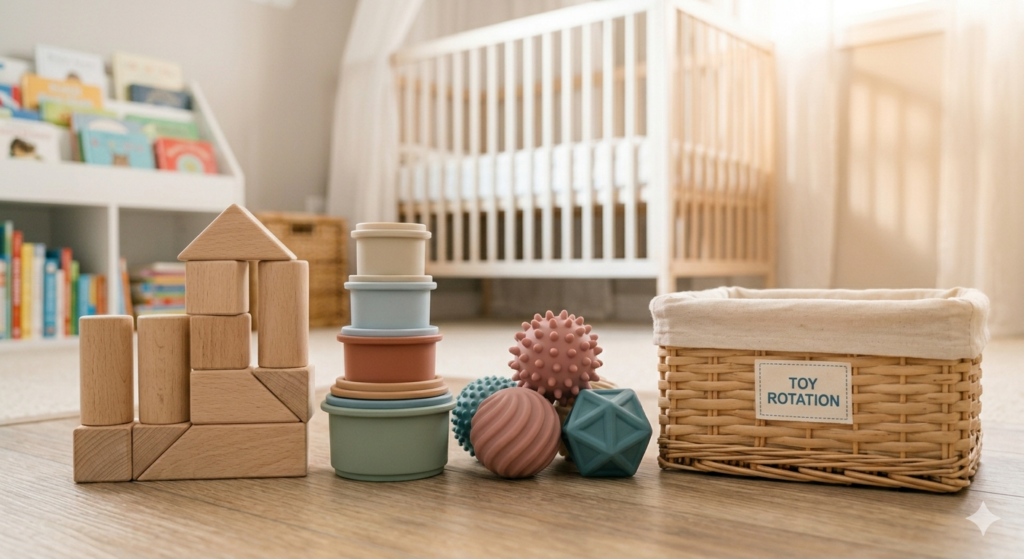
- The Rule of Three (Toy Rotation): Don’t dump the whole toy chest on the floor. An infant’s brain can suffer from “sensory overload.” Instead, present just three baby development toys at a time. Rotate them every Sunday to keep the novelty alive.
- Narrate the Play: You are the best “accessory” to any toy. When your baby grabs a blue block, say, “You found the blue square! It feels smooth.” This builds vocabulary alongside motor skills.
- Encourage “Productive Struggle”: If your baby is struggling to stack a cup, wait 10 seconds before helping. This small window allows them to develop problem-solving resilience.
- Silence is Golden: If a toy makes noise, ensure it has an “off” switch. Over-stimulating sounds can hinder a baby’s ability to focus on their own vocalizations.
- Prioritize “Cause and Effect”: Look for toys where a clear action (pushing a lever) leads to a clear result (a bell rings). This is the foundation of logical thinking.
FAQ: Your Playtime Dilemmas Solved
What are the best baby toys for development on a budget?
You don’t need to spend a fortune. What are the best baby toys for development? Often, they are already in your kitchen! A whisk with large pom-poms inside or a plastic tub with a lid provides excellent fine motor practice for virtually zero cost.
How long should my baby play with a development toy each day?
Aim for 15-20 minute sessions of focused floor play. Most infants experience “attentional fatigue” after 20 minutes. This is the perfect time to switch to a different sensory input, such as music or a walk outside in the stroller.
Conclusion: The Best Toy is You
As we navigate the world of baby development toys in 2026, it’s easy to get caught up in the quest for the “perfect” gadget. But remember: the most sophisticated toy in the world is just a piece of wood or silicone without your interaction.
The real magic of toys for babies 6-12 months development happens in the “Serve and Return”—the moments when you cheer as the tower falls or point out the texture of a soft book. Start small, choose high-quality materials, and focus on the joy of discovery. Your baby isn’t just playing; they are building the foundation of their entire future, one block at a time.