
We live in a world that is changing at an unprecedented pace. According to the U.S. Bureau of Labor Statistics, STEM-related occupations are projected to grow 10.8% by 2032, nearly five times faster than non-STEM fields. As parents, we often ask ourselves: “How can I best prepare my child for a future that hasn’t been written yet?”
The answer doesn’t lie in more screen time or rote memorization. It lies in play. Specifically, in the strategic use of STEM toys. These are not just playthings; they are the “building blocks” of a Growth Mindset—the belief that intelligence and problem-solving skills can be developed through persistence and experimentation. In this guide, we’ll explore how to transform your living room into a laboratory of discovery.
The Basics: What are STEM toys exactly?
One of the most frequent questions I receive from curious parents is: What are STEM toys? With so many products carrying educational labels, it’s easy to feel overwhelmed.
To be a “true” STEM tool, a toy must integrate at least two of the four pillars: Science, Technology, Engineering, and Mathematics. But the real secret sauce isn’t in the electronics—it’s in the active engagement.
- The Pilot vs. The Passenger: A toy that just dances when you press a button is entertainment. A STEM toy requires the child to figure out how to make it dance.
- The Scientific Method: High-quality children’s STEM toys encourage kids to form a hypothesis (“If I add this gear, the wheel will spin faster”) and test it in real-time.
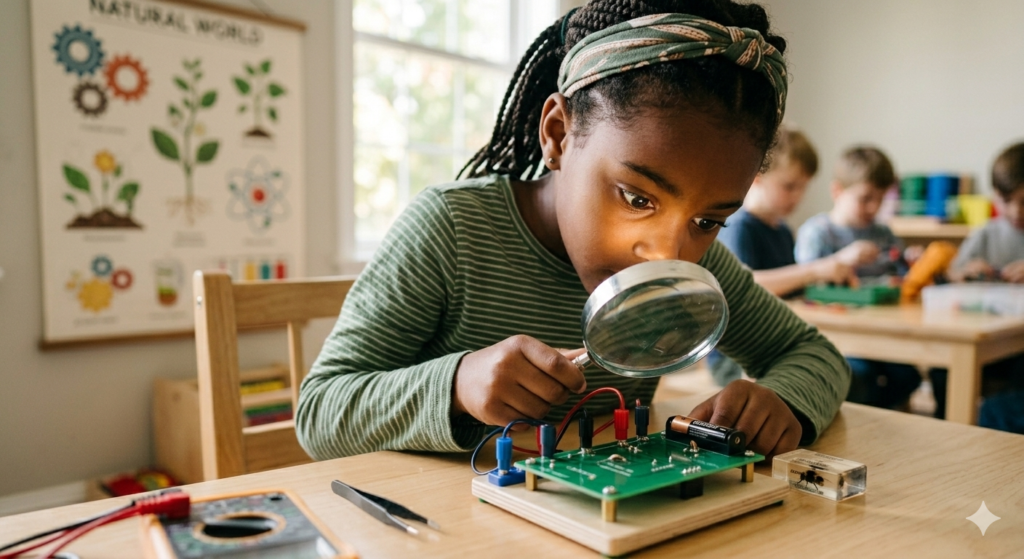
From Toddlers to Teens: Top Children’s STEM Toys by Age
To get the most out of your investment, you must match the toy to your child’s cognitive stage. A toy that is too complex leads to frustration, while one that is too simple leads to boredom.
Early Explorers (Ages 3-5): The Mechanical Foundation
At this age, STEM is about spatial reasoning and fine motor development.
- Magnetic Tiles: These are the gold standard for preschoolers. They teach geometry and the basics of architectural integrity.
- The “Apple Test”: Challenge your child to build a bridge that can support the weight of one apple (approx. 150 grams). This introduces the engineering concept of “load-bearing” through tactile experience.
- Pros: Enhances 3D visualization. Cons: Requires supervision to ensure small magnets stay securely encased.
Young Innovators (Ages 6-9): Logic and Coding
This is the “Golden Age” for introducing the logic of programming without the need for a screen.
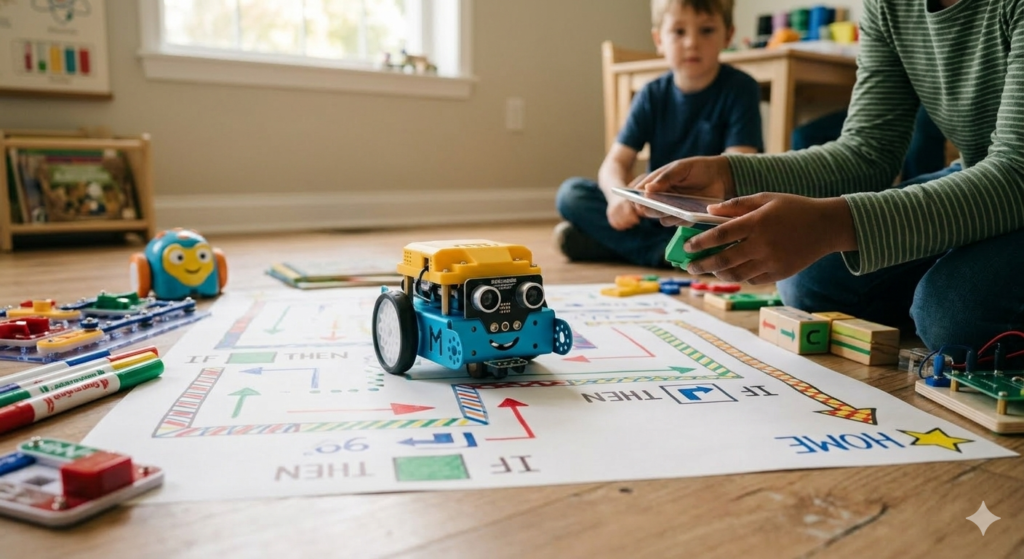
- Screen-Free Coding Bots: Many children’s STEM toys now use physical tiles or color-coded paths to teach sequential logic.
- Real-World Case: Sarah, a mom of a 7-year-old, shared: “We tried a coding app, and he got distracted by other games. But when we switched to a physical robot he could ‘code’ with colored markers, he spent two hours creating a complex map. He was learning logic, not just staring at a pixel.”
Advanced Creators (Ages 10+): Robotics and Real Circuits
For older kids, it’s time to move into professional-grade tools like Arduino or Raspberry Pi.
- The Tech Spec: Look for kits that involve real breadboards and resistors. This age group is ready to learn actual programming languages like Python.
- Hydraulic Arms: These kits teach fluid mechanics. Students learn that applying pressure to a small syringe can lift a weight 10 times heavier—a perfect lesson in mechanical advantage.
Beyond Play: 4 Brain-Boosting Benefits of STEM Toys
Why should we prioritize STEM toys over traditional playthings? The developmental data is clear:
- Developing Resilience: In engineering, a collapsed tower isn’t a failure—it’s a “redesign opportunity.” This teaches kids to handle setbacks with curiosity instead of tears.
- Spatial Intelligence: Handling 3D objects improves mental rotation skills, which researchers have linked to future success in mathematics and surgery.
- Enhanced Vocabulary: As children play, they naturally begin using words like “friction,” “symmetry,” and “velocity” to describe their work.
- Collaborative Problem Solving: Many complex kits require “teamwork.” This builds the social-emotional skills needed to communicate technical ideas to others.
Buyer’s Guide: 5 Things to Check Before Purchasing
Before you click “buy,” use this checklist to ensure the toy offers long-term value:
| Feature | What to Look For | Why it Matters |
| Open-Endedness | Can it be built in multiple ways? | Encourages creativity and increases replay value. |
| Complexity | “Low floor, high ceiling” | Easy to start, but offers room for advanced mastery. |
| Material Safety | BPA-free plastic / Non-toxic wood | Ensures safety for younger siblings who might share. |
| Instructions | Explains the “Why,” not just the “How” | Turns a construction project into a science lesson. |
| Durability | High-quality rivets and connectors | STEM play can be “rough”—toys must withstand testing. |
FAQ: Navigating the World of STEM Play
What are STEM toys exactly?
STEM toys are educational tools designed to stimulate learning in Science, Technology, Engineering, and Math. Unlike traditional toys, they are “active,” meaning they require the child to solve a problem or create something to see a result.
Are STEM toys more expensive?
Not necessarily! While a $150 programmable drone is an investment, a $20 chemistry set or even a pack of high-quality building planks is a powerful STEM tool. The value lies in the engagement time, not the price tag.
Can STEM toys help with school performance?
Yes. By making abstract concepts (like gravity or electricity) “hands-on,” children find school subjects much more intuitive. It builds the confidence they need to tackle difficult STEM curriculum later in life.
Conclusion: Start Your Home Laboratory Today
The best STEM toys don’t come with a “correct” answer—they come with a question. As parents, our role isn’t to provide the solution, but to provide the environment where our children feel safe enough to experiment.
Whether you are starting with a simple set of magnetic tiles or a complex robotics kit, remember that you are doing more than just buying a gift. You are planting the seeds of innovation.
My Final Advice: Don’t be afraid to be “stumped” alongside your child. Some of the best learning moments happen when you both have to look at a broken model and say, “Hmm, why didn’t that work? Let’s try again.” Curiosity is the most powerful tool in your child’s kit—keep it sharp!