
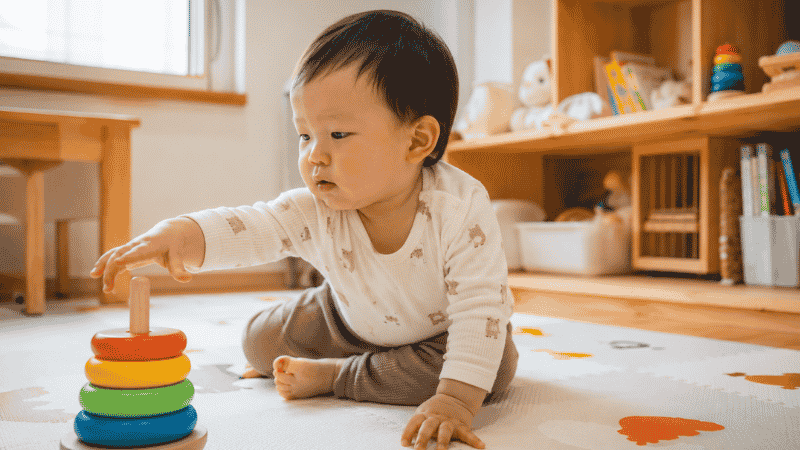
Picture this: it’s your baby’s first birthday. You’ve spent weeks researching, reading reviews, and carefully choosing what feels like the perfect toy. You wrap it beautifully, everyone gathers around, and your little one tears off the paper with impressive enthusiasm — then immediately crawls away to play with the crinkly wrapping.
Sound familiar?
Here’s the thing no one tells you before that moment: choosing the right toys for 1 year old kids isn’t about finding the flashiest product on the shelf. It’s about understanding where your baby actually is developmentally — and what their brain and body are genuinely hungry to explore.
I’ve been through this twice. I’ve bought the loud singing bus that everyone recommended, and I’ve watched it get ignored after day two. I’ve also stumbled onto simple, quiet toys that became obsessions for months. Over time, I’ve learned the difference — and that’s exactly what this guide is about.
Whether you’re shopping for your own child’s first birthday, looking for educational toys for 1 year old toddlers, or trying to find meaningful gifts for 1 year old babies, this is the honest, development-first guide you actually need.
Key Takeaways
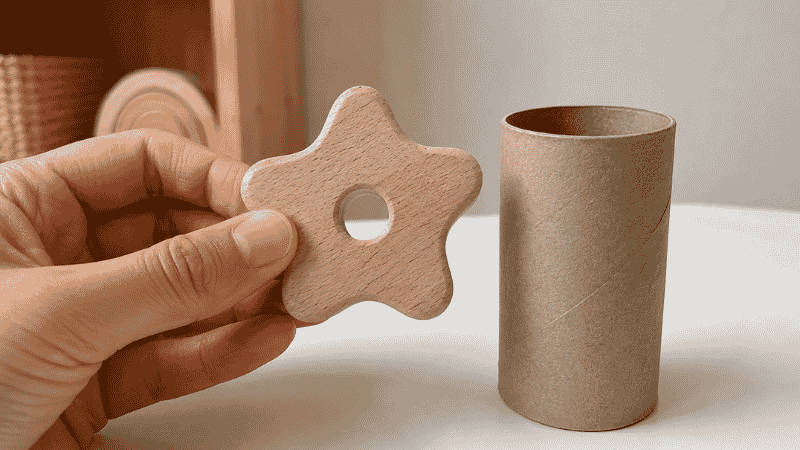
- The toilet paper roll test: Any toy part that fits through a toilet paper tube is a choking hazard. Apply this before every purchase.
- 12 months ≠ 18 months: Your baby’s toy needs shift dramatically across the first year of toddlerhood — this guide breaks it down by stage.
- Quiet toys often win: Research from Zero to Three shows open-ended toys encourage more language and problem-solving than electronic toys that “do the work” for the child.
- Safety certifications matter: Look for ASTM F963 or CPSC compliance — these aren’t just stickers, they’re tested safety standards.
- Your presence is the most powerful toy: According to the CDC’s developmental milestone guidelines, caregiver interaction during play doubles the learning benefit of any toy.
What a 1-Year-Old Actually Needs From a Toy
Before we get to the list, let’s talk about what’s actually happening in your baby’s brain and body right now — because this changes everything about how you choose toys.
Around their first birthday, most babies are in the middle of a remarkable developmental sprint. According to the CDC’s developmental milestones, by 12 months, many children are pulling themselves to stand, saying one or two words, and exploring objects by shaking, banging, and dropping them. By 18 months, that same child may be walking confidently, pointing to show interest, and beginning simple pretend play.
That gap — from 12 to 18 months — is enormous. A toy that’s perfect at 12 months can feel frustrating and boring at 16 months, and vice versa.
The best developmental toys for 1 year old children share four qualities:
- They require the child to do something — not just watch and listen
- They offer multiple ways to play — so interest doesn’t die after one “solution”
- They’re safe for mouthing — because one-year-olds still use their mouths as sensory tools
- They match the child’s current motor and cognitive stage — not where you hope they’ll be next month
The 12-Month vs. 18-Month Difference: Why This Matters
Most toy guides lump all “1-year-olds” together, but your baby at 12 months is developmentally different from your baby at 18 months. Here’s a quick breakdown to help you choose:
At 12–14 Months, Look For:
Your baby is likely just starting to pull up to stand and may be taking first steps. Their hands are getting more coordinated, but they’re still figuring out how to release objects intentionally.
Best toy features:
- Large, easy-to-grasp pieces
- Simple cause-and-effect (push button → sound)
- Push toys with a handle they can hold while learning to walk
- Soft stacking cups or rings (large, smooth, no small parts)
At 15–18 Months, Level Up To:
Your toddler is likely walking (and possibly running), starting to string two words together, and entering the “I do it myself” phase. Their attention span has grown slightly — from about 2–3 minutes to maybe 5–8 minutes on one activity.
Best toy features:
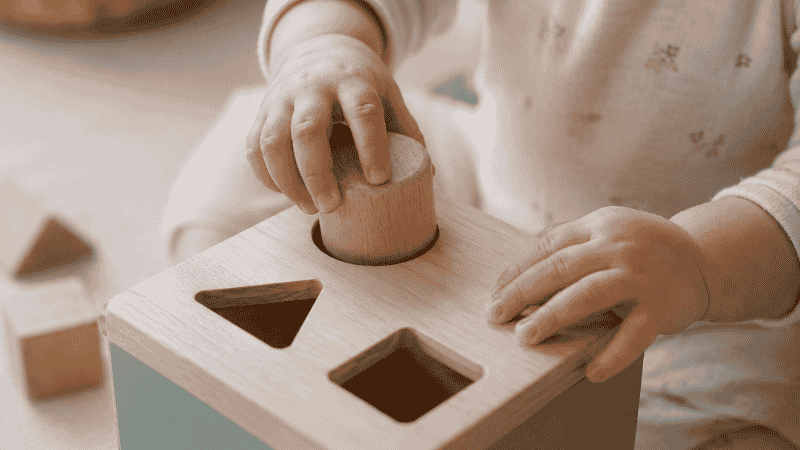
- Shape sorters with 3–5 basic shapes
- Simple puzzles with large knobs
- Push-along riding toys
- Stacking toys with more pieces and complexity
- First pretend-play props (play phone, toy food, simple doll)
Quick Reference: Best Toys for 1-Year-Olds by Category
| Category | Top Pick | Best For | Why It Works |
|---|---|---|---|
| Best Overall | Lovevery The Babbler Play Kit | 12–15 months | Designed for exact developmental stage; high-quality, no junk |
| Best for First Steps | Melissa & Doug Wooden Walking Wagon | 12–18 months | Solid, weighted base — doesn’t fly away when they lean on it |
| Best for Fine Motor | Fat Brain Toys SpinnyPins | 12–18 months | Variable weight pins challenge the hands without frustration |
| Best Sensory Toy | Manhattan Toy Winkel Rattle | 12–14 months | Safe for mouthing, engages both hands, quiet |
| Best for Active Play | Pikler Triangle (mini) | 15–24 months | Channels the climbing urge safely indoors |
| Best Budget Pick | Melissa & Doug Stacking Rings | 12–18 months | Classic for a reason; durable, safe, open-ended |
| Best Screen-Free Audio | Yoto Mini Player | 18+ months | Builds independence and language without a screen |
| Best First Gift | Hape Shape Sorter | 12–18 months | Simple enough for 12 months, challenging enough for 18 |
The Builders: Toys That Develop Fine Motor Skills and Problem-Solving
At one, babies are moving from “grab and drop” to “I am going to figure out how this works.” Their pincer grasp is developing — that’s the ability to pick up small objects with the thumb and index finger — and they crave activities that let them practice this.
Why this matters: According to the American Academy of Pediatrics, fine motor development in the first two years directly supports later writing, feeding, and self-care skills. You’re not just buying a toy; you’re building the foundations for independence.
Stacking Cups and Rings
The humble stacking cup is one of the most underrated toys you can buy. It has no batteries, no app, and no off switch — and your child will find at least six different ways to play with it.
At 12 months, they’ll knock the tower down. By 14 months, they’ll start trying to stack. By 16 months, they’ll sort them by size. By 18 months, they’ll use them as pretend cups in imaginary tea parties. One toy. Six months of play. That’s the value we look for at Toizora.
Safety note: Choose cups with smooth, rounded edges and no paint that can chip. Look for BPA-free plastics or untreated wood.
Shape Sorters
A shape sorter is a 12-month-old’s first “puzzle” — and the frustration-to-triumph ratio is genuinely important. A good shape sorter has 3–5 basic shapes (not 12), large enough pieces to prevent choking, and a satisfying “thunk” when the shape drops in.
What to avoid: Shape sorters with too many shapes or tiny pieces are developmentally inappropriate for this age and can create frustration that turns the child off the toy entirely.
The Movers: Toys That Support Walking and Gross Motor Development
The first birthday often coincides with the first steps — and for the next six months, your baby’s entire mission is to get more confident on their feet. The right toys support this without creating dependence or safety risks.
Push Walkers (Not Baby Walkers)
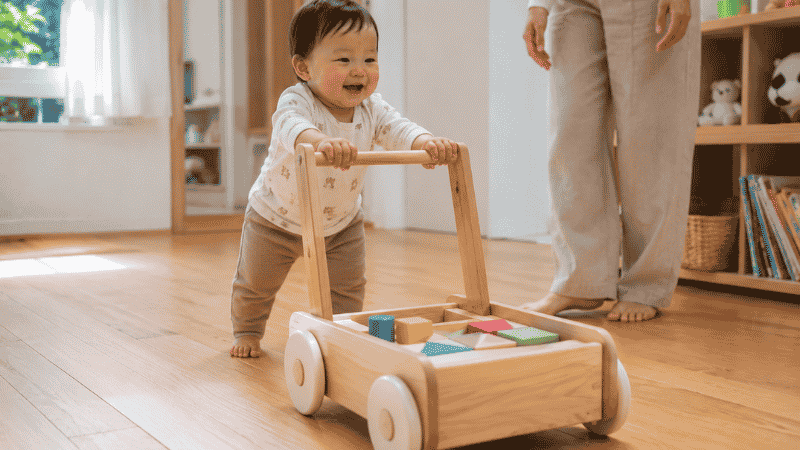
There’s an important distinction here: push walkers (the kind your baby pushes in front of them like a cart) are excellent for developing walking confidence. Sit-in baby walkers (the kind where the baby sits in a suspended seat and scoots) are actually not recommended by the American Academy of Pediatrics, as they can delay walking and pose tipping hazards.
Look for push walkers with:
- A wide, stable base that won’t tip
- Adjustable resistance on the wheels (so it doesn’t slide away too fast)
- A sturdy handle at the right height (roughly waist-height when standing)
Balls
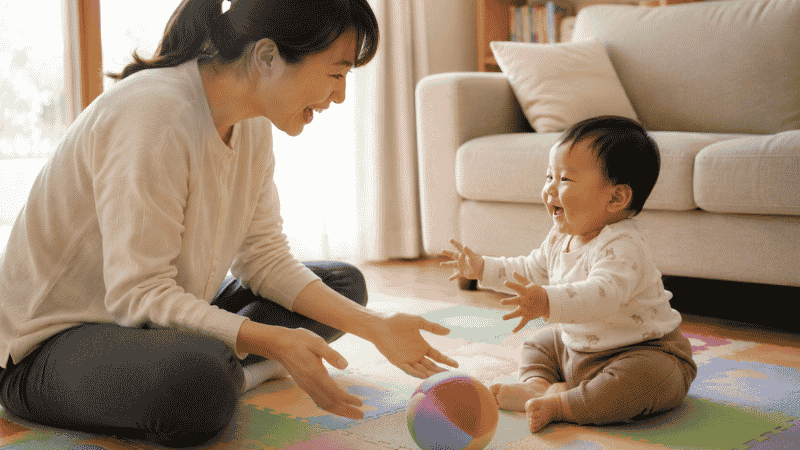
I know this sounds too simple, but a good soft ball might be the best thing you can buy a 1-year-old. Rolling it back and forth with a caregiver builds social connection, language (back and forth turn-taking mirrors conversation), and gross motor coordination — all at once.
Choose a ball that’s too large to fit in their mouth (larger than 1.75 inches in diameter) and soft enough not to cause injury if it hits a curious face.
The Talkers: Toys That Build Language and Communication
One of the most common questions I hear from parents of 1-year-olds is: “How do I help my baby talk?” The answer, perhaps surprisingly, isn’t a toy that talks to them. It’s toys that give you and your baby something to talk about together.
According to research from Zero to Three, the most effective learning toys for 1 year old children are ones that spark back-and-forth interaction between child and caregiver — not electronic toys that deliver one-way stimulation.
Board Books
Board books are genuinely one of the best “toys” for 1-year-olds, though we rarely think of them that way. At this age, reading isn’t about letters — it’s about language rhythm, shared attention, and learning that pictures represent real objects. That’s a cognitive leap that happens here.
Choose books with:
- High-contrast images or bold, simple illustrations
- One object or concept per page
- Durable pages that survive the “I will now try to eat this” phase
Simple Pretend-Play Props
At around 15–18 months, something magical happens: your baby starts imitating you. They’ll pick up your phone and hold it to their ear. They’ll try to brush their hair with whatever is nearby. This is the beginning of pretend play — and it’s a huge developmental milestone.
Simple props like a toy phone, a soft baby doll, or a play food set give them something to “practice” real-life routines on. And when you play alongside them — answering the “call” they make on the toy phone — you’re building their language and social development simultaneously.
The Sensory Explorers: Toys for Touch, Sound, and Discovery
One-year-olds are still very much sensory learners. They learn through touch, sound, smell, and yes — still through their mouths. The best sensory toys for 1 year old children engage multiple senses at once without overstimulating.
What Makes a Good Sensory Toy
- Varied textures: Soft, bumpy, smooth, ridged — each texture sends different information to the brain
- Gentle sounds: Rattles, crinkle fabrics, and simple musical instruments (not loud electronic ones) are ideal
- Safe for mouthing: Food-grade silicone or untreated wood are the safest materials when mouthing is likely
Teething Toys with Purpose
At 12 months, many babies are still teething — and a good teething toy can double as a sensory tool. Look for natural rubber or food-grade silicone, no liquid-filled chambers (which can leak), and no BPA or phthalates.
Tip: Chill a silicone teether in the fridge (not the freezer) for 15 minutes before offering it. Frozen teethers can be too hard and may damage sensitive gum tissue.
Safety First: What Every Parent Needs to Know Before Buying
This section matters more than any product recommendation I can make. Even the “best” toy becomes dangerous if it doesn’t meet basic safety standards.
The Non-Negotiables
1. The Toilet Paper Roll Test Before buying any toy — or before letting older siblings’ toys near your 1-year-old — try this: if a toy or any piece of it fits through a toilet paper tube, it’s a choking hazard. One-year-olds explore with their mouths, and their throats are very small.
2. Button Battery Warning Button batteries are one of the most serious hazards in children’s toys. If swallowed, they can cause severe internal burns within two hours. Always check that battery compartments are screwed shut, not just snapped closed. If a toy requires button batteries and the compartment isn’t secured with a screw, don’t buy it.
3. Material Safety
- Plastics: Look for BPA-free and phthalate-free labeling. In the U.S., toys should comply with CPSC regulations.
- Wood: Choose toys with non-toxic, water-based paint or natural beeswax finishes. Avoid cheap painted woods where the coating can chip.
- Fabric: Wash fabric toys before first use. Look for flame-retardant-free labeling where possible.
4. Safety Certifications to Look For
- ASTM F963: The U.S. standard for toy safety
- CPSC compliance: Required for all toys sold in the United States
- CE mark: European safety standard (relevant for imported toys)
Red Flags: What to Skip
- Any toy with parts smaller than 1.75 inches in diameter
- Toys with long cords or strings (strangulation risk)
- Toys with magnetic pieces small enough to swallow (powerful magnets are extremely dangerous if two are swallowed)
- Toys with loud, sudden electronic sounds — these can startle and can damage developing hearing with prolonged exposure
- Anything labeled “for ages 3+” regardless of how “simple” it looks
What NOT to Buy: The Honest Avoid List
I believe in telling you what not to buy just as much as what to buy. Here’s what I’d skip:
Loud electronic learning toys (at this age) If a toy does all the talking, singing, and thinking, your baby just watches. Research consistently shows that passive entertainment from electronic toys produces less language development than simple toys that require child and caregiver interaction. Save the electronic learning systems for age 2+.
Sets with 20+ tiny pieces These become cleanup nightmares and choking hazards simultaneously. At this age, more pieces ≠ more learning.
“Baby walkers” (sit-in style) As mentioned above, the AAP advises against these. They can actually delay walking development and are a tipping hazard on stairs.
Anything that requires sustained sitting for more than 5 minutes One-year-olds have an average independent attention span of 2–5 minutes. Toys designed for longer focused play (complex puzzles, detailed building sets) will just frustrate them.
How to Make Any Toy 10x Better: The Parent Play Secret
Here’s something every child development expert agrees on: the toy itself is only half the equation. The other half is you.
When you sit on the floor and play alongside your 1-year-old — narrating what they’re doing, responding to their signals, celebrating their tiny wins — you are providing something no toy can replicate. The Harvard Center on the Developing Child calls this “serve and return” interaction, and it’s one of the most powerful drivers of early brain development.
You don’t need to be a child development expert. You just need to:
- Narrate: “You put the blue ring on! Now the red one?”
- Follow their lead: Let them dump the bucket out for the fifteenth time. That’s intentional play.
- Celebrate the process: The point isn’t the stacked tower. It’s the stacking.
Even with the most basic, inexpensive toy, your engaged presence transforms it into a developmental powerhouse.
Frequently Asked Questions
How many toys does a 1-year-old actually need? Fewer than you think. Research from Zero to Three suggests that having too many toys can actually overwhelm toddlers and reduce the quality of play. A good rotation of 4–6 accessible toys at a time is ideal. You can store others and swap them out every few weeks — a “new” toy to your baby is one they haven’t seen in a month.
Are electronic toys bad for 1-year-olds? Not inherently bad, but they’re often overpromised. Toys that talk, sing, and light up on their own tend to create passive observation rather than active engagement. At this age, simple is almost always better. If you do use electronic toys, choose ones where the child’s action triggers the response (push button → sound), rather than ones that play on a loop.
What toys help 1-year-olds learn to talk? The best “language toys” are ones that give you and your baby something to talk about together — board books, simple pretend-play props, and stacking toys. Reading aloud for even 10–15 minutes a day has been shown in multiple studies to significantly increase vocabulary by age 2.
What’s the best first birthday gift for a 1-year-old? For first birthday gift ideas that are actually used, I’d prioritize: a push walker, a set of stacking cups or rings, a small selection of board books, or a Lovevery play kit. These are simple, safe, developmental, and — importantly — not loud.
Can my 1-year-old use toys meant for older kids? Generally, no — and not just because of the age label. Toys for 3+ often have small parts, complex instructions, or elements requiring skills a 1-year-old hasn’t developed yet. The age labels on toy packaging in the U.S. are CPSC-regulated safety guidelines, not just marketing suggestions.
My 1-year-old ignores every toy and just wants my phone. Is this normal? Completely normal — and honestly a compliment. They want to do what you do. The solution isn’t a better toy; it’s engaging them with a toy alongside you. Put them in a high chair next to you while you cook and give them a wooden spoon and a pot. You’re the most interesting thing in the room. Use that.
How do I know if a toy is safe? Check for ASTM F963 compliance, CPSC certification, and BPA-free labeling. Do the toilet paper roll test for any loose parts. Look for screwed battery compartments. And trust your instincts — if a toy feels cheap, has a chemical smell, or has parts that pop off too easily, skip it.
The Bottom Line
Finding the best toys for 1 year old babies doesn’t have to be stressful. You don’t need to spend a fortune or fill a playroom. You just need a handful of well-chosen, safe, open-ended toys — and your own presence on the floor beside them.
Start simple. Prioritize safety. Choose toys that invite them to do the thinking, not toys that do it for them. And remember: the wrapping paper will always be exciting. That’s okay. It means they’re curious — and that’s the only thing that actually matters.
Ready to keep exploring? Check out our guide to the Best Toys for 2-Year-Olds when your little one is ready to level up — or browse our Age-Appropriate Toy Guide for the full picture from newborn to age 8.
References
- Centers for Disease Control and Prevention (CDC). (2023). Developmental Milestones: 12 Months. https://www.cdc.gov/ncbddd/actearly/milestones/milestones-12mo.html
- American Academy of Pediatrics (AAP). (2024). Choosing Safe Toys for Your Child. https://www.healthychildren.org
- Zero to Three. (2025). Best Toys for Babies and Toddlers. https://www.zerotothree.org/resource/best-toys-for-babies-toddlers/
- Harvard Center on the Developing Child. (2023). Serve and Return Interaction. https://developingchild.harvard.edu
- U.S. Consumer Product Safety Commission (CPSC). Toy Safety Standards. https://www.cpsc.gov
- NAEYC. (2024). Good Toys for Young Children by Age and Stage. https://www.naeyc.org/resources/topics/play/toys